What it means for China's economy…
Last month, the Chinese Government made sweeping changes to the export tax breaks that domestic companies receive.
Here's what happened:
· On September 14, the Ministry of Finance, the General Administration of Customs, the National Development and Reform Commission, the Ministry of Commerce and the State Administration of Taxation jointly issued a notice to cancel export tax rebates for some products, including all nonmetal mineral products such as coal, gas and some kinds of timber;
· They also lowered the current 13 percent rebate rate for textile products, furniture, plastic, lighters and some timber products to 11 percent;
· They enhanced the rebate rate for certain sectors like hi-tech, IT and biomedical products from 13 percent to 17 percent.
· They also raised the current rebate rate of 5 percent or 11 percent for farm produce-based processed products to 13 percent.
The new regulations went into effect the next day.
Some say what the government did may historically be seen as little more than a reshuffling of benefits, which should ultimately die out altogether. But others say the reforms were necessary to improve everything from China's economy to its environment.
Irrational rebates
When China began to open up to the outside world in the early 1980s, its foreign trade policy was designed to encourage exports to promote the country's economic development. To achieve this objective, in 1985, the Chinese Government adopted the policy of export tax rebates, assisting domestic companies with tax breaks on revenues derived from exports, to promote the export business.
In 1998, in order to fight the Asian financial crisis and to expand exports further, the Chinese Government greatly enhanced the export tax rebate rate, which rose to more than 15 percent during 1999 and 2000. Statistics from the State Administration of Taxation show that from 2001 to 2005, refunded taxes totaled 1.19 trillion yuan, 2.8 times more than the total refunded taxes from 1995 to 2000.
"But in the long run, this is the least rational taxation policy," said Liu Fuxiang, professor from the University of International Business and Economics.
China's export tax rebates in 2005 totaled over 300 billion yuan, accounting for 1.8 percent of that year's GDP and almost equal to the country's total expenditures on education and health in 2004. What's more, behind the giant foreign trade surplus nourished by tax rebates are high energy-consuming products, products that contribute pollution or those with low added value. The tax rebate policy seems incapable of sustaining China's economic growth from a long-term perspective.
Professor Liu said that ultimately, abolishing the export tax rebate policy is inevitable in the future.
What a relief!
Dr. Mei Xinyu, a researcher with the Ministry of Commerce, believes that the adjusted tax rebate policy will balance China's mounting trade surplus with other countries, thus helping to reduce China's trade frictions with these countries.
Foreign trade statistics issued by the General Administration of Customs show that the import and export volume in August reached a historical high, hitting $71.97 billion and $90.77 billion, respectively. The trade surplus in that month climbed to $18.8 billion.
While a large trade surplus helps increase foreign exchange reserves, a huge trade surplus puts pressure on Renminbi to appreciate, which affects the stability of China's macroeconomic and trade policy.
"By announcing the new tax rebate policy at this moment, China means to tell its major trading partners that it will try to reduce its trade surplus with them," Mei said.
Statistics issued by the Ministry of Commerce show that China's trade surplus in the first half of 2006 hit a historical high of $61.41 billion. Among the surplus, that of textiles and clothes amounted to $53.94 billion, making up 87.8 percent of the total. The new policy cut the tax rebate rate for textiles by 2 percentage points, which is expected to curb the export of textiles to some extent.
Cutting the tax rebate rate is generally happening among products that are exported in large quantities.
Premier Wen Jiabao expressed in the EU-China Business Summit on September 12 that China's policy is to keep a basic balance in imports and exports and does not intend to seek a trade surplus. Wen's remarks laid a foundation for the adjustment of the old export tax rebate policy.
Further, the new regulations aim to optimize the country's industrial structure by curbing the exportation of high energy-consuming products or those causing heavy pollution, while encouraging exports of high-tech products, said Zhao Jinping, Deputy Director of the Research Department of Foreign Economic Relations under the Development Research Center of the State Council.
"The new tax rebate policy will undoubtedly help to improve China's industrial upgrading and eliminate high energy-consuming businesses of low added value," Mei said.
The tax rebate policy will also relieve the state of certain financial burdens.
The taxes that used to be refunded to enterprises will be divided between the central budget and local budget in the proportion of 75:25.
According to statistics from the State Administration of Taxation, since 1998, refunded taxes increased more than 10 percent every year. If the old tax rebate policy had remained unchanged, financial burdens would have mounted precipitously.
…And how industry is reacting
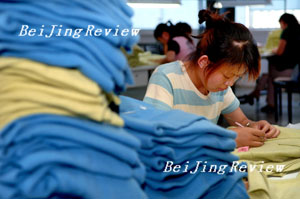
Textiles, you lose.
Sorry, but under the new September 14 regulations, your industry will suffer sweeping cuts in tax breaks it has been receiving from the Chinese Government.
"Textile exportation is no longer an easy business," said an employee of the China National Textile and Apparel Council, who declined to be named.
According to the council's calculation, the 2 percentage points cut in the industry's tax rebate rate will result in a loss of 1.46 billion yuan in the fourth quarter of 2006, which means a 0.06 percent drop in the net profit margin of this industry in 2006.
As for the profit loss in 2007 and beyond, no one can say.
Besides the textile industry, coal exportation also will take a serious hit.
The new regulations have cancelled the export tax rebate for coal to discourage its exportation. In 2005, China saw a coal output of 2.19 billion tons, with 71.72 million tons being exported. In order to maintain a market share, China will still keep its annual coal exports at 60 million tons or so, reducing the exports by about 10 million tons, said Zhang Xiangdong, a researcher from Ping An Securities Co. Ltd.
In Zhang's opinion, the textile industry will suffer the most serious loss, followed by coal, steel and construction materials, due to the new tax rebate policy.
But while some industries are definite losers following the regulations, others are certainly winners.
The new tax rebate policy brings good news to the electronic information and pharmaceutical businesses.
On September 20, the board of directors of Xiamen Overseas Chinese Electronic Co. Ltd. (Xoceco) issued a bulletin, claiming that the enhanced tax rebate for the company's major export-oriented products will help to increase the company's profits in the future. The export tax rebate rate for Xoceco's major products like LCD TV (Liquid Crystal Display TV) and PDP TV (Plasma Display Panel TV) will rise from the current 13 percent to 17 percent, which means an extra profit of 30 million yuan from now to the end of 2006. Xoceco is the first listed company to express satisfaction with the new tax rebate policy.
Apart from Xoceco, stocks of Shanxi Qinchuan Machine Tool Group Co. Ltd. and several other companies also are seeing a rise as a response to the enhanced export tax rebate rate.
Thanks to the enhanced tax rebate rate, the exportation of electronic products, automobiles, engineering machinery, agricultural machinery and machine tools also should increase.
|