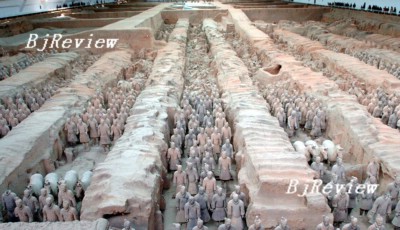
Chinese scientists have recently uncovered new clues about the origin of the world-famous "terracotta army" of Emperor Qinshihuang, the first emperor of China's Qin Dynasty (221-206 B.C.), determining that the horses were made near the mausoleum, but the warriors themselves were constructed elsewhere.
This conclusion was reached after an analysis of pollen in the clay of the terracotta army. Scientists from the Institute of Botany in the Chinese Academy of Sciences studied the clay under a microscope and identified 32 different kinds of pollen grains.
"The pollen found in the horses was similar to that of Qinshihuang's mausoleum, but the pollen in the warriors was quite different," Hu Yaqin, the leader of the research project, said.
According to him, the pollen found in the warriors came mainly from herb plants, such as mustard and cabbage, and plants like sagebrush, wormwood, quinoa, spinach, beets and chard, while the pollen in the horses came from trees such as pine, kamala and ginkgo.
Scientists surmise that the horses were made near Qinshihuang's mausoleum in order to make transport easier and safer. The horses each weigh about 200 kg and are 2 meters long with delicate and fragile legs. The warriors each weigh 150 kg.
But the scientists still do not know where the warriors were made.
"This work may open a new trail for archaeologists in regard to ancient terracotta or pottery. The pollen can tell us things we want to know," Hu said in his article, "What can pollen grains tell us about terracotta?" which was posted on the website of the Journal of Archaeological Science in London.
Emperor Qinshihuang's mausoleum is located near Xi'an, capital of northwest China's Shaanxi Province. The statues of warriors and horses were buried with the emperor more than 2,000 years ago. His mausoleum has never been excavated, but the life-size figures were unearthed from surrounding pits in the 1970s. Warriors and horses were believed to be built to safeguard him after his death.
Because of protection problems, only 1,500 terracotta warriors and horses have been unearthed, and nearly 6,000 items still lie buried in the dark soil.
|