| 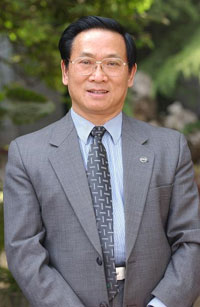
"Moral education plays a vital role in both family and school education," said Zhuo Li, President of Shijia Primary School.
Zhuo joined Shijia Hutong Primary School (now Shijia Primary School) as a maths teacher in 1962, after graduating from high school.
"We relocated here in 2005, and now have a five-storey building with modern facilities such as audio and video rooms, computer rooms, swimming pool, underground parking lot and so forth. Can you imagine that the school, some 50 years ago, was an old shrine with 19 shabby rooms," said Zhuo proudly.
Established in 1939, the school was renowned as one of the best schools in Beijing in the 1950s. Despite poor facilities at the time, it produced thousands of famous alumni, including Lu Qin, Associate Editor-in-Chief of Chinese Teenagers News, and Pu Cunxin, veteran drama actor at the Beijing People's Art Theatre.
The facility-upgrading project began in 1987, and in 1991, a year after assuming his current position, Zhuo initiated the idea of producing a harmonious education, in terms of quality.
A student-centered idea
The core of a harmonious education, according to Zhuo, is rooted in moral education.
"Family and school share the responsibility of educating children. By and large, moral education in primary schooling consists of two parts: well-trained behavior, and a healthy mentality. Both play a vital role in both family and school education," said Zhuo.
Unfortunately, however, moral education in most Chinese families is far from satisfying. Chinese children nowadays tend to be self-centered and spoiled -- spoon-fed in every way. No wonder they cannot fend for themselves when the time comes.
"Students in our school don't merely absorb knowledge, but more importantly, learn how to become persons with virtues and morals," said Zhuo. "Moreover, they are encouraged to attend various kinds of activities that help to develop in a comprehensive way. For example, hobby classes like singing, dancing, calligraphy, model-making, sports and so forth are available and open to all, which in turn will help to develop children's interests and talent in different areas."
His views are echoed by Lu Qin, better known nationwide as Zhi Xin Jie Jie (literally "your intimate sister who can have a heart-to-heart talk with you").
"I spent six years in Shijia Hutong Primary School in 1950s, and enjoyed life there. A happy childhood is extremely crucial to one's life. The happiness of childhood has nothing to do with how much money you have. Rather, it derives from a position where your interest and capabilities are allowed to develop," said Lu to Beijing Review in an exclusive interview last year.
Listening to their hearts
A few years ago Zhuo received a letter written by an American kid. It said, "…my hands are too small to handle everything perfectly; my legs are too short to catch up with your steps…Let me explore things with my own eyes, and please give me some freedom…" This changed his perception.
"What I'd like to say is that making mistakes is a privilege for kids; otherwise, there is no need for schooling," he said. "Why not see the world from their angle and listen to their hearts carefully and seriously?"
"I totally agree with the Four Pillars of Education, described in Chapter 4 of Learning in the UNESCO Task Force on Education for the Twenty-first Century -- learning to know, learning to do, learning to live together, and learning to be. These four pillars of knowledge cannot be anchored solely in one phase in a person's life or in a single place."
Zhuo continued, "Being a human being is more meaningful than success; growing up is more meaningful than exam scores. Keep these tips in mind and create a harmonious environment for our children, they will be grow up in a psychologically healthy way." |