| Tokyo-based Chinese filmmaker Li Ying's Yasukuni, a documentary about the controversy surrounding the Yasukuni Shrine in Japan, won the Humanitarian Award for Documentaries at the 32nd Hong Kong International Film Festival on March 26.
"I'm very happy to see the result," said Li Ying in an exclusive telephone interview with Beijing Review, soon after the award ceremony. "The film is about peace and war. My understanding of ‘humanitarian' is that the two sides of the contradiction should not merely think about his own side, but see what happens on the other side. To a great extent, it means going beyond narrow nationalism."
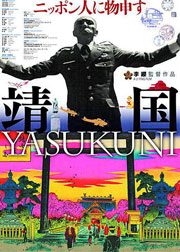
Completed in 2007, the film sheds light, impartially, on what actually still goes on in and outside the vicinity of the shrine. It begins by focusing on 90-year-old Naoji Kariya, the only surviving swordsmith from that era, a man who helped forge 8,100 steel-bladed weapons (known as yasukunitou) within the shrine's premises. It traces the history of these weapons, which were being shipped to the front until 1945; it delves into what the blades were used for--the Nanjing Massacre of 1937, for example, and a widely reported beheading competition carried out by two officers, who were later executed for war crimes.
The documentary is punctuated by excerpts of Kariya creating his last blade in 2006, and evinces respect for an artisan's single-minded dedication to his craft. With the absence of voiceovers, the filmmaker's personal judgment gives way to the candid airing of opinions from different people. It also looks at Junichiro Koizumi's controversial visit, and follows the alliance of Koreans, Taiwanese aboriginals, Okinawan families and a Buddhist priest petitioning for the removal of their ancestors' names from the shrine.
Since its debut at the Pusan International Film Festival 2007 (South Korea), Yasukuni has received rave reviews and accolades from many international film festivals, including Sundance 2008 (United States) and the 58th Berlin Film Festival.
However, various responses have emerged inside Japan following the media preview there last December.
"Our documentary was made a target of attack during shooting," Li told Beijing Review in an exclusive interview in January. "Right-wingers abused us and the film was labeled as anti-Japanese. But it was normal to hear all kinds of comments, positive or negative, after the media preview in Japan.
"I don't mean to teach Japanese how to review history, but am hoping that people who see it will also look at themselves."
Ahead of its April release in Japan, the biggest challenge to the film seems to be pressure from right-wingers. A group of lawmakers of the governing Liberal Democratic Party requested a pre-release screening of the film; the film was financed in part by a fund under the Agency for Cultural Affairs, perceived by some to be "anti-Japanese," according to a report from China's Global Times Newspaper citing the Japanese Asahi News in early March. One of the lawmakers did indicate that they would exchange views with the Agency of Cultural Affairs on subsidizing film production. Moreover, a cinema in Tokyo has decided to cancel its release.
In fact, the film--a decade in the making--is a transnational production work, which has received funds from South Korea, the United States, Japan and China during production.
The Japan release, scheduled for April 12, may not go smoothly, for various reasons.
"But I really hope that this award will help," said Li. |