|
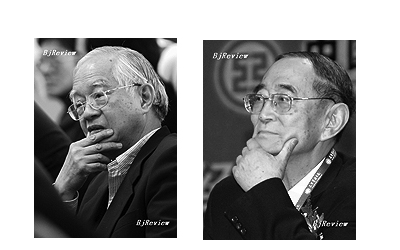
After a 10-year suspension of face-to-face talks, economist adversaries Li Yining (left) and Wu Jinglian, two of the most respected men in their field in China, held a direct dialogue on January 12. The meeting, part of a high-profile forum marking the 30th anniversary of the initiation of China's reform and opening-up policy, was lauded as a signal of the academic community's strong will to tackle theoretical challenges ahead together.
Li and Wu, both 77 years old, first clashed on the orientations of China's reform in the late 1980s, when Li prioritized restructuring of state-owned enterprises while Wu proposed the introduction of a market-based pricing mechanism as the primary task.
Their differences became known to the public in 2001. At that time, the country's fledgling stock market, which was launched with the aim of facilitating joint-stock reorganization of state-owned enterprises, ran bullish, but a series of disclosures of insider trading and price manipulation repeatedly snuffed out investor confidence.
Wu started the war by describing the stock market as a big casino and said that it was abnormal for the public in general to participate in stock speculation. The criticism was fiercely rebuked by Li and several other eminent economists who alleged Wu had failed to update his planned economy-dominant mindset.
Though China's $4.2 trillion stock market rose to be the world's best-performing one in 2007 after years of regulation, Wu's stand seemed to have changed little. During the January 12 meeting, when Li listed the joint-stock transformation of state-owned enterprises and ensuing rapid development of the stock market as one of the major achievements for China over the past three decades, Wu contended that he disagreed with the judgment.
Despite their academic disparities, Li and Wu in fact have something in common. Both of them are natives of eastern Jiangsu Province and studied in the same high school for three years. They are also both vice chairmen of the Economic Committee of the 10th National Committee of the Chinese People's Political Consultative Conference, the country's top advisory body.
More importantly, as Li pointed out in an earlier lecture, he and Wu share the same belief that the country must persevere in the ongoing reform path to accomplish modernization. |