|
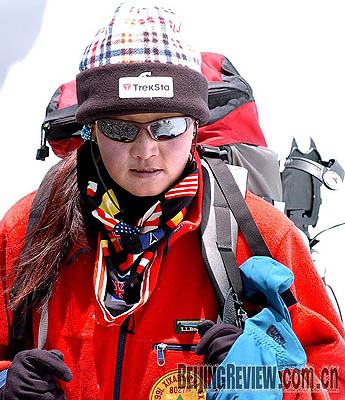
Female Torchbearer Scales New Heights
Among the five Chinese mountaineers who took the 2008 Olympic flame to the summit of Qomolangma (Mount Everest) on May 8, the first torchbearer Gyigyi has received much media attention not only for her good looks, but also because of the achievements and sacrifices she has made in her mountain-climbing career.
Before the latest ascent, the 39-year-old climber is one of a handful of women who had scaled the world's highest peak twice, in 1999 and 2005. Gyigyi's first success was with her husband Renna, which made them the third married couple to summit Qomolangma together.
Unfortunately, Renna was killed in a rockslide in 2005 when he was attempting the 8,068-meter Gasherbrum 1, the world's 11th highest peak along the China-Pakistan border. In July 2007, Gyigyi finally scaled Gasherbrum 1 in honor of her late husband.

Filmmaker Exposes Yasukuni Shrine
Chinese filmmaker Li Ying's controversial documentary Yasukuni Shrine finally made a stunning debut in Tokyo on May 3. The documentary, which took Li 10 years to complete shooting with funds from the Japanese Government, looks at a factual account of Yasukuni Shrine. It has received mixed reviews in Japan. Though furiously boycotted by right-wingers, most Japanese viewers said it accurately illustrates the complexity of Japan's war legacy.
The story begins by focusing on 90-year-old Naoji Kariya, the only surviving artisan from that era who helped forge 8,100 steel-bladed weapons, known as yasukunitou, and shipped them to the frontline during World War II. It traces the history of those weapons, what the blades were used for, and includes the Nanjing Massacre in 1937.
Since completed in 2007, the film has received invitations from many international film festivals, including Busan 2007 (South Korea) and Sundance 2008 (United States). It made its European premiere at the 58th Berlin Film Festival this February. At this March's Hong Kong Film Festival, the film took the best humanitarian award for a documentary.
"What I am hoping to do with this film is look at history, and help people rethink the war legacy in Japan that seemed to be ignored for a long time," Li told Beijing Review.
Born in 1963, Li began directing documentary films for China Central Television in 1984 and moved to Japan in 1989. He co-founded Dragon Films Inc. in 1993 to produce TV programs and films with his crew.
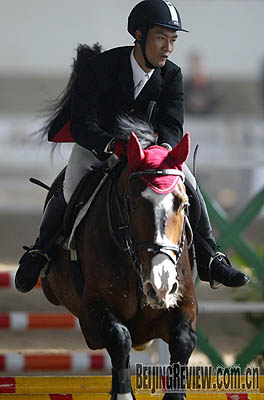
Farmer Horseman Rides Into Olympics
Chinese farmer Li Zhenqiang finally realized his longstanding dream to participate in the Olympic Games in his own country.
The 40-year-old farmer from Chang'an County, south China's Guangdong Province, rode his $1.55-million horse to qualification at the equestrian park in Belgium to become the first rider from the Chinese mainland to gain admission into the Olympic steeplechase.
Li is an indigenous Chinese farmer, engaged in building material business before 1994. From the time he first visited a horse club with his friends in 1994, he was hooked and has been involved in riding ever since. In 1996, Li founded his own club in the village and began all-day practice through watching videotapes.
In the several years after 1999, Li has entered 14 competitions at home and abroad, including the Busan Asian Games and China's National Sports Games. In 2002, Li won his first championship at the "BNW" Master Grand Finals, and ranked sixth in the steeplechase at the Asian Games, the best record for a Chinese rider. |