|
|
|
|
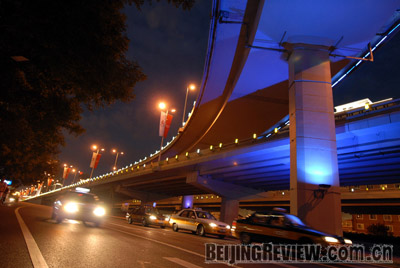
CONSTRUCTION BOOM: Beijing made extensive improvements to its infrastructure in the run-up to the Olympics |
China Development Observation: How much could Beijing benefit from the Olympic Games?
Chen Jian: Beijing is obviously the biggest beneficiary of the Games, reflected in its GDP roaring at double-digit growth rates in the past eight years. About 2 percentage points of those came from contributions made by the Olympics. The Olympic Games have been a catalyst for the capital city to forge ahead with self-improvement, especially on its infrastructure construction.
In 2007, the city saw a handful of modern buildings soar from the ground up, including over 10 standard Olympic stadiums, Terminal 3 of the Beijing Capital International Airport, which is the world's largest, and the National Grand Theater. The long-awaited subway Line 5 and Line 10 also came into use in lead-up to the Games.
The infrastructure update has also become a growth engine for the capital city, whose per-capita GDP jumped from $3,000 five years ago to the current $7,400.
In another move, the green Olympics gave impetus to the city's industrial restructuring. As a batch of heavy chemical enterprises moved out, Beijing has met the target of slashing energy consumption and green gas emissions for two years in a row.
More importantly, Beijing and the whole country have come under the international spotlight for a long time. And hosting successful Olympic Games could further burnish the city's reputation and add fuel to its economic exuberance. That would also quicken the country's pace in merging into the world.
Will the Beijing Olympic Games be able to make a profit?
Chen Jian: Estimates from Beijing's bid report for the Games put its budget revenue and operation expenditures at $1.625 billion and $1.609 billion, respectively. As a result, there would be some surplus left after handing over a certain portion to the International Olympic Committee (IOC). However, the expenditures subsequently turned out to have been underestimated, especially those for insurance, risk management, public relations and consultancy and legal services.
Meanwhile, the IOC has been ratcheting up its requirements for host cities, driving up expenditures. For example, the Beijing Olympic Games are the first in history to be broadcast with high-definition television, which entailed huge investments. Besides this, the input in urban landscape also exceeded the original estimate.
Moreover, Beijing has got a firm handle on population inflows these days for safety reasons. That is expected to make a dent on the city's hotel occupancy and tourism, squeezing the revenue brought by the Games.
|