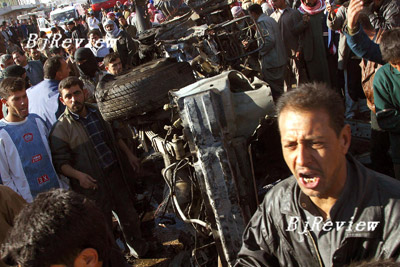
Despite the intense controversy and media frenzy it has caused, former Iraqi leader Saddam Hussein's death may only have a minimal impact on the situation in Iraq, some Chinese analysts believe.
Gao Zugui, Deputy Director of the Institute of Strategic and Security Studies at the China Institutes of Contemporary International Relations (CICIR), refrained from calling the execution of Saddam on December 30 a "turning point."
"No fundamental changes came from Saddam's arrest or death sentence," he said. "I doubt if his execution can have any significant effect."
It could be a "milestone" or a "watershed event" for the United States, though, he added. While downplaying the significance of the hotly contested execution, Chinese experts underlined the importance of reconciliation in the fragmented Iraq.
Tolerance matters
Gao acknowledged that the execution of Saddam would dash the hopes of his followers and prompt them to give up and join Iraq's political process. However, this effect was more evident when Saddam was captured in December 2003 because many expected that he would make a comeback before that, he explained. Since then, more and more people have been convinced that Saddam's era will never return, he said.
At the same time, Gao said Saddam's followers could be reintegrated only if the Iraqi Government led by Prime Minister Nouri al-Maliki carries out reconciliation across the country among different sects, forces and groups.
He pointed out that one of the major mistakes made by the United States in Iraq was that it outlawed Saddam's Baath Party and banned its members--high-ranking officials and ordinary members alike--from participating in the country's politics. If the Bush administration continues with this defective policy, many people will not be able to contribute to their nation's development even if they are willing to take part in the reconstruction, he warned.
Zhang Xiaodong, a research fellow at the Institute of West Asian and African Studies of the Chinese Academy of Social Sciences, echoed this view. He noted that Iraq has long been fragmented with its religious, ethnic and political complexities. What it lacks most is tolerance, something that enables all sections of society to bid farewell to the past and jointly build a unified, peaceful and stable Iraq.
Given the urgent need of reconciliation, Zhang was worried that the execution of Saddam might worsen the Iraqi situation in the long run as it could give rise to fresh conflicts.
Gao of the CICIR said a fundamental change in the Middle East hinges on a number of factors, such as whether the current Iraqi Government can endure and how well the Sunnis can get along with the Shiites. The hanging of Saddam will hardly result in such a change, he said.
A more reasonable goal
Gao said the Bush administration sought to have Saddam executed hurriedly partly because it wanted to show its determination to make a new start in 2007. For all the questioning about the legitimacy of the Iraq war, it at least succeeded in eradicating a "dictator," he said. As it put an end to a lingering concern at home, the Bush administration will have more maneuvering room when it adjusts its policy toward Iraq, he predicted.
|