The Chinese oil market is becoming more competitive-sort of.
On January 1, Measures for the Administration of the Refined Oil Market and Measures for the Administration of the Crude Oil Market issued by Ministry of Commerce took effect, marking an era that private and foreign oil companies can compete fairly in the oil market with Chinese state-owned oil enterprises.
Chong Quan, spokesman of the Ministry of Commerce, noted that the opening of the wholesaling right of refined oil and crude oil would create a new competitive situation in the Chinese oil market, which will be split by state-owned enterprises, private companies and foreign oil companies. Before, Chong said the refined oil market was controlled by China National Petroleum Corp. (CNPC) and China Petroleum & Chemical Corp. (Sinopec). The crude oil was distributed collectively by the government.
However, judging by the current situation, a much greater competitive market soon is unlikely, as the market is currently dominated by state-owned oil conglomerates.
State still in control
Pei Xiaofeng, an analyst with Everbright Securities Co. Ltd., said the oil market opening won't cause a major setback for state-owned oil companies.
"There are three reasons," said Pei. "Firstly, the market opening doesn't mean it will be actually marketized, as the oil price is still controlled by the government. Secondly, after years of development, CNPC and Sinopec have established an integrated and comprehensive market network as well as a group of eminent sales professionals. They have had a major influence on the market and the market is deeply controlled by them. Thirdly, the opening of the refined oil wholesaling market doesn't mean the opening of oil imports. Currently, the government is unlikely to open the refined oil import right for foreign or private oil companies."
Obviously, it is most difficult for private and foreign companies to shake the position of the CNPC and Sinopec.
As major suppliers of oil, CNPC and Sinopec enjoy absolute control over the Chinese refined oil market due to the comprehensive operational and sales network they have established through years of monopoly.
Niu Li, an economist with the State Information Center, said private and foreign oil companies are also still subject to the pricing management mechanism by the Chinese Government.
At present, the price of Chinese refined oil is decided by the National Development and Reform Commission (NDRC), a government organ. The international oil price fluctuates from time to time, while the Chinese oil price, after being set by the NDRC, will be maintained for a long period of time. Sometimes, the domestic oil price will be lower than the price of oil imports.
Sinopec recently revealed that China will carry out a new refined oil pricing mechanism, which will be based on crude oil prices in Brent in the United Kingdom, Dubai in Saudi Arabia, and Minas in Brazil, instead of the former mechanism based on prices in New York, Singapore and Rotterdam.
However, oil companies cannot price oil freely. According to China Securities Journal, the reason is that the government supervisory department needs to take many aspects into consideration, including the purchasing power and price index, energy conservation, replaceable energy development, fuel surcharge and international oil prices.
Niu Li pointed out that if the refined oil pricing right remained unchanged, the refined oil retailing price would remain the same. Therefore, state-owned oil companies, which have absolute control over domestic oil sources, would unlikely be hit hard.
Foreign players
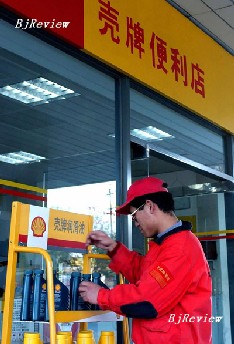
As the second largest oil consumer, China is becoming a major playground for international oil barons. In December 2004, China opened its refined oil retailing market. By now, the world's largest oil and petrochemical companies have established factories or networks in China and most of them have entered the Chinese oil and petrochemical industry save the wholesaling sector.
The opening of the wholesaling business of the refined oil market will make it convenient for foreign and private oil enterprises to enter the crude oil and refined oil wholesaling sector.
|