It depends what industry you're in.
High-tech, pharmaceutical and other exporting industries are finding clear skies than ever before after new trade policies.
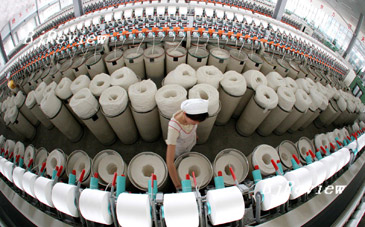
But textile exporters are trying to survive a perfect storm of new policies that threaten to sink their business.
"My guess is in 2007, one-fifth of the textile companies in Wenling will close," said Liang Qun, senior manager of the China Artex Taizhou Import and Export Co. Ltd. in Zhejiang Province, after China cut tax rebates for textile companies 2 percentage points in September 2006.
Wenling, a county of Taizhou, is known for its numerous shoe-making family workshops. Liang's company produces shoes, fabrics and garments, as well as metal tools with annual sales of $10 million.
In order to balance its exports and imports, the Chinese Government has adopted various measures, including adjusting the tax rebate mechanism. As of September 15, China lowered its tax rebate for textile exports from 13 percent to 11 percent.
"We will lose about $15,000 for shoes and fabrics," Liang said. Net profit for every pair of shoes is only 1 yuan in his company.
"Our profit margin is already razor-thin," he said.
Textile industry is hit
"These measures are disadvantageous to export industries of high energy consumption, high pollution and low added value, but favorable to high value-added and hi-tech exports, as well as imports of advanced technology," Mei Xinyu, a trade researcher with the Chinese Academy of International Trade and Economic Cooperation affiliated to the Ministry of Commerce, told Beijing Review.
The textile industry is among the ones that have rough luck. "The tax rebate cut will force more textile companies to go bankrupt," Liang Qun said. The reduction of the tax rebate rate has delivered another blow to the shoe manufacturing industry, which had already been battered by the rising price of raw materials, a higher tax rate and an improvement in workers' compensation.
According to an online poll by Webtextiles, China's first textile portal, more than 65 percent of the 2,200 polled said the tax rebate drop will have a noticeable impact on their companies, while only 17 percent said the impact will be modest. Over 75 percent of the polled are against the 2 percentage-point reduction.
However, some other textile producers are not so worried. Song Yan, Senior Manager of the Violet Home Textile Co. Ltd. in Jiangsu Province, responded calmly to the tax rebate drop. "The policy does not affect us very seriously," she said. Violet Home Textile produces mainly high- and medium-level bed wear sold at department stores in the United States, Canada, Europe and the Middle East, with annual sales of $10 million.
Song predicted that her company would lose at least $100,000 for orders already placed but not yet performed. "We will take the reduced tax rebate into account when pricing future orders," Song said, adding she would put a premium on her products by coming up with new designs and colors.
So the key to dealing with textile woes appears to be increasing value-added aspects of manufacturing and controlling costs. Zhou Jie, an analyst of the textile industry at Everbright Securities Co. Ltd., believes that those companies whose products are competitive with a high added value can offset lost profits by improving price negotiation and transforming their export patterns.
Take Nanjing Textiles Import and Export Corp. Ltd. as examples. According to company secretary Dong Jie, early in January 2006, the company had planned to transform its export strategy by expanding value-added products. On the one hand, it has increased profit margin when accepting orders and, on the other, it has adjusted the export structure by reducing exports of materials whose profit margin is small and expanding exports of finished products with high profits.
|