For the first time, Chinese warships have taken part in a multinational naval exercise hosted by a foreign country, which is aimed at improving the capacity to fight maritime terrorism.
Twenty-three warships from nine countries---China, Bangladesh, France, Italy, Malaysia, Pakistan, Turkey, Britain and the United States---participated in the weeklong exercise from March 6-13. In addition to the participating countries, 24 nations sent observers to the event, which was hosted by Pakistan.
The Chinese task force, composed of two guided missile frigates, Lianyungang and Sanming, left the port of Ningbo in east China's Zhejiang Province on February 19 and arrived at the Karachi naval shipyard 14 days later.
The Chinese warships were involved in target practice on March 8 and successfully organized a maritime search and rescue mission on March 9, as the multinational naval exercise "Aman 07" in the North Arabian Sea entered the sea phase.
"It is an opportunity to enhance mutual understanding and cooperation among friendly navies and to benefit from each other's experiences," Qiu Yanpeng, the head of the Chinese task force, told Beijing Review before the sea phase started.
"Aman" means peace in the Urdu language. According to the Pakistani Navy, "Aman 07" aimed to display a unified force against maritime terrorism and drug and weapons trafficking and to build the capacity to conduct multinational exercises.
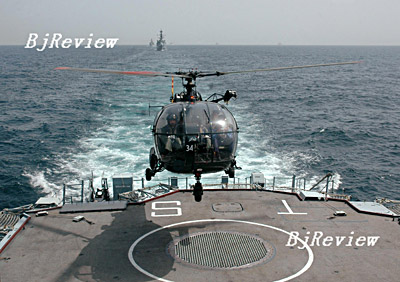
During the four-day sea phase, 15 exercises were scheduled, including attacking fast-moving targets, shooting targets at sea, landing helicopters and conducting a joint search and rescue mission. The Chinese Navy took part in 12 exercises, in addition to organizing the search and rescue mission.
Although this was the first time the Chinese Navy participated in such a multinational naval exercise, in the surface firing exercise, the first shell from a Chinese frigate successfully hit and sank the "target."
"The Chinese Navy operates its programs very well," Admiral Muhammad Afzal Tahir, the Chief of the Naval Staff, told Beijing Review after reviewing the fleet.
"I am grateful for the Chinese Navy's response to the Pakistan Navy. I feel the exercise is like a bridge that further enhances the communication and understanding between our two forces," Pakistani Vice Admiral Asaf Humayun Hi told Beijing Review.
Deepening ties
The exercise was divided into harbor and sea phases. The harbor phase included conferences, coordination meetings and safety briefings, while the sea phase involved exercises focusing on maritime security operations.
Standing on the deck of a Pakistani warship and pointing to the blue water in the North Arabian Sea off Karachi where he was witnessing a multinational naval exercise on Saturday, Pakistani President Pervez Musharraf said, "The relationship between China and Pakistan is deeper than this ocean."
Musharraf said that the relationship between the navies of Pakistan and China is strong. Pakistan also has strong defense ties with China and a lot of cooperation in defense projects is under way which would further enhance bilateral defense capabilities for peace and security.
He said the relation of Pakistan and China would grow further with the passage of time because of the significance of this region and the importance of the Arabian Sea.
"This is an excellent exercise. It has great tactical and operational value for the navy from the training point of view. They are learning to conduct integrated exercises with so many countries," the president said.
The participation of a number of countries demonstrates that Pakistan is determined to work with other nations to make the seas safe and secure, Musharraf said.
The Chinese ships were to leave Karachi on March 13 and take about two weeks to arrive back home. This is the first time that Chinese warships have traveled so far without a refueling tanker.
"To refuel our warships, we have to learn how to coordinate with ports or countries along the route and get support from them," said Commander Wei Xiaodong, a Chinese observer on a Pakistani warship, adding that it is a test of the survival capacity of the Chinese Navy.
In the 7,000-km journey from Zhejiang Province to Karachi, the two frigates stopped for refueling in Colombo, capital of Sri Lanka. They were to visit Indonesia for refueling on the homeward journey.
A refueling tanker provides convenience but at the same time costs a lot of money, Wei said, referring to the increased consumption of energy and additional naval crew.
|