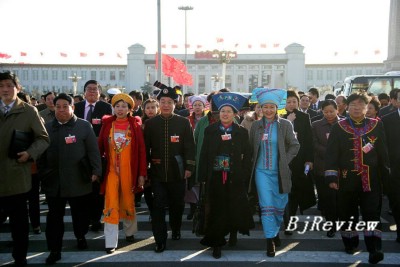
A fairer distribution of China's growing wealth topped the agenda of this year's annual meeting of the National People's Congress (NPC), which was held between March 3 and 16.
The government introduced a raft of measures aimed at providing medical treatment and better education for poorer areas, as well as increasing rural employment opportunities and assisting disadvantaged urban groups.
March is a good month to get a comprehensive picture of China's policy changes at the highest level. The annual session of the NPC, the country's top legislature, usually takes place in March and lasts for about two weeks, when NPC deputies, nearly 3,000 in number, meet in Beijing to review the premier's work report, the budget and the work reports of the Supreme People's Court and the Supreme People's Procuratorate.
If you do not have two weeks to closely follow the agenda of NPC sessions, an easier way to get information about any change in China's official line is to spend some time reading the Central Government's work report that the premier delivers at the opening full session of the NPC.
The catchphrase for this year's work report was "people's livelihood." It was made very clear in this year's document that the Central Government will focus greater importance on improving people's livelihoods in the coming year. "Issues that concern people's interests most will be actively addressed so as to maintain social fairness and justice and enable the whole population to enjoy the fruits of reform and development," said the work report.
Asked to comment on the government's work report, an NPC deputy from west China's Shaanxi Province, Li Pengde, walking out of the conference hall after the NPC opening session, said he was impressed by the government's commitment to improving ordinary people's lives. "The government is indeed spending money generously on people," he said.
Speeding ahead with an average economic growth rate of around 10 percent for almost three decades, China has experienced incredibly rapid economic growth, but sometimes at the expense of social equality. Now the government seems to be shifting its focus from baking a bigger cake to giving everyone a fair slice of it.
The last two decades have seen a surge in public complaints about unaffordable education, lack of medical treatment, unemployment, soaring house prices, a widening wealth gap, corruption and food safety concerns, which are partly the by-products of China's market-oriented reforms. The country's gross domestic product (GDP) for 2006 was 20.94 trillion yuan, double that of four years previously. Now the government is hoping that sound economic performance will provide the foundation for an improvement in people's standards of living across the country, rather than for a wealthy few.
One of the six chapters of the government work report, which comprised a quarter of the whole report, entitled "Promoting the Construction of a Socialist Harmonious Society," was dedicated to measures addressing problems faced by China's poor, including education, health care, employment, social security and work environment safety.
Fattening education bills
Speaking at a news conference for the NPC session, Minister of Finance Jin Renqing said twice that the central treasury was more than happy to pay the costs of education.
An educational bill introduced by the Central Government in 2005 exempts rural students from paying tuition fees for their nine-year compulsory education. Under new plans, students from poor rural families at primary or junior secondary schools will now be eligible to receive free textbooks and a subsistence allowance from the government. And the free nine-year education program introduced two years ago will be expanded to cover all of the 150 million rural students in primary and junior secondary schools.
|