The UN Security Council unanimously adopted on March 24 a new resolution imposing tougher sanctions to pressure Iran to suspend its uranium enrichment activities. The decision, of course, was not welcomed by Iran, which maintained a defiant stance.
Resolution 1747 imposes harsher sanctions than those included in a previous resolution on the Iranian nuclear issue, calling for a ban on Iranian arms exports and a freeze of the assets of an additional 28 individuals and entities involved in Iran's nuclear and missile programs. In the previous resolution, adopted last December, the Security Council ordered all countries to stop supplying Iran with materials and technology that could be used in its nuclear and missile programs.
The sanctions in a sense put a section of Iran's economy under international control, which is why Iran's stance and attitude have toughened; it has called the resolutions "illegal" and "unacceptable."
Soon after Resolution 1747 was approved, Iran said it was partially suspending cooperation with the International Atomic Energy Agency (IAEA), the UN nuclear watchdog, by revoking a pledge to inform it of any plans to build new nuclear facilities.
Meanwhile, Iranian President Mahmoud Ahmadinejad said, "It is not a new issue for the Iranian nation. Enemies of the Iranian nation have made a mistake this time too," adding, "Iran will not stop its peaceful and legal nuclear trend even for one second because of such an illegal resolution."
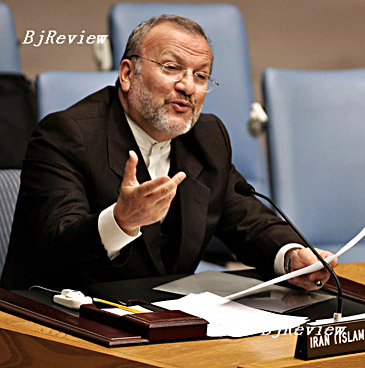
Iranian Foreign Minister Manouchehr Mottaki, addressing the UN Security Council after the vote, defended Tehran's nuclear program as being for civilian use and rejected the new resolution as a "scheme" aimed at "depriving the Iranian people of their inalienable rights."
"Iran does not seek confrontation, nor does it want anything beyond its inalienable rights," Mottaki said. "I can assure you that intimidation will not change Iranian policy."
Mottaki said the world has two options in proceeding on the nuclear issue--continued negotiations or confrontation---and the resolution was the wrong choice. "Of course, it will have its own consequences," he said.
Focus on diplomacy
Hua Liming, former Chinese Ambassador to Iran, said that even if military action is taken over the nuclear issue, negotiation still will be the final solution. "Settling the issue through peaceful talks is still possible," he said.
Although enriched uranium can serve as the fissile core of nuclear weapons, Iran insists it wants the technology only to generate power. Hua said the refusal to suspend uranium enrichment is Iran's baseline. Iran regards owning nuclear technology as a sign of being an influential country in the region. However, it currently does not have the technology to obtain high-quality enriched uranium, which is why it would like to gain more time to continue nuclear research, he added.
|