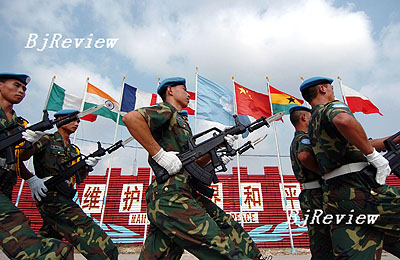
It has been 15 years since China decided to send a peacekeeping force with the United Nations Transitional Authority in Cambodia under UN Security Council Resolution 745 adopted on February 28, 1992. Four years earlier, in 1988, it joined the Special Committee on Peacekeeping Operations. In the nearly two decades since then, China has transformed itself from a country that refrained from UN peacekeeping to one that participates in it in a comprehensive manner, a shift that demonstrates a fundamental change in its attitude toward this multilateral endeavor. In this context, it made a major adjustment in its policy toward peacekeeping.
The 26th General Assembly in 1971 adopted Resolution 2758, which restored all the lawful rights of the People’s Republic of China in the UN. As China and the UN cemented their bonds, the country began to join the international community, opening a brand-new chapter in its multilateral diplomacy. It went on to take an active part in international affairs with unprecedented vigor and vitality. Its efforts were not only appreciated by developing countries but also recognized by developed countries, making it a positive factor in the international community.
After its status was restored in the UN, China needed to familiarize itself with the operation of the organization, including its procedures. Also, it was preoccupied with its work in the Special Committee on Decolonization and the seven standing committees when the Generally Assembly was in session. As a result, it had little time to follow the UN peacekeeping operations, something that was completely new to it. In addition, China was politically conservative about peacekeeping, believing that it could not help resolve chaos and regional hotspot issues through this way. It held that the rescue efforts are tantamount to nothing but a mere buffer, with a big gap between gains and losses. China did practically nothing in this regard except some research. In the 17 years from 1971 to 1988, China’s policy on UN peacekeeping remained unchanged because of its old perception.
The country adjusted its diplomatic strategies, including its attitude toward UN peacekeeping, when reform and opening up started in the late 1970s. It came to realize that the peacekeeping operations, which had become well established, are an important means to safeguard international peace and security. Resulting from deep-seated problems, the conflicts and confrontation in some hotspot regions cannot be fundamentally resolved through peacekeeping. The final solution instead lies in the improvement in the overall situation in the hotspot regions, in economic development and in unremitting negotiations. Nevertheless, it is generally acknowledged that peacekeeping can help relieve a crisis, thus rendering strong support to the vulnerable developing countries.
Statistics show that in the 52 years from 1948 to 2000, the UN carried out 54 peacekeeping missions in 52 countries and regions, most of which were in developing countries. A large number of countries contributed troops, including developed countries such as the United States, Britain, France, Canada and the Netherlands and developing countries on various continents---seven in Africa, six in Asia and six in Latin America. Twenty-two countries participated in more than 50 missions. Military personnel from many developing countries served as commanders of UN peacekeeping forces. These stark facts prompted China to reexamine its policies on peacekeeping: It should reposition itself to align with the developing countries and offer sympathy and support for their security concerns.
Another reason for China’s policy shift is that it redefined its role in the international system as a permanent member of the Security Council. The current international system is obviously not perfect, but it still has the vitality to promote the development of productivity. To establish a new political and economic order in the international community is a long-term and painstaking endeavor. At the current stage, China is expected to push the present international order to develop in the right direction together with other developing countries. Of course, the UN peacekeeping mechanism, which has been proven successful in the past six decades, should be made the most of.
|