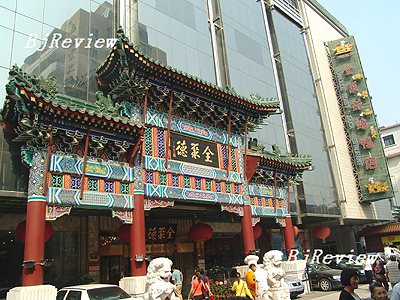
Visitors to Beijing will have no chance to taste the finest roast duck in the country at the century-old Quanjude Restaurant's Qianmen outlet for a while, as the famous eating establishment has shut for a six-month renovation. This is just one of the steps in the massive facelift taking place across the capital's Qianmen area.
Located south of the Tiananmen Square, the Qianmen area has been a popular business, shopping, entertainment and culinary center of Beijing since the 17th century.
Besides roast duck, other traditional Beijing snacks have been available here for hundreds of years, such as famous brands of pickled vegetables from Liubiju and dumplings from Duyichu.
The Tongrentang Traditional Chinese Medicine Shop, which was established in 1669 and has produced pills, powders and ointments for royal families for 188 years since 1702, is also located in the area. It was here that many banks and financial institutions once made the area the earliest financial district of Beijing.
The small hutongs (alleyways) and lanes, along with its siheyuan (courtyards) and pailou (a ceremonial gate in old time), have made Qianmen a special place to Beijingers, especially those who have lived and grown up there. It is also the place where Peking Opera and Chinese acrobatics were born.
Tear it down
But soon the area will be confined to photographs and memories, as the 700-year-old courtyards and the ancient homes come crashing down. It's all part of an ambitious plan to modernize the city in the run-up to the Beijing Olympic Games in 2008.
According to the project plan, by the end of this year, Qianmen Street will be remade into a 2.5-meter-wide pedestrian walkway, which is expected to restore the image of the area in the first half of the 20th century. Trolley cars will be available to transport tourists and new courtyards, shops and places of entertainment will add a bustling atmosphere to the area.
Along with the remodeling of other historic sites in Beijing, the reconstruction of the Qianmen area has caused much controversy. Conservationists are concerned that without courtyards, hutongs, pailous and other traditional architecture, Beijing will lose its cultural identity.
Emotional impact on people
The impact does not only affect the city's exterior, but also the cultural recognition of people who have their roots firmly planted there and those who have traditionally visited the area for generations.
Feng Guangju, owner of a traditional quick-boiled tripe snack bar in the Qianmen area, said that although he has decided to move his business to a new place, he still hopes he can move back one day if possible.
"Many old-style restaurants like mine have operated for over 100 years in the Qianmen area, and people are used to finding traditional Beijing foods here," Feng said. "It will be hard to restore the place it has in people's hearts and minds elsewhere."
However, it remains doubtful whether small snack bars like Feng's can move back to their original sites after the renovation of the Qianmen area is completed. The rent prices of commercial properties in the state-of-the-art business district are expected to be very expensive, too high for owners of snack bars like Feng to afford.
|