In December 27, 2006, an earthquake near Taiwan snapped six underwater Internet cables and left a large part of Asia, particularly the northeast, struggling for an Internet fix. In Hong Kong and on the Chinese mainland, access was mostly limited to local sites. Users were unable to log onto MSN and Yahoo! Messenger, and email services of Microsoft and Yahoo! became unavailable.
That was a black day for many people depending on messengers and emails to work. According to a survey by one of China's portals, Sina.com, later that day, over 90 percent of 70,000 survey respondents said the Internet accident had seriously affected their life and work.
"What do you call this kind of man like me, who does not want to eat when hungry and does not drink water when thirsty, as long as I'm surfing on the Internet: a netizen or a superman?" wrote a Chinese blogger nicknamed BloodBrood from Hubei Province.
"I spend dozens of hours every day sitting in front of the computer and having no idea what I am doing: clicking on one website after another, one post after another. Days just go by like that," the blogger lamented about his everyday life with the Internet around.
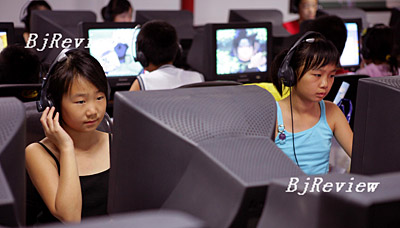
His words were an indication of just how far the Internet has come--and how its existence is taken for granted by a generation of young Chinese, who are the savviest of the tech-savvy, as likely to demand a speedy broadband connection as to download music onto an iPod, or upload digital photos to their blogs.
In China, before the middle 1980s, today's Internet activity was far beyond people's imagination. It was not until 1987, when China successfully sent out its first email to Germany, that the world's most populous country stepped into the Internet era.
Since then the Internet has shaped the way people work, relax and even date. It's created a different notion of community for them and new avenues for expression that are, at best, liberating and fun.
"Today's youth are continuously connected to other students and friends and families in ways that older generations never would have imagined," said Sun Yunxiao, Deputy Chief of the Chinese Youth Research Center.
Another revolution
In 1973, the U.S. Defense Advanced Research Projects Agency (DARPA) initiated a research program to develop communication protocols, which would allow networked computers to communicate transparently across multiple, linked packet networks. This was called the Internetting project and the system of networks which emerged from the research was known as the "Internet."
That "Internet," since its birth, has influenced the world at an unprecedented level, and has had an impact on people's lives some would say is more profound even than the Industrial Revolution. Even in a developing county like China people do not seem to be left behind in harnessing the power of the Internet to communicate, to learn, to entertain and to create.
To the 162 million Chinese Internet users like Jason Shan, the Internet has become part of their daily life and work, and something they can't do without.
"I can't imagine what my life would be like without the Internet," said a Chinese netizen under the Internet ID Zjbbi, who in real life is a university teacher in Beijing. "I rely heavily on the Internet," he confessed.
He traced his first encounter with the amazing technology to 2000 when he was still a high school student. "It was just like I'd discovered another secret world right in front of me," he said, describing his excitement when he saw for the first time that one of his friends was chatting with a foreigner in a Yahoo chatroom.
|