|
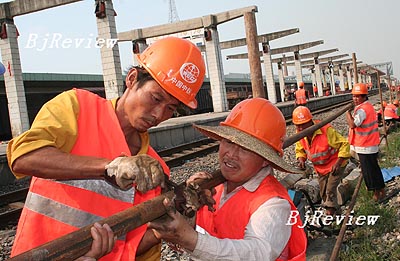
Workers across China have their eyes on the first draft of a new labor law that could work in their favor during disputes with management.
The draft law on labor dispute mediation and arbitration was submitted to the Standing Committee of the National People's Congress (NPC), China's top legislature, for a first reading on August 26.
The law has been formulated amid an increasing number of disputes throughout the country. The absence of such a law has put employees at a disadvantage when they try to protect their interests in labor disputes. Because of this, the much anticipated law has been the focus of the media and public attention since its drafting began.
Costs of protecting labor's interests
China resumed the labor dispute arbitration system in 1987 and formed procedures to cope with labor disputes as "mediation, arbitration and trial" after the regulation on handling corporate labor disputes and Labor Law were promulgated in 1993 and 1994. Under this system, while the mediation procedure is non-compulsory, any labor dispute has to go through the arbitration procedure and only goes to court if arbitration fails.
It is stated in Article 79 of the Labor Law that parties in a dispute can only bring their case to a people's court if at least one party is not satisfied with the adjudication of arbitration. The judicial explanation of the Labor Law issued by the Supreme People's Court states that the court can refuse to hear a case on the basis that the arbitration committee did not deliver a timely verdict or if the arbitration committee refused to hear the case.
Although this system has proved effective in solving labor disputes, recent years have witnessed a steady rise in labor dispute cases. According to official figures, 2005 saw more than 10 times the number of cases as 1995; with a total of 317,000 disputes filed, about one fourth of the total number of the previous 10 years.
Against a backdrop of intensifying tension between labor and management, people have begun to question the 20-year-old arbitration solution. The major complaint is that it takes a long period to reach a verdict. According to statistics collected by the NPC Standing Committee, arbitration on labor disputes in Shanghai and Guangdong Province takes an average of 40 to 50 days; after the failed arbitration, the first trial on labor disputes takes an average of 110 days in Guangdong Province and over three months in Shanghai; the second trial takes an average of more than two months in Shanghai.
The lengthy process is partly attributed to the complication of the disputes, which often involve work injuries. The confirmation of employment relations and the appraisal of work injuries usually have to be conducted several times between arbitration and trial, which explains why in some extreme cases the whole process has taken 19 years.
The biggest victims of these slow procedures are usually the employees, who often badly need compensation from their employer for medical treatment or simply to buy food and other necessities.
The arbitration authorities, who are supposed to play the core role in the current labor dispute solution scheme, exert nominal influence throughout the process. Zheng Dongliang, a senior researcher for a think-tank under the Ministry of Labor and Social Security, said the Labor Law stipulates that labor dispute arbitration committees should consist of representatives from the labor department of the government, from trade unions and from employers. But the Labor Law does not contain regulations on the nature of labor dispute arbitration committees. Labor dispute committees started as a nominal organization without fixed staff or administration expenses. Because of this, arbitration committees have become an office of the government labor department.
In many areas of China, labor arbitration committees suffer from acute shortages of people, made worse by a rise in the number of group labor dispute cases. So far, China has a total of 3,138 arbitration committees, which have 7,424 professional arbitrators and 12,906 part-time arbitrators. In some regions, one professional arbitrator has to participate in the handling of over 200 cases, which has severely endangered the quality of the result. In this scenario, it is understandable that the proportion of labor disputes that end with arbitration has been dropping steadily in recent years, from over 70 percent before 1992 to 32 percent in 2004.
|