|
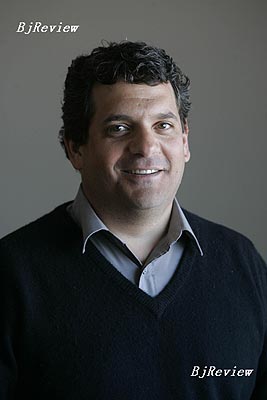
It's common knowledge that China has the fastest growing economy in the world. What is not common knowledge is exactly how Western companies can gain a foothold and increase their profits by doing business inside this next great superpower. Ted Plafker, a Beijing correspondent for The Economist, has written a fully detailed, yet user-friendly prescriptive guide to navigating the business landscape of the world's most populous nation--Doing Business in China.
On September 11, Plafker, a business journalist who has worked in China since 1989, sat down for an interview with Beijing Review reporter Ding Wenlei to talk about the purpose of writing the book and share his views on how individuals and companies can succeed in this challenging and often confusing environment.
Beijing Review: What was your main purpose in writing a book about doing business in China? How long had you been thinking about writing this book?
Ted Plafker: The idea started over two years ago. The publisher, Warner Business Books in the United States, approached me with an idea for a business book, a prescriptive guide about doing business in China. They looked for a writer and thought I was someone in the right position to do the book. I had been here since 1989, writing on all kinds of Chinese affairs, including business, economics, trade, politics, virtually every aspect of the Chinese story. Besides this, my wife, who is also American, has been running a company here for a long time. She provided me with a backstage view for the book. Over the years I have been watching her do business in China, and this has provided great background for me. She is an extra window for me that others may not have.
What are the most important things Western businesspeople need to know about doing business in China?
The most important thing is not only understanding China. Everyone is very eager to figure out China since they think it is a goldmine and they want to know where to sign on. They also need to figure out whether their business matches with China, with what they know about their own company. There are certain companies that might be too small, might focus on different directions and might not have the resources to function in China. You can't just come here to set up a company and let it go. It requires intensive effort to decide what to produce and sell in China. So you have to understand your own company, your own business, and have to figure out whether you have the resources, the people, the money and the time to make it work. The first big decision I talk in the book is whether you need to be here.
Are there certain criteria to guide them in making the decision?
There are some benchmarks, like whether they should have a revenue of at least $20 million a year and about 200 to 300 employees. But there are exceptions. Some companies of a much smaller scale and some that focus on narrow directions have managed to be successful.
The topics you cover are quite ambitious and broad, and certain things, the legal system for example, can be highly complicated for an outsider. How difficult was it to research this book?
That may have been the hardest chapter to research. I think it's hard, probably, being a lawyer here. I get all these newsletters and information sheets that law offices send out every month to their clients. Every month you get this long list with a lot of changes. And not small changes. The insurance industry, for example, was totally converted and everything you couldn't do before, you can do now. There are changes all the time. I'm not a lawyer, and can't give blanket legal advice to anyone. I repeat several times in that chapter that I give a basic idea about how the system works, and what the biggest issues in the Chinese system are. You really need good legal help when you are here no matter what you are doing. The good news with the legal changes, though it's hard to keep up with, is that most of the changes are in the right direction toward a more open, more rational and more accessible situation.
As a China watcher, do you think there are efforts the Chinese Government needs to make to improve the legal system?
One of the big problems that I see is the way the legal system is still an instrument of the state. The government talks a lot about the "rule of law," but if the law goes against the government, the law doesn't always win. The legal system is not independent and there is still a lot of political involvement in the legal system. The way the system is here, I don't think it's changing very fast, and I don't think the government is preparing to totally let the system open if it works against its preferences and its desires.
What surprised you most during your research for this book?
I don't know that I found any surprising new information about China as this is the stuff I have been dealing with every week and writing about for magazines over the past 18 years. The reason I felt conformable writing the book was because I have been very closely involved with the material. The surprises for me have more to do with the micro-aspects, like how it is different writing a book from writing a magazine article. I knew it would be different, but I didn't know how exactly it would be different. I write magazine articles every week of about one thousand words. You can easily keep that in your head and sit down, start and finish. You can think the whole thing out at once, but a book is much bigger. A book is, say, about 80,000 words, but an article is around 800 words. A book has to hang together and has to make sense. When writing a book, you have to stick together, you have to watch when you repeat yourself, or contradict yourself.
Were there any unexpected revelations about foreigners doing business in China?
I didn't have any big blockbuster secrets, but I think some of the stories I tell were surprises for someone who knows China, some of the stories about the corruption, and some of the stories about the companies who came here with such totally wrong ideas.
Did you have any feedback about the book from your Chinese friends or colleagues? Do you think there is anything of interest to Chinese readers in the book?
The book has been translated into a couple of languages, though not Chinese yet. It would be a bit funny if some Chinese come to me to read about how to do business in China. But they might find it interesting as an example of what a foreigner thinks about doing business in China.
How have ordinary investors and businesspeople from the West been affected by the recent product safety scandals and the resulting political backlash in the United States?
The timing I guess is good for me since I talk about the food safety issue in the book. The thing is, everyone comes here for lower costs. In the West, a lot of people look at China as the one that is driving down the price of everything, that China is undercutting everyone for the cost. But China does not always drive the price. When our companies come and say that the price needs to be cheaper and cheaper, Chinese producers have to go along. So this is very much the responsibility of both sides. I feel like everyone is diving down to the bottom. Companies will spend more, and I guess the price will rise and the margin will fall. More has to be done and more has to be spent on quality control.
The political backlash in the United States is interesting. People get very excited about China for any number of reasons. In other countries, the reasons could be currency and labor issues or political tensions. Because China is so big, everyone always worries about how if things are going well in China or not, it will have a huge impact on them. So anything that happens in China gets magnified quickly and gets emotional. I understand a little bit that people in the United States see America as losing jobs and political influence to China, especially in Asia. They are also worried when they see something bad like the dangerous toys, as most of their toys are coming from China. So they think all these toys from China are bad.
I once talked with a German friend, and he told me Germans are not bothered by such worries and he thought such worries were typically "American." Do you agree?
Yes, I guess I know less about Germany, and I know that reaction in the United States is emotional and not rational. It's interesting that the European Union has done a better job selling to China and they have a pretty good trade balance with China. In general, China's trade with Europe is healthy and balanced. In the United States, it's way out of whack. Some Chinese would say--and to most economists I think it's acceptable--that the U.S. trade deficit is not because of the currency issue. The currency is undervalued maybe by about 8-12 percent. But even if you fix it, you wouldn't solve the balance. It's about America's spending habits and China's saving habits. It's all these macro-economic issues of imbalance. So China does need to develop domestic demand and rely a little bit less on export growth, and the United States needs to save more money and stop borrowing and spending more than saving. It's not the United States that likes to take the blame ourselves. If the Congress is up for election, they don't want to tell the people that it's our fault we spend too much. They say it's China's fault.
How does "brand China" repair its image in the wake of recent events?
It's difficult and I feel like there is no shortcut. I don't know if it's China's responsibility, but China will get the burden. Companies like Disney and Mattel have had three more recalls recently. Mattel designed these products, putting names on toys and failed to inspect the production. Americans are not so quick to believe what a big company tells them and what China says in public. Most Americans won't take it seriously just because the Chinese minister says so. I don't think China will correct this image problem very quickly because it will be a long-term effort to solve the problem and improve the quality. |