|
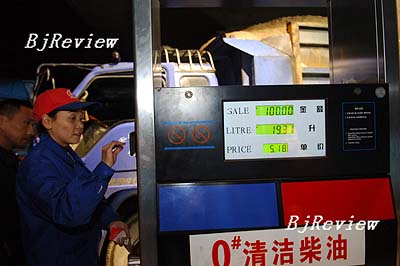
This year's oil shortage was reminiscent of the previous one in 2005. Cargo drivers drove gingerly with half-full tanks, diesel generators sat silently waiting for oil that wasn't there, and many taxis even stopped running because of the shortage.
This time the oil shortage, which first started in southern cities like Guangzhou and Shenzhen in August, spread to northern cities like Zhengzhou and Taiyuan in November.
The China National Petroleum Corp. (PetroChina), the country's largest oil producer, transferred over 100,000 tons of diesel oil to the south before the end of November. Though the shortage has subsided to some extent, people are still haunted by its nightmares. Bosses at some gas stations still complain about the restrained oil supply.
Systemic problems
When the 2005 oil shortage occurred, many experts pointed a finger at the refined oil system in China-the domestic retail price was lower than the cost, and the oil price was determined by the government.
This year, many experts hold the same opinion.
According to the refined oil pricing mechanism, the National Development and Reform Commission (NDRC) decides the benchmark prices and retailers can float prices by up to 8 percent of the benchmarks.
The link between domestic and international oil prices is mostly irrelevant. The government fears that soaring international oil prices will cause social turmoil, which is why the NDRC sets domestic oil prices far lower than international prices. As a result, even though international oil prices are rising significantly, domestic prices are kept at an artificially low level.
"The aftermath of such a system is that most of the domestic refineries choose to sell their oil on the international market rather than support domestic needs," said Yu Hui, a researcher with the Chinese Academy of Social Sciences.
Statistics from the General Administra-tion of Customs show that refined oil exports grew 27.6 percent in the first half of this year, while refined oil imports decreased 1 percent year on year. The most recent shortage problem has not changed the situation. Latest customs statistics show that refined oil exports rose 30.4 percent in the first 10 months, while imports fell 8.9 percent year on year.
Some refineries, which depend heavily on imported crude oil, suspended production or reduced output due to higher international oil prices. The Statistics Bureau of Shaanxi Province revealed that after October, the amount of oil being processed dropped significantly and monthly output was about 300,000 tons, half of what it was last year. In 2005, while the rest of the country faced an oil crisis, Shaanxi was hardly affected. This time it was a different story.
On August 10, the Oil Market Report published by the International Energy Agency predicted that China would face an oil crisis due to the special pricing mechanism.
Yu said that another consequence of low domestic oil prices was an increased demand for energy. "Since the oil price is low, many people are more willing to drive, leading to a rapid increase in the number of automobiles," Yu said.
Yu said that at the end of 2005, the number of vehicles owned by Beijing residents was 2.58 million, 71.1 percent higher than in 2000. Many people have been buying cars that guzzle oil and gas, adding more pressure to the oil supply. Yu estimated that by 2020, there will be 130 million to 150 million cars in China, and these will need 300 million tons of oil.
Yu also pointed out that half of China's oil supply depends on imports and oil consumption will reach 500 million tons by 2020.
|