|
"The sixth speed-up will boost passenger and cargo transportation capacities by more than 18 percent and 12 percent respectively," said Hu Yadong, Vice Minister of the Ministry of Railways.
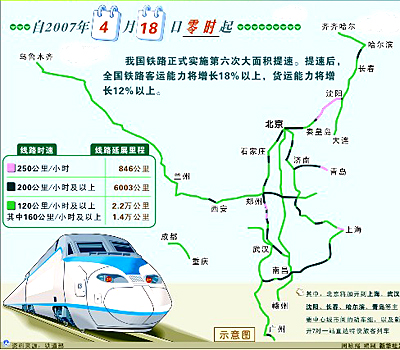
The CRH series now runs at speeds of around 200 km per hour and on some sections of the track at 250 km per hour, reducing journey time by an average of two hours. The annual cargo capacity has also increased from 150 million tons to 250 million tons.
In other words, the series has been launched to a bid to improve overall transportation capacity. The initiative not only saves time for passengers, but also improves China's cargo transportation capacity to meet the needs of rapid economic development. Between April 18 and October 18, for instance, passenger capacity on the trains run by the Beijing Railway Bureau reached 80 million, or some 440,000 people everyday -- a 7 percent increase compared to the same period of last year. Cargo transportation also saw an increase of 450 million tons/km, or 2.2 percent.
Undoubtedly, the introduction of the CRH series has contributed to the success of the sixth speed-up. It can be seen as a milestone in China's railway history, a path-breaking event that puts the country right on top with France, Germany and Japan, the world leaders in rail technology.
According to Zhang Shuguang, Deputy Chief Engineer of the Ministry of Railways and Director of its Transport Administration section, China's railway technology has scored substantially. More than 10 leading rolling stock firms have benefited from the large-scale technological imports, affecting a historic leap in the production level of rolling stocks. The country has now formed an industry group of rolling stock makers.
So far, there are four models in the series, namely CRH-1, CRH-2, CRH-5 and the latest, CRH-3. Each of them has been jointly developed by local companies and foreign partners -- Bombardier of Canada, Kawasaki of Japan, Alstom of France and Siemens of Germany, respectively. About 80 percent of its parts and components are domestically produced.
However, the success of the CRH series is not merely a function of technological import. "The key to manufacturing the world's top track traffic equipment is self-innovation," said Wang Jun, Vice Chairman and General Manager of CSR Sifang Locomotive & Rolling Stock Co., Ltd, addressing the Asia-Europe Meeting (ASEM) Business Leader Forum and Growing Enterprises Development Summit. The summit was held during the ASEM Trade and Investment Fair on Small- and Medium-sized Enterprises, in Qingdao from October 29-November 1.
"We received the production order for 60 CRH-2 trains as early as October 2004," said Wang, "and we knew clearly that there were huge gaps in terms of research and development, as well as the technological level, between China and the world leading powers.
"Under such circumstances, we decided to transfer and adopt the latest technology as well as reliable technological platforms. In cooperation with Kawasaki of Japan, we imported core technology first; and then studied it; and finally, with innovation, the CRH-2 rolled off the production line. We've already mastered nine core technologies and 10 supplementary technologies to manufacture the CRH-2 with a speed of 200 kph and above."
Thirty CRH-2 trains, produced by Wang's company and accounting for 71 percent of the total, were put into service on April 18. Furthermore, a total of 59 CRH-2 in service came from Wang's company by the end of October.
According to He Huawu, Chief Engineer of China's Ministry of Railways, the overall cost of the sixth railway speed-up stands at 29.6 billion yuan ($3.8 billion).
"The cost is affordable and it's worth it," he said.
A promising blueprint
According to a Xinhua News Agency report on October 20, China has finished building the body of its new bullet train.
The latest version of the CRH series, a domestically produced locomotive capable of traveling at 300 km per hour, will probably be launched soon, said the report. This is confirmed by Wang.
"The completion of the body lays a solid foundation for the year-end scheduled debut of the whole train," he said. "The train body, made of aluminum alloy, weighs about seven tons and is the lightest of its kind in the world. The thinnest part only measures 1.5 millimeters."
The company will deliver ten such trains to the Ministry of Railways in the first half of next year, also putting into service the Beijing-Tianjin express route before the Beijing Olympic Games.
"By the end of this year, 160 CRH motor unit trains and 448 high-power electric locomotives will be in operation," said Zhang Shuguang.
He said that 700 CRH trains, as well as some 17,000 km (10,655 miles) of new passenger and freight rail networks, are scheduled to be added by the end of 2010. China's 11th Five-Year Plan, which ends in 2010, earmarks $190 billion for rail infrastructure.
In addition, the construction of the Beijing-Shanghai high-speed route was approved in September. With a budget of 186.5 billion yuan (around $24.5 billion), the 300 kph CRH will cover the 1,318-km route, which is scheduled for completion by 2011.
By 2020, bullet trains will steam along 130,000 km of track -- just over a third of the nation's rail network, said Zhang. |