|
"I haven't been back to my hometown to celebrate the Spring Festival for four years, neither did I this year. I am used to it."
Zhang Junde, 27, has been living in Beijing for more than four years. He works as a builder in Chaoyang District. "After I had lived away from my hometown for one year, my wife followed me and now we both live in Beijing. We rent a house and work in different districts," he said.
Zhang's life is common for a new generation of migrant workers who were born in the 1980s, and are trying to make a new home rather than earning money and returning to the countryside.
There are an increasing number of younger faces among migrant workers, according to Cai He, a professor at Zhongshan University and an expert on domestic migrant workers. Cai believes migrant workers can be divided into two groups according to the year they were born. Those who were born before 1980 can be categorized as the first generation, those after 1980, the second generation.
The second generation differs from the first in several respects. Their link with farming is less than that of the first generation, and they have more fresh ideas, as well as different goals.
Not just about money
Working also as a builder, Li Feng is from Henan Province. He was born in 1988 and came to Beijing one and a half years ago. "In my hometown, people of my age or even younger are pressured by their parents to get married, but I think that is quite early for me," he said. He works on a construction site in Sanlitun, a very fashionable area of Beijing that is full of bars. "The life in Beijing is very colorful. I hope I can stay here as long as possible. I want to learn more in order to deal with more sophisticated work," he said.
His idea was echoed by many other migrant workers of the new generation who are not satisfied with just engaging in low-level physical work.
The 28-year-old Yang Qun moved to Zhongshan, a city in south China's Guangdong Province, from Hunan Province in 1999, when she was just 19. With an introduction from a friend he worked in a shoe shop as a quality tester.
"Because all the shoes were for exporting, I had to learn English, and it was really a great challenge for me," she said.
In 2003, Yang quit the job and spent a year studying English. Now she has a diploma in English and has changed jobs several times, getting a pay rise each time. She is head of the development department in her present company, with a salary of 5,000 yuan a month. She said it is impossible for her to go back to her hometown to live the same life as her parents.
Yang can be regarded as a model for migrant workers who want to gain a better life by their own hard work. Being successful is not only judged by salary, but also many other elements, including social status and sense of achievement. According to a survey conducted by the Chinese Academy of Social Sciences in 2006, among migrant workers who were born in the 1980s, only 18.4 percent put "making money" as their first goal, while 74.1 percent put "learning more knowledge" and "widening their view" as most important.
"I didn't realize the importance of knowledge in school, and I regret that a lot now. I plan to learn to use computers in my spare time and change to a more decent job," said Xue Xiaoyang, who comes from northeast China's Jilin Province. Xue has tried many physical jobs, which he said are tiring and dangerous.
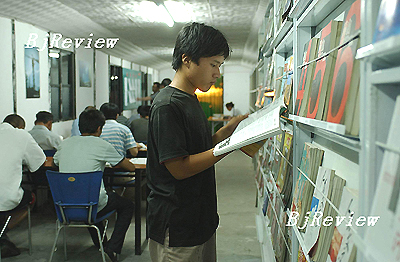
From their appearance, many younger migrants look just like local people or even college students. They wear jeans, have fashionable hairstyles, listen to popular music, and feel more optimistic than the former generation about life.
Influenced by the environment of the cities, their values, ways of thinking, even eating habits have changed a lot. "I feel quite free with my friends here, and I'm kind of not used to the lifestyle in my hometown," said Li, the builder from Henan Province. |