|
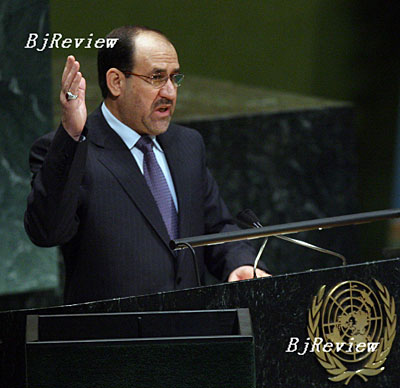
Five years ago, the United States launched the war on Iraq under the pretext of eliminating the country's weapons of mass destruction, and promoting democracy there and in the Middle East at large. It soon toppled Saddam Hussein's regime. But it has not found the "smoking gun," nor has it established democracy in Iraq. Instead, it has since plunged the country into a state of chaos with its new government unable to take control. Iraq took second place on Foreign Policy's "Failed State Index 2007." The country's failure is squarely attributable to the U.S. invasion.
Political reconstruction
Since the United States overthrew Saddam's regime in 2003, Iraq has been engaged in a difficult political reconstruction process. In the stages marked by direct U.S. control and administration by the interim governing council, the interim government and finally the constitutional government, Iraq's political authority was and still is derived from the ethnic and sectarian power struggle under American influence. In other words, the legitimacy of the current Iraqi regime is based on the so-called democratic election against the backdrop of foreign intervention and the wrangling between different ethnic groups and religious sects.
Can a government formed in this manner earn popular support in Iraq? Despite their military clout, the U.S. occupation forces have found it impossible to win the Iraqi people's hearts. The legitimacy problem is the most important reason for Iraq's persistent turmoil.
Also, Iraq has yet to put in place an effective new state apparatus, especially law enforcement. Laws made in the context of rampant ethnic and sectarian conflicts are likely to suffer from defects unless legislators transcend ethnic and sectarian interests. At present, the political order featuring the contention among Shiites, Sunnis and Kurds has been institutionalized with the establishment of a federal system in Iraq. The power struggle among these ethnic groups and religious sects has further weakened Iraq's shaky national identity. Because of the same problem, Iraq's new army and security forces can hardly fulfill their task of maintaining security.
Saddam maintained unity in Iraq with his high-handed rule. His regime took various measures to iron out ethnic and sectarian differences and crack down on tribal forces. Because of the drawbacks of the nationalist regime and the inherent problems of its forceful measures, Saddam's regime failed to achieve national integration. In a sense, it only suppressed and covered up ethnic and sectarian conflicts. That's why the conflicts became extraordinarily acute after the fall of his regime. Tribal forces also took this opportunity to assert their influence, casting a shadow on Iraq's political development.
Today, tribes and tribal coalitions still constitute an important part of Iraqi society. Many Iraqis cherish a sense of attachment and loyalty to their tribes in one way or another. According to the U.S.-based Council on Foreign Relations, there are likely more than 1,000 tribal organizations in Iraq today. They are playing a significant role in the country's social, political and cultural life, especially in small towns and rural areas.
The Kurdish issue, which bears down on Iraq's sovereignty and territorial integrity, also adversely affects the country's political reconstruction. Under Iraq's federal system, the Kurdish people's secessionist aspirations have grown. Kurds currently enjoy a high degree of autonomy in Iraq. They have established the Kurdistan Regional Government in Iraq's three northern provinces. They even have their own armed forces as well as a regional flag and emblem.
|