|
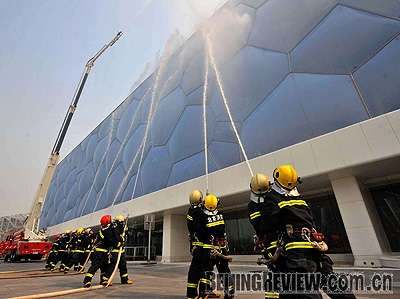
FIRE AND WATER: Firefighters from Beijing Chaoyang District Brigade of Public Security and Fire Control take part in an emergency drill at the Water Cube, the Beijing Olympic Games venue for water sports, on April 28
As the national capital and the host city of the Olympic Games, Beijing has stepped up construction of its emergency response system in recent years. The system is a complicated mechanism enabled by advanced technology.
In October 2006, Beijing published a document entitled Planning for Disaster Mitigation and the Emergency Response System Construction During the 11th Five-Year Plan (2006-10). It outlined four major goals to be achieved in the coming five years, with the arrangements for the 2008 Olympics Games included.
The document specified five systems to be constructed, including an emergency preparedness and management system, an emergency command and telecommunication system, an emergency response team and emergency response training.
The emergency response mechanisms include emergency forecast and early warning, information disclosure, emergency decision-making and management, news release, social mobilization, investigation and evaluation, as well as reconstruction.
The document set up a batch of key infrastructure projects to be completed in the next five years, and called for the establishment of a public safety management system to be integrated into the national system.
According to the document, Beijing is to set up a 3+2 crisis management model. The 3 refers to the municipal and district (county) levels of government in Beijing, and the municipal special emergency command center that deals with accidents involving urban public infrastructure, public health, transportation safety and earthquakes. The 2 refers to the emergency telephone number 110 and the non-emergency number 12345, where the public can get assistance.
"The crisis management model involving interactions between various levels of government and a special crisis management agency will boost Beijing's crisis management capacity," said Professor Xue Lan, a crisis management expert in the School of Public Policy and Management at Tsinghua University. "The old model should be gradually replaced by such a comprehensive crisis management model."
Beijing has distributed the Disaster Prevention and Emergency Response brochure free to residents. "The public's responses to impending or ongoing disasters are instrumental to people's survival, the extent of their loss and the cost of crisis management," explained Shan Chunchang, Vice Director of the Committee of Experts of the National Natural Disaster Reduction Committee.
Since July 8, 2005, Beijing has implemented the revised the "Unexpected Public Safety Incident Emergency Contingency Plan." So far, dozens of specialized emergency contingency plans have been made.
|