|
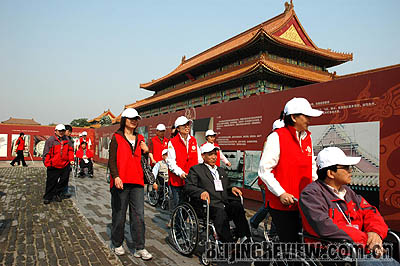
FORBIDDEN BUT ACCESSIBLE: Disabled people tour the Forbidden City by wheelchair on May 18. An increasing number of tourist attractions in Beijing have begun to install disabled facilities in recent years
"Back in 1991, when a neighbor told me that a sidewalk for the blind had been built in Beijing, I rushed there by taxi. Sitting on the curb, I could not help sobbing," recalled Ye Yifan, a blind man from Beijing. Ye, 47, lost his sight to disease 20 years ago.
Now, Beijing has more than 880 sidewalks for the blind, with a total length of 1,541.3 km. More sidewalks are still being built.
As the host city of the 2008 Paralympic Games, Beijing is committed to building a barrier-free city for the disabled. Although the concept of a barrier-free city emerged shortly after World War II, it has been in China for no longer than two decades. "As China is a developing country, the barrier-free standards implemented in Beijing still lag behind those of developed countries," confessed Zhang Qiuping, Director of the Paralympic Games Department of the Beijing Organizing Committee for the Games of the XXIX Olympiad (BOCOG). "Nevertheless, Beijing Municipal Government has done a lot in this respect, especially after the city won the bid for the Games."
Removing the barriers will not only make life easier for disabled people and senior citizens, but also encourage them to participate in social activities. "As a host of the Olympic and Paralympic Games, Beijing pledged to become a barrier-free city," explained Zhao Chunluan, an official with the Beijing Disabled Persons' Federation.
On May 16, 2004, the National Day of the Disabled, which falls on the third Sunday of May, Beijing published a rule titled the Regulations of Beijing Municipality on the Construction and Management of Non-barrier Facilities. The regulation was the first local regulation of its kind in China. It stipulated that when public or residential buildings are built, expanded or renovated, non-barrier facilities must be added. Many believe it is costly to build barrier-free facilities. However, Zhou Wenlin, a senior architect with the Beijing Institute of Architectural Design, said, "If planned in the design phase, barrier-free facilities do not incur much additional construction cost. To put it simply, just replace the staircases with ramps."
Accessible Games
During the Beijing Paralympic Games from September 6-17, more than 600 officers and more than 6,500 disabled athletes will come to Beijing. Twenty Olympic venues will be used in both the Olympic Games and the Paralympic Games. All these venues have been constructed strictly according to the technical manuals on Paralympic Games venues made by the International Paralympic Committee (IPC), and have been evaluated by relevant experts designated by the IPC. Designed to best accommodate the needs of disabled persons, the venues have passages, bathrooms and seats accessible to disabled people as well as conspicuous signs and a voice system to give directions. So far, most of the facilities are in place and have been checked and approved by experts.
The Olympic Village will be "home" to athletes during both events. After the Olympic Games, the village will be occupied by Paralympic athletes. Several facilities such as a wheelchair parking lot and repair center have been added. The design has been meticulously tailored to meet the special needs of the athletes so they will feel at home, reiterated Deng Yaping, Deputy Director of the BOCOG Olympic Village Department and a distinguished table tennis player and Olympic gold medallist.
|