|
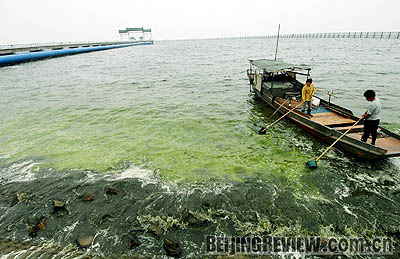
PERSISTENT PROBLEM: Despite a year of water treatment, blue-green algae has broken out again this year in Wuxi, in east China's Jiangsu Province
Outbreaks of blue-green algae, which sparked last May's water pollution crisis in Wuxi, Jiangsu Province, hit Taihu Lake again this summer and affected the water supply of millions of people. Early this April, large areas of algae emerged in western and southern parts of the lake, a month earlier than in 2007, according to Lin Zexin, Deputy Director of the Management Bureau of Taihu Area. Some experts have predicted that this summer there will be a large-scale outbreak of algae.
The Taihu area, featuring its fast growth of township enterprises, is one of China's most developed regions and makes up 10 percent of the country's gross domestic product (GDP). Rapid economic growth has been accompanied by a degeneration of water quality, which now lingers between inferior level-4 and level-5.
China's State Council launched a campaign in December 1998 to tackle pollution in Taihu Lake, spending millions of yuan, but accomplishing little.
"The resolution has not been implemented into the townships and enterprises, it has not become a conscious action of ordinary people," said Zhang Lijun, Vice Minister of Environmental Protection. Another reason for the failure to tackle the problem has been that responsibility for river management is unclear due to the separated river section management system.
Lin acknowledged that dealing with the pollution in Taihu Lake requires a long battle rather than a short-term action. Water in the lake is in the medium level of eutrophication. It takes at least three to five years to control this level of pollution, and failure to do so could otherwise have long-term ecological consequences.
The provincial government of Jiangsu has initiated an emergency plan to ensure drinking water safety and that the outbreak of algae does not evolve into a water crisis.
Severe shortages
China is the world's largest water consumer but the per-capita water resource in China is just one quarter of the world's average level. It's estimated that two thirds of China's over 600 cities are thirsty for water, of which 100 have severe water shortages.
According to Zhou Shengxian, Minister of Environmental Protection, water pollution is common in China and pollution control has lagged behind. The overall water situation is critical as the country continues to industrialize, creating more polluting industries and companies that consume high levels of water and energy. Despite an increasing focus on green production there has been no significant decrease in water pollution as a result.
Zhou said that half of the country's 20,000 chemical plants are located along the Yangtze River and some 3,800 are along the Yellow River. The use of water remains inefficient and water resources are often spoiled by companies breaking the law.
The goal
China's shortage of water resources is deepening as industrial pollution lowers water quality.
|