e-magazine
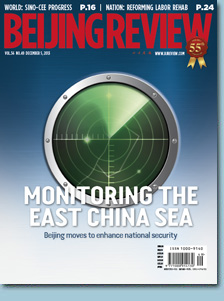
The Hot Zone
China's newly announced air defense identification zone over the East China Sea aims to shore up national security
Current Issue
· Table of Contents
· Editor's Desk
· Previous Issues
· Subscribe to Mag
Subscribe Now >>
Expert's View
World
Nation
Business
Finance
Market Watch
Legal-Ease
North American Report
Forum
Government Documents
Expat's Eye
Health
Science/Technology
Lifestyle
Books
Movies
Backgrounders
Special
Photo Gallery
Blogs
Reader's Service
Learning with
'Beijing Review'
E-mail us
RSS Feeds
PDF Edition
Web-magazine
Reader's Letters
Make Beijing Review your homepage
Hot Links

cheap eyeglasses
Market Avenue
eBeijing

Top Story
Top Story
UPDATED: June 26, 2008 NO. 26 JUN. 26, 2008
A Slippery Proposition
Energy experts weigh the pros and cons of China becoming a member of the International Energy Agency
By ZHU XIAOLEI
Share

In the long run, Dong said he anticipates China and the IEA to improve their dialogue mechanism and work more closely together in these areas.

Pang said that China's cooperation with the IEA in energy conservation, environmental protection and climate change technology could deliver impressive benefits to the world at large. As a country that adheres to an independent oil policy, China could conduct more bilateral and multilateral cooperation and constructive dialogues in the energy field, he said.

(With reporting by Wang Yanjuan and Chen Wen in New York)

About the IEA

The International Energy Agency (IEA) is a Paris-based intergovernmental organization founded by the Organization for Economic Cooperation and Development in 1974 in the wake of the oil crisis. It encompasses 27 member countries.

The IEA was initially dedicated to preventing disruptions in the supply of oil, as well as acting as an information source on statistics about the international oil market and other energy sectors. Recently, the organization has expanded their mandate to include energy security, economic development and environmental protection. It has a role in promoting and developing alternate energy sources, rational energy policies and multinational energy technology cooperation.

IEA member countries are required to maintain total oil stock levels equivalent to at least 90 days of net imports. At the end of June 2007, IEA member countries held a combined stockpile of almost 4.1 billion barrels of oil, 1.5 billion of which are under government control for emergency use.

Source: en.wikipedia.org


   Previous   1   2   3   4  


Top Story
-Protecting Ocean Rights
-Partners in Defense
-Fighting HIV+'s Stigma
-HIV: Privacy VS. Protection
-Setting the Tone
Most Popular
 
About BEIJINGREVIEW | About beijingreview.com | Rss Feeds | Contact us | Advertising | Subscribe & Service | Make Beijing Review your homepage
Copyright Beijing Review All right reserved