|
The U.S. financial crisis was a hot topic at the World Economic Forum's summer meeting in the Chinese port city of Tianjin in late September. More than 1,000 participants discussed what role China would play in global economic leadership in the years ahead and its economic development.
In light of the U.S. financial crisis, Chinese companies, just as other international firms, must overcome the challenges it has introduced to play a significant role in global economic leadership in the future. How companies should cope with the risks of the crisis was the central focus of the participants at the Annual Meeting of the New Champions, also known as the Second Summer Davos Forum.
Making the best of it
The U.S. financial crisis has directly affected the Chinese banking industry. Many Chinese banks do business with U.S. financial companies, and China considers the U.S. financial market as its model for financial reform.
Liu Mingkang, Chairman of the China Banking Regulatory Commission (CBRC) and one of the speakers at the forum, said on September 27 that despite the current financial turmoil, China would make the best of the situation to improve its information sharing system. He said the CBRC has cooperated with bank regulators from various countries and signed 32 memorandums of understanding for cooperation.
"Since the beginning of this financial turmoil, we have been providing various kinds of very important information, telling our opinions to financial regulators of other countries in a friendly but straightforward way," Liu said. He also said the CBRC would adopt a more effective way to protect the depositors so they could avoid losses from the financial crisis, but he did not provide details.
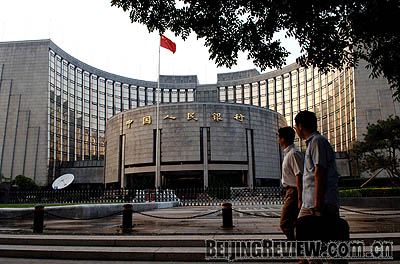
On September 16, the day that Lehman Brothers Holdings Inc. said it had filed for bankruptcy, the People's Bank of China, the country's central bank, lowered the interest rate on loans as well as the deposit reserve rate to allow more capital to enter the market. It was one of the steps the central bank has taken of late to loosen the tight monetary policy that has been in place for more than a year.
When the U.S. financial crisis started, some Chinese economists suggested that China's financial institutions purchase U.S. financial stocks. But Jiang Jianqing, Board Chairman of Industrial and Commercial Bank of China (ICBC), said at a forum session on September 27 that his bank would hold on tight to its "pockets" instead of "bottom fishing" for U.S. financial stocks.
"We are still stressing our investment base on strategies, but not on finance," Jiang said.
Liu added that China's banking industry also was ready to absorb unemployed talent from the Wall Street.
Boon for venture capital
The venture capital sector is one of the fuses that ignited the current U.S. financial crisis. John Zhao, CEO of Beijing Hony Future Investment Advisor Ltd., said he believes that while the crisis may have a negative impact on China's investment banking industry, it would not be the same overwhelming disaster that it has been for American investment banks. Unlike U.S. institutions, Chinese investment banks are still in the initial stages of development, and bankers are making cautious investment decisions.
|