|
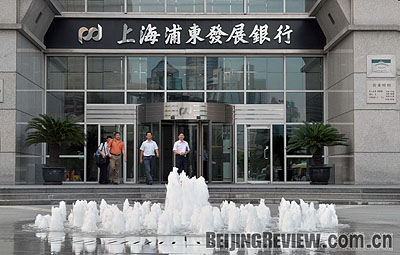
THE CHAMPION: Shanghai Pudong Development Bank Co. Ltd. Delivered the best performance in terms of net profit growth of China's 14 listed banks in the first three quarters
While the rest of the world has groaned under the spreading global financial turmoil, China's banking industry reported another season of good harvest when 14 listed banks all managed to secure high net profit growth in the first three quarters of this year.
According to their quarterly reports, the 14 banks reaped a total of 334.1 billion yuan ($49 billion) in net profit during the period, up 50.62 percent year on year, an indication that the banking industry has grown much faster than public companies in other sectors. Shanghai Pudong Development Bank Co. Ltd. delivered the best performance in terms of net profit growth, which stood at 150.92 percent. China Citic Bank Corp. Ltd. and China Minsheng Banking Corp. Ltd. ranked second and third, with net profit growth of 137.3 percent and 101.13 percent, respectively, in the first three quarters. All three are shareholding commercial banks.
Of the three listed state-owned banks, the Construction Bank of China Corp. (CBC) increased its net profit by 47.58 percent during this period, the Industrial and Commercial Bank of China Ltd. (ICBC) by 46.03 percent, and the Bank of China Ltd. (BOC) by 29.42 percent.
Wall Street contact
There have been worries that the global financial crisis could spill over into China's commercial banks, which hold various amounts of foreign currency assets. Based on the third quarter reports of public banks in China, Li Gang, an analyst at China Securities Co. Ltd., said he believes the financial crisis has had a limited impact on the country's banking industry, because it has not affected the banks' net profit growth, despite some losses.
The three state-owned banks have closer business contact with U.S. financial institutions than other Chinese commercial banks, Li said. They have certain amounts of funds in reserve for a possible devaluation of their assets; otherwise, they would have reported much higher net profit growth in the first three quarters, Li added.
BOC had held about 129 billion yuan ($19 billion) worth of U.S. subprime bonds by September 30, accounting for 1.96 percent of its total assets, and had 24.3 billion yuan ($3.57 billion) on hand to cover a possible future devaluation of the bonds, according to the bank's quarterly report.
The bankruptcy of Lehman Brothers Holdings Inc. created some small losses for BOC. By September 30, the book value of its holdings of Lehman Brothers' securities had been $11 million, while its losses stood at $65 million. The net book value of BOC's loans to Lehman Brothers was $8 million, while the devaluation preparation balance for the loans was $45 million.
ICBC was the second largest holder of subprime mortgage bonds in China, which totaled $186.7 million at the end of September and accounted for 0.14 percent of its total assets. The book value of the bank's Lehman-related bonds stood at $152 million, or 0.01 percent of its total assets, while its corporate collateralized debt obligations totaled $505 million, or 0.04 percent of its total assets. To cover these assets, ICBC had set aside devaluation preparation funds worth up to $1.31 billion. For its $1.68 billion worth of Fannie Mae- and Freddie Mac-related bonds, which equaled 0.12 percent of its total assets, ICBC had $76 million in reserves for related devaluations.
|