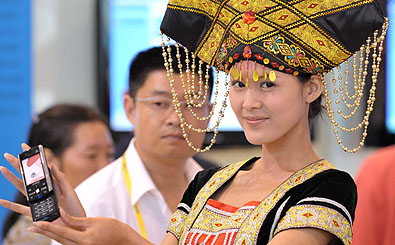
Mobile TV was thrust into the spotlight at this year’s 3GSM World Congress held in Barcelona, Spain, in mid-February. But while large multinational telecom companies like Nokia, Alcatel, Samsung and Sony Ericsson were all on hand to push their mobile TV networks and handsets at the international mobile show, there seems no way this technology will be seen in China in the foreseeable future.
Citing reasons ranging from government licensing to concerns about the lack of a unified standard for China’s mobile phone TV industry, China’s top cell phone makers are reluctant to become involved in production.
Lucrative market
At the congress, Philippe Keryer, President of Alcatel’s Mobile Division, sounded a clarion call for the need to move into the Chinese market. As China will host the Olympics in 2008, the telecom operators should be well prepared for launching commercial mobile TV services by the end of 2007, so that their customers can view Olympic events on their cell phones, he said.
China has the largest number of cell phone users in the world. By the end of 2005, the number hit nearly 300 million, accounting for about 18 percent of the world’s total. Of these users, 50 percent upgrade their cell phones every one to two years, while nearly 20 percent use their phones for less than a year before buying new ones.
China is therefore believed to be a huge potential market for multinationals. According to Herbert Mittermayr, Vice President of Alcatel Mobile TV, Alcatel has begun discussions on developing cell TV services with some network operators including China Mobile and on the licensing of the TV programs with China’s State Administration of Radio, Film and Television (SARFT).
He Qingyuan, President of Nokia (China) Investment Co. Ltd., announced in February that mobile TV would be one of Nokia’s key products in 2006.
Compared with Alcatel and Nokia, their South Korean counterparts have advanced at a quicker pace. According to the Beijing R&D Center of the South Korean Electronics and Telecommunications Research Institute, terrestrial DMB (digital multimedia broadcasting), a mobile TV technology, is set to come into operation in Beijing, Shanghai and Guangdong in the first half of this year.
In May last year, China Unicom unveiled its “U-web” cell phone video service, the first mobile TV service in China. China Mobile, another large telecom company, rushed to follow suit, launching a mobile TV service based on the GPRS network shortly thereafter.
| .jpg)