|
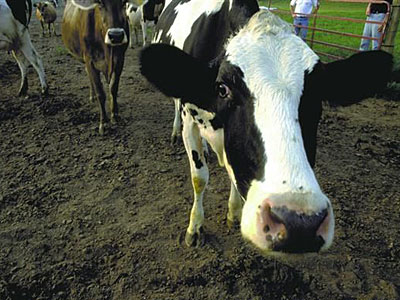
Chinese scientists are attempting to keep milk free of chemical residues by using herbal medicines, rather than antibiotics or hormones, to treat bacterial infections in cows and increase their milk production.
Liang Jianping, a leading veterinary pharmacist with the Institute of Modern Physics under the Chinese Academy of Sciences, said on Wednesday that his research team produced zero-residue milk at an experimental dairy farm by using herbal medicines to treat mastitis (an inflammation of the udder) and endometritis (an infection of the uterus).
"The milk was supplied to yogurt manufacturers, and the yogurt produced was sold to restaurants and hotels at a price about twice that of regular yogurt," said Liang.
Researchers used the anti-bacterial herbal medicine Liu Qian Su, which is extracted from the plant genus madder. It can be metabolized in a few hours and leaves no harmful residues in milk or other food, according to Liang.
Instead of using female hormones, they used puerarin extracted from the herb kudzu (a member of the pea family native to southeast China) to raise cows' milk production. Puerarin, usually used to treat coronary heart disease and angina, can achieve the desired effect by expanding the blood vessels of cows.
The next step was to provide the technique to dairy manufacturers in the northwestern Gansu Province, where the institute is based, said Liang, also member of a Ministry of Agriculture committee overseeing veterinary drug residues in food of animal origin.
"Overdoses of antibiotics in cows can leave chemical residues in milk, which pose a risk of drug resistance and allergic reactions in humans," said Liang.
Liang noted that overuse of antibiotics is common in China as dairy farmers flout dosage regulations.
Liang, who also led a state-level research program on commercializing safe veterinary drugs in 2002, said that China doesn't currently test for antibiotic or hormone residues in milk.
Stricter standards are urgently needed, according to Liang, whoadded that supervision over the production process is just as important as the product-testing process.
(Xinhua News Agency November 19, 2008) |