|
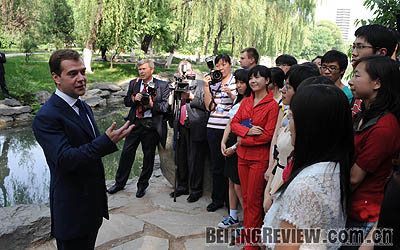
YOUTH FRIENDLY: Russian President Dmitry Medvedev talks with Chinese students at Peking University after he delivered a speech there on May 24
Russian President Dmitry Medvedev paid a state visit to China on May 23-24, a symbolic tour that was hailed as a testament to the two countries' unprecedented good relations.
China is Medvedev's first foreign destination outside the Commonwealth of Independent States (CIS) since he was sworn in on May 7. The Russian president is also the first head of state to visit China after the Wenchuan earthquake on May 12.
In Beijing, he met Chinese President Hu Jintao, Chairman of the Standing Committee of the National People's Congress Wu Bangguo, Chairman of the National Committee of the Chinese People's Political Consultative Conference Jia Qinglin and Vice President Xi Jinping. All agreed to push forward the China-Russia strategic partnership.
The two countries signed a number of documents on bilateral cooperation in the fields of energy, aviation, forestry and tourism. They also summarized their common positions on international affairs in a joint statement. Apart from the concrete agreements made during Medvedev's visit, his trip sent a clear signal that the new Russian president would continue to steer Sino-Russian relations along the path to long-term friendship and cooperation, Chinese international studies experts said.
Robust relations
Given its special timing, the visit provided evidence that Russia regards China as the friendliest country outside the CIS, said Ji Zhiye, Vice President of the China Institutes of Contemporary International Relations. Medvedev visited China only after Kazakhstan on his first overseas mission as Russian president.
With this visit, Medvedev intended to show that he would adhere to his predecessor Vladimir Putin's policy toward China and preserve established bilateral mechanisms, he added.
The two countries' presidents hold at least one formal meeting every year. In addition, they meet five to six times on other occasions such as the Summit of the Shanghai Cooperation Organization (SCO), the Summit of the Asia Pacific Economic Cooperation and the G8 Summit. These meetings let top Chinese and Russian leaders compare notes on strategic issues in a timely manner, Ji said.
The two countries' premiers meet annually to work out plans on important issues. They also have an intergovernmental cooperative committee co-chaired by their vice premiers to oversee concrete cooperation in various fields, Ji said.
China and Russia laid the legal groundwork for the sustained development of their bilateral relations with the signing of the Sino-Russian Good Neighborly Treaty of Friendship and Cooperation in 2001. Four years later, they formally put an end to their historical border disputes. Strong trade and economic ties also have contributed to the stability of China-Russia relations. The two countries' trade volume jumped from several billion dollars in the 1990s to $10 billion at the beginning of the 21st century and to $48.1 billion in 2007.
They also hosted national theme years to boost cultural and social exchanges-the Year of Russia in China in 2006 and the Year of China in Russia in 2007. Their cooperation in energy and hi-tech fields has borne fruit. The two countries have announced that they will carry out a joint Mars exploration project in 2009.
Moving ahead
While holding talks with Medvedev, Hu raised four proposals on deepening the Sino-Russian partnership:
-- strengthening political mutual trust and support;
-- deepening substantial cooperation;
-- expanding people-to-people and cultural exchanges; and
-- enhancing strategic coordination in international and regional affairs.
In their joint communiqué, the two presidents identified energy cooperation as an important component of Sino-Russian strategic relations. The two countries will continue to work together on oil, gas and power projects. They will establish a vice premier-level mechanism for coordinating energy cooperation. Both heads of state believe that nuclear power is one of the priorities of bilateral economic cooperation, according to the joint communiqué. They also announced they would hold a Year of the Russian Language in China in 2009 and a Year of the Chinese Language in Russia in 2010.
Russia is assisting China in building the Tianwan Nuclear Power Plant in Jiangsu Province. Negotiations on the construction of the second phase of the project are currently underway, according to a report on rusnews.cn.
| .jpg)