|
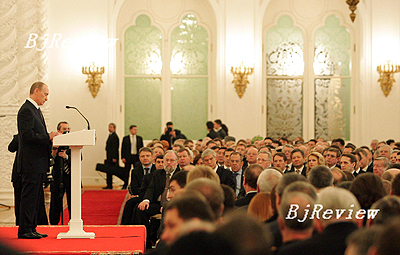
Vladimir Putin is one of the most attractive political leaders in the world, and by some accounts one of the most successful based on his accomplishments while in office.
When analyzing Putin's two consecutive terms as president during the past eight years, some Chinese foreign affairs scholars give him a high score, because they believe that he has greatly improved Russia's comprehensive national strength.
"I would say that Vladimir Putin is the most outstanding Russian leader in recent decades," said Shi Ze, Director of the Center for Security Studies of Surrounding Areas, the China Institute of International Studies (CIIS). He stressed that Putin's most prominent achievement has been that he changed the image of Russia as a laggard country.
Shi recalled that when Putin became president in 2001, Russia was in a messy situation. Its economy lagged behind. Its political situation was unstable and national separatists were active. Political and financial oligarchs, some of whom were controlling the country's media, distributed the central government's power. Inside the country, citizens were complaining about poor living standards; outside, Russia was not respected as a big country.
"Now, Russia has a stable and orderly political and social environment, while its economy is generally trying to attain sustainable development," Shi told Beijing Review.
Shi said Putin recovered the Central Government's authority first by striking at the oligarchs, who had assumed ownership of the country's state-owned companies through privatization, including several large oil and gas firms. By sentencing these oligarchs to jail and reclaiming the companies, Putin's administration not only ended their influence on government policies, but also set a strong base for the country's economic development, he said.
The second way that Putin enhanced the country's political situation was his direct appointment of regional officials, Shi said. Putin also contained separatists, including those in Chechnya who were responsible for several major terrorist attacks in Russia. As a result, the influence of the Chechen rebels has now died down, Shi said. Putin also strengthened the country's links to and cooperation with other former Soviet Union republics, which have helped to improve the Central Government's power, he said.
Shi also pointed out that Putin's wise choices in selecting his colleagues helped him to consolidate power and rebuild the country's political and economic strength. The foremost example has been Dmitry Medvedev, Putin's appointed successor and current First Deputy Prime Minister.
Putin has "an excellent and efficient team" that has made great achievements in implementing practical policies and combating corruption, Shi said.
More economic muscle
International affairs experts also pointed out that Putin has done well in revitalizing Russia's economy during his tenure as president. At a press conference on February 14, Putin said the country's gross domestic product (GDP) had grown 72 percent since 2000. If Russia could sustain its current annual GDP growth of 7.2 percent, it could double its GDP by the end of 2009, he added. According to government statistics, Russia's GDP growth reached 8.1 percent last year. The Russian economy also has been fortified by foreign exchange and gold reserves totaling nearly $500 billion.
Putin had seized a golden opportunity to boost the economy as world oil price started to skyrocket, Shi said.
"For Russia, rising oil prices not only bring a large amount of wealth, but also give the country a strong base for optimizing its economic growth structure, which will focus more on sustainable development rather than simply selling natural resources," Shi said.
For the Russian people, the country's economic development brings practical benefits, Shi said. They currently have the seventh greatest per-capita purchasing power in the world and over the last few years their actual incomes and retirement pensions have more than doubled.
Russia's economic might also has helped improve its military forces, because the country has more money to buy innovative equipment, while it produces more hi-tech weapons, Shi said.
All these in turn have enhanced Russia's standing in the world, Shi said. Putin's energy source diplomacy has played a big role in the country's relations with other nations, so that Russia is now more respected as a big power on the world stage.
"Russia is an important power that says ‘no' to a unilateral world," Shi said. In recent years, Russia under Putin has strengthened its cooperation in various areas with China and India. Russia and some Western countries have joined hands to fight terrorism. And Russia's input has become more important in discussions about international problems, such as nuclear issues in Iran and on the Korean Peninsula, Shi said.
"Putin is a very popular president with his people," Shi said, adding that during the past years he has maintained a high approval rate of 75 percent-80 percent. Shi said Putin's annual public press conferences serve as an open channel between Putin and the Russian people.
The great communicator
Wang Lijiu, a scholar at the China Institutes of Contemporary International Relations (CICIR) agrees that Putin's yearly public press
|