|
away an annual 4.1 million tons of edible goods. Before heading to Japan for the G8 Summit, British Prime Minister Gordon Brown said food waste is one of the factors fueling food prices.
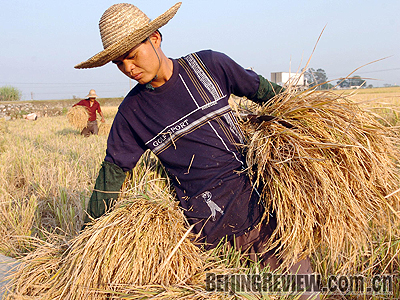
WELL FED: A farmer harvests rice in the rural areas in southwest China's Guangxi Zhuang Autonomous Region. China supports one fifth of the world's population with 9 percent of the world's arable land
China has contributed greatly to the world's food security. The numbers speak for themselves. It produced 501.5 million tons of grain in 2007, when the world's grain output was 2.075 billion tons. Its grain output was on the rise from 2004 to 2007. It feeds about 20 percent of the world's population with some 9 percent of the world's arable land. For nearly 10 years, China has met over 95 percent of its grain demand on its own and exported a net amount of 8 million tons of staple grains such as wheat, rice and corn annually on average.
Complicated background
Attempts to blame developing countries for growing global food demand neither tally with the facts nor represent a constructive attitude toward tackling the food problem. Causes of the current food crisis are quite complicated.
First, rising oil prices have driven up the production costs of agriculture. Given the oil price hikes, fertilizer prices in the international market have nearly tripled in the past five years. Zhang Haibing, Deputy Director of the Division for World Economy Studies at the Shanghai International Studies Institute, pointed out that fertilizer costs generally take up more than 10 percent of total agricultural production costs, and rising fertilizer prices naturally make agricultural production costs higher. They can also lead to higher transportation costs of agricultural products.
Second, extreme weather has resulted in the decline of total agricultural output. For example, Australia's wheat output in 2007 was only 60 percent of that in normal years due to the record drought. Because wheat and rice are alternatives to each other, reduction of wheat output caused rice prices to soar.
Third, grain reserves have been drastically on the decline across the world. Today, global grain reserves stand at some 405 million tons, of which rice reserves amount to 102.4 million tons, the lowest point since 1982. Moreover, Zhang pointed out that restrictions imposed by major rice exporters such as India and Viet Nam on their rice exports have cut global rice supplies by one third.
On the demand side, Western countries' drive for biofuels has made a major impact on international food prices. A leaked World Bank report claims that a basket of world food prices it studied went up by 140 percent between 2002 and February this year. The bank found that U.S. and EU efforts to develop biofuels had the biggest impact on food prices,
|