
|
| China |
| A legal answer to an aging society's silent crisis? | |
|
|
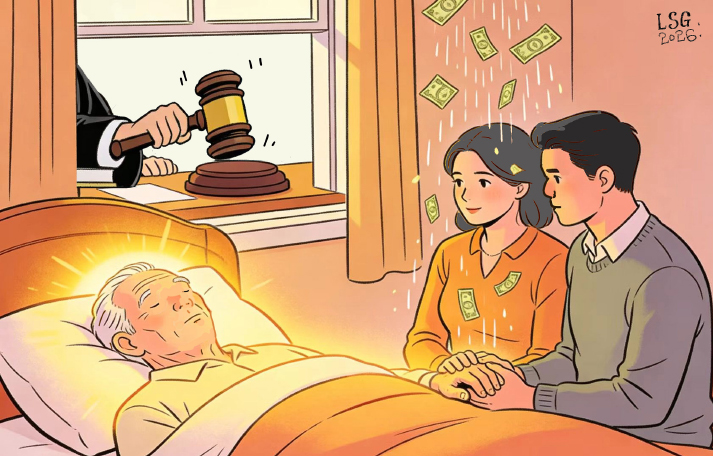 (ILLUSTRATION BY LI SHIGONG)
An estate administrator is a person or entity legally appointed to manage, preserve and distribute a deceased person's assets. The Supreme People's Court (SPC) recently released landmark cases on the estate administrator system as established by the Civil Code, the nation's first unified civil law statute that took effect in 2021. The move has sparked public debate over how to handle the country's "lonely death" phenomenon, in which a person who has no legal heirs dies without a will. Is this system a necessary safeguard for an aging society, or does it just raise concerns about state overreach? Zhong Yi (Nanfang Daily): The estate administrator system is a timely and necessary institutional innovation in response to deep demographic shifts. As China grapples with an aging population, declining birth rates and growing household wealth, the legal vacuum in posthumous estate management had become untenable. The system's primary virtue lies in its "safety net" function: When a deceased person has no legal heirs and leaves no will, the Civil Code now provides a clear mechanism—civil affairs authorities, appointed by courts upon petition, step in to prevent assets from falling into limbo or being plundered. The recent case of Ge Yicheng, who died without heirs or a will, illustrates the system's humanistic potential. A couple who had voluntarily cared for Ge for three years, with no legal obligation to do so, were awarded a portion of his estate by the court. This embodies the principle of "rights corresponding to obligations" and the integration of law, reason and human sentiment. It rewards genuine kindness without arbitrarily expanding the scope of legal heirs. However, the system remains a work in progress. Procedures for identifying ownerless estates are still vague and oversight mechanisms for estate administrators are insufficiently defined. Moreover, deep-rooted cultural taboos around will-making, combined with the absence of a professionalized estate administrator industry, mean that social acceptance will take time. The release of typical cases by the SPC is in itself a form of social education, signaling that the system's ultimate purpose is not bureaucratic control but orderly wealth transition. The road ahead requires continuous institutional refinement and public engagement. Editorial (ThePaper.cn): The estate administrator system has been widely misunderstood, and the SPC's recent cases serve as a necessary corrective. In the wake of several high-profile "lonely death" incidents, some voices on social media have distorted the role of civil affairs authorities as estate administrators, framing it as "the state eyeing private property." This is a serious misreading of the law. Under the Civil Code, the appointment of an estate administrator follows a strict legal hierarchy: The testator's appointed executor takes precedence; failing that, the heirs may elect one. Only when no heirs exist or all have renounced their inheritance may a civil affairs department be designated, and even then, exclusively through a court ruling initiated by an interested party. The department cannot act on its own initiative, let alone "confiscate" private property. Two specific misconceptions are addressed head-on. The first concerns "the state taking over estates." In reality, those who provided care for the deceased, even if not legal heirs, can claim a share of the estate, as demonstrated in the Ge case, in which carers received 1.3 million yuan ($192,000). The second concerns debt liability. The system strictly follows the "limited inheritance" principle, meaning the administrator, whether an heir or a government agency, must repay any debts, but is liable only up to the value of the estate. As China enters a deeply aging society, the estate administrator system provides a clear, fair and predictable framework for handling posthumous affairs. It balances the interests of heirs, creditors and the public good, prevents fraudulent debt evasion disguised as inheritance renunciation, and upholds the traditional virtue of supporting the elderly. Public misunderstanding should not overshadow the system's genuine social value. Copyedited by Elsbeth van Paridon Comments to yanwei@cicgamericas.com |
|
||||||||||||||||||||||||||||
|