
|
| World |
| Participants of Hong Kong forum weigh a shared future against a fragmenting global landscape | |
|
|
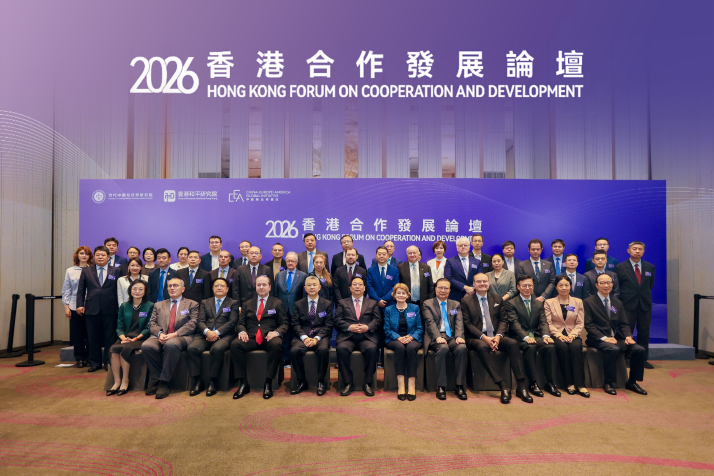 Participants pose for a group photo during the 2026 Hong Kong Forum on Cooperation and Development in Hong Kong Special Administrative Region on May 19 (COURTESY PHOTO)
Against a backdrop of lingering geopolitical tensions, mounting climate challenges, technological disruption and widening development gaps across continents, the world is trapped in a predicament where unilateralism and zero-sum thinking repeatedly undermine multilateral efforts. In such an era, can cooperation still serve as a viable instrument of global governance? Leveraging Hong Kong Special Administrative Region (SAR)'s unique position as a cross-cultural and cross-system hub linking China and the rest of the world, participants of the 2026 Hong Kong Forum on Cooperation and Development, held on May 19-20, exchanged actionable solutions to global woes and cemented consensus on win-win cooperation amid turbulent times. Recent diplomatic milestones including the China-U.S. summit in Beijing and Russian President Vladimir Putin's state visit to China further elevated the forum's practical importance. These developments grounded its discussions firmly within the shifting dynamics of global governance. Breaking the gridlock The forum, co-organized by the Academy of Contemporary China and World Studies, a think tank under China International Communications Group (CICG), the Peace Research Institute Hong Kong and the China-Europe-America Global Initiative, brought together over 100 participants from the Chinese mainland and Hong Kong SAR, Russia, the United States, France, Italy and Thailand. CICG President Chang Bo delivered the opening address, elaborating on the deep cultural roots of cooperation in Chinese civilization. "Cooperation is the inherent quality of China's fine traditional culture," he said, adding that the Chinese nation has always valued harmonious coexistence and mutually beneficial exchange. From rallying the global united front against Japanese aggression during World War II to actively promoting "greater BRICS cooperation" and genuine multilateralism, cooperation has remained an enduring and timeless value for China. BRICS is a 10-member group of emerging economies originally consisting of Brazil, Russia, India, China and South Africa. "Only through win-win cooperation can we accomplish great things," Chang emphasized. The China-proposed Belt and Road Initiative (BRI), a framework to boost connectivity along and beyond the ancient Silk Road routes, which involves more than three quarters of the world's countries, and China's four global initiatives on development, security, civilizations and governance are concrete expressions of Eastern wisdom and a major country's sense of responsibility. The vision of a community with a shared future for humanity has been consecutively incorporated into United Nations General Assembly resolutions, demonstrating broad international recognition, he said. Proposed by China in 2013, the concept was first formally written into a UN document on February 10, 2017, when the UN Commission for Social Development adopted a resolution on Africa's development. Genuine peace can never be obtained through confrontation but accumulated via persistent dialogue and mutual respect, Romano Prodi, former Prime Minister of Italy and former President of the European Commission, said, calling for deeper European Union-China collaboration, stressing that joint efforts between the two major economies serve as a stabilizer for global economic and geopolitical order. Irina Bokova, former UNESCO Director General and senior advisor to the Board of Directors of the Europe-Asia Center, a Brussels-based independent non-profit organization promoting Europe-Asia relations, identified three major challenges, regional conflicts, climate change and the technological revolution, that require global cooperation. "Unilateralism is not an answer," she said. "Global governance should not be dominated by a small number of states, nor should international rules become instruments of geopolitical competition. Effective global governance must be based on fairness, consultation, international law and broad participation." According to her, China's four global initiatives are coherent and systematic, embodying genuine multilateralism and aligning with the core spirit of the UN Charter. Josef Gregory Mahoney, a professor of politics at the School of Politics and International Relations at East China Normal University and Executive Director of the International Center for Advanced Political Studies under the school, highlighted the implications of China's "new internationalism" in global affairs, saying it stands in sharp contrast to the binary, us-versus-them mindset of certain countries. This "new internationalism" can be understood as a cohesive strategy to reshape global governance into a system that is more multipolar, cooperative and favorable to the development of all nations, especially those in the Global South. China's initiatives, Mahoney said, have always aimed for a shared future for humanity and the actualization of the Five Principles of Peaceful Coexistence. Jointly initiated by China, India and Myanmar in 1954, the Five Principles are: mutual respect for sovereignty and territorial integrity, mutual non-aggression, non-interference in each other's internal affairs, equality and mutual benefit, and peaceful coexistence. Multilateralism is of the utmost importance for creating a new and sustainable information space, Ivan Polyakov, Vice President of the Russian International Affairs Council and Chairman of the international media network BRICS TV, said. "It is the media that create the context and conditions for international dialogue across communities, countries and systems, set the tone for this dialogue, and lay the foundation for promoting global cooperation," he added. The BRICS media network, established following the 2017 BRICS summit in Xiamen, a coastal city in the southeastern Chinese province of Fujian, now brings together over 100 media outlets from 30 countries, producing content in six languages and reaching more than 80 countries. "The media are no longer just a mirror of reality; they are becoming the architects of a semantic space in which countries act as co-developers of the global infrastructure of peace and creation," Polyakov said, calling for the creation of a new sustainable global information exchange platform.  Artists perform on a passenger train traveling from Kunming, Yunnan Province in southwest China, to the Lao capital of Vientiane on April 14 (XINHUA)
Empowering through development "Chinese modernization breaks the myth that 'modernization equals Westernization.' It proves that modernization does not rely on plunder and confrontation but can be achieved through peaceful development, openness and win-win cooperation," Wirun Phichaiwongphakdee, Director of the Thailand-China Research Center of the Belt and Road Initiative, said during a panel discussion. He added that the BRI has turned China's development opportunities into global public goods. Its flagship projects like the China-Thailand Railway, China-Laos Railway and Jakarta-Bandung High-Speed Railway in Indonesia bridge geographical distances and narrow development gaps, opening up modernization pathways for Global South countries. "No development can be built on war and turmoil, and no beautiful future can be born on land plagued by hunger and poverty," Wirun emphasized. "China's eradication of absolute poverty (in late 2020) gives the Global South real confidence. Development should serve all people. Only when more countries and regions have a secure development environment, sufficient food supplies and modernization opportunities can humanity truly share a common future." Mahoney echoed this sentiment. "People from more and more countries and regions are visiting China, trying to find solutions to their development challenges," he said, "China's win-win logic, which rejects zero-sum games, provides a new paradigm for global governance." Edward Bi, Deputy Secretary General of the Europe-Asia Center, offered a European perspective. "Europe has deep expertise in green technology and low-carbon development, while Asia has vast market vitality and industrial synergy. Deepening pragmatic cooperation aligns with the common interests of both sides and is a key pathway to global sustainable development." Chan Suet Yi, Chair of the Arts Education Committee, Hong Kong Arts Development Council, stressed the importance of human qualities in the AI era. "Technology and AI are cold; art brings emotional warmth and cultural depth. The true, the good and the beautiful—these qualities are essential for genuine cooperation." She added that Hong Kong's inclusivity, blending Chinese and Western cultures, makes it an ideal place to foster such values. Hong Kong as a bridge At the forum, speakers highlighted Hong Kong SAR's unique advantages and its potential role as a bridge between China and the rest of the world. Tam Yiu-chung, Secretary General of the Hong Kong Coalition and Honorary President of the Peace Research Institute Hong Kong, said the institute, with its international research and communication strengths, aims to serve as a high-level think tank—rooted in the Guangdong-Hong Kong-Macao Greater Bay Area (GBA), facing Southeast Asia and radiating globally—to facilitate experience-sharing on global governance. The establishment of the International Organization for Mediation (IOMed) provides a new mechanism for peaceful dispute resolution, Cheung Kwok-kwan, Deputy Secretary for Justice of the Hong Kong SAR Government, said. The Hong Kong-headquartered IOMed is the world's first intergovernmental international legal organization dedicated to resolving international disputes through mediation. As a leading arbitration center in Asia, Hong Kong relies on its common law system and internationally aligned legal environment to fully support IOMed's operations. "Hong Kong can play a unique role in legal arbitration and risk management, helping to promote a fairer and more reasonable international order," Cheung noted. Zhao Yun, Associate Dean of the Faculty of Law at the University of Hong Kong, welcomed the establishment of IOMed. "Unlike litigation and arbitration, mediation preserves relationships and seeks win-win outcomes. Fostering a culture of harmony through peaceful mediation—what a great achievement." "Mediation demonstrates the power of dialogue, mutual trust and understanding. It is not a zero-sum game but effective win-win cooperation," Teresa Cheng Yeuk-wah, Secretary General of IOMed, adding since the organization began its operations last October, it has resolved several commercial and maritime disputes. "Hong Kong retains the vitality and dynamism it had in the 1980s. It is an outstanding benchmark city in the global economy," John Quelch, Executive Vice Chancellor of Duke Kunshan University, said. He raised the urgent issue of AI governance. "AI lowers the perceived cost of waging war. You don't put human soldiers at risk. That is why global governance of AI is as critical as nuclear non-proliferation treaties," he said, adding we need high-level dialogue to prevent technology from spiraling out of control. "Mediation was never a simple East-versus-West dichotomy. It is a meeting point where different civilizations, across cultural differences, have pursued common values," Elizabeth Woo Li, a cross-cultural scholar, offered a nuanced analysis. She also called Hong Kong a "living laboratory" for international mediation, given its rich cross-cultural heritage. Song Ping, Deputy Editor in Chief of China Daily Asia Pacific, used the Lancang-Mekong Cooperation (LMC) mechanism as a case study. "The Lancang-Mekong River (known as the Lancang in China and the Mekong downstream—Ed.) flows through six countries (China, Myanmar, Laos, Thailand, Cambodia and Viet Nam—Ed.). Without coordinated governance, geographic proximity can breed friction. But the LMC has built a regional governance mechanism with tangible results: over 800 projects supported by a special fund, nearly 100,000 pieces of hydrological data shared and a recent memorandum of understanding on hydrological information," She said, adding that Hong Kong can do more than just facilitate physical connectivity; its legal, financial and rule-coordination capabilities can connect different markets, systems and development stages. The forum concluded with the participants' shared recognition that neither cooperation nor development can be taken for granted in today's ever-fracturing world. Yet, dialogue remains possible, solutions exist and the bridge, however fragile, still stands. Whether the world chooses to cross it is a question that extends far beyond the conference hall. (Print Edition Title: Can Cooperation Still Work?) Copyedited by Elsbeth van Paridon Comments to mamm@cicgamericas.com |
|
||||||||||||||||||||||||||||
|








