
|
| World |
| China's vision resonates with global partners | |
|
|
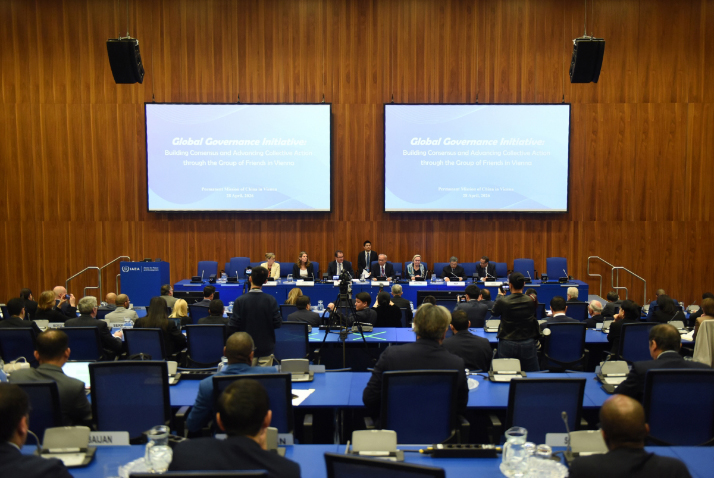 The Group of Friends of Global Governance Vienna Chapter is launched at the United Nations Office at Vienna, Austria, on April 28 (XINHUA)
At the United Nations headquarters in New York City, the United States, on May 28, Chinese Foreign Minister Wang Yi proposed nine directions for reforming and improving global governance at a meeting of the Group of Friends of Global Governance. The directions range from improving the efficiency of UN reform and strengthening the authority and capacity of the UN Security Council to updating peacekeeping operations, building international consensus on development, improving human rights governance, reforming the international economic and financial system, strengthening AI governance, improving rules in new domains and promoting civilizational exchange. Wang said the group had become "a stabilizing factor and a force for justice in a turbulent world," and called for the mechanism to be further leveraged and strengthened. The meeting, bringing together UN Deputy Secretary General Amina Mohammed and representatives from more than 60 countries, came at a time when the UN itself is undergoing reform. The UN80 Initiative, launched on March 12, 2025, ahead of the organization's 80th anniversary, seeks to build "a simpler, more effective and more coherent UN System" that delivers better for people and the planet amid shrinking resources and rising global needs. Against that backdrop, the Group of Friends of Global Governance has become one of the platforms through which developing countries are seeking to make their views heard on how global governance should change. China stands ready to work with different parties to make good use of and strengthen the mechanism, draft joint plans for the reform and improvement of global governance, and build a community with a shared future for humanity, Chinese Foreign Ministry spokesperson Mao Ning said at a press briefing on May 29. A platform takes shape The Group of Friends of Global Governance was formally established on China's initiative at the UN headquarters on December 9, 2025. Its 43 founding members include China, Pakistan, Cuba, among others from Asia, Africa, Latin America and the Pacific. China's Permanent Representative to the UN Fu Cong said at the inaugural meeting that China had promoted the establishment of the Group of Friends of Global Governance under the guidance of the Global Governance Initiative (GGI). The GGI, proposed by President Xi Jinping at the Shanghai Cooperation Organization (SCO) Plus Meeting in Tianjin in September 2025, is anchored in five core principles, namely, sovereign equality, international rule of law, multilateralism, a people-centered approach and emphasis on real action. "It is our hope to join hands with all partners to deepen exchanges and cooperation on major global governance issues, pool our collective strength, uphold the banner of multilateralism and work together for a future of fairness," he noted. The group is open to all UN member states and welcomes more like-minded countries on board, according to Fu. The platform expanded quickly. On February 27, the Permanent Mission of China to the UN Office at Geneva and Other International Organizations in Switzerland hosted the group's launch meeting at the Palais des Nations, which was attended by representatives from nearly 60 countries. On April 28, the Group of Friends of Global Governance Vienna Chapter was launched. "In less than five months, with more and more member states and increasing influence and cohesion, the Group of Friends of Global Governance continues to develop, taking root in New York, Geneva and Vienna (Austria). It fully demonstrates that reforming and improving global governance and tackling global challenges together is where the arc of history bends and public opinion trends," foreign ministry spokesperson Lin Jian said on April 29. At the May 28 meeting, Wang summarized five points of consensus reached by members since the group's establishment: advancing greater democracy in international relations; upholding the purposes and principles of the UN Charter; safeguarding the UN's central role and opposing unilateralism and power politics; narrowing the Global North-South gap through reform; and focusing on practical problems and visible results. Participating countries, according to the Chinese Foreign Ministry readout, said the GGI is consistent with the purposes and principles of the UN Charter, defends and practices multilateralism, and strengthens the central role of the UN in international affairs. They agreed that the nine directions proposed by China are in line with the UN80 reform initiative. 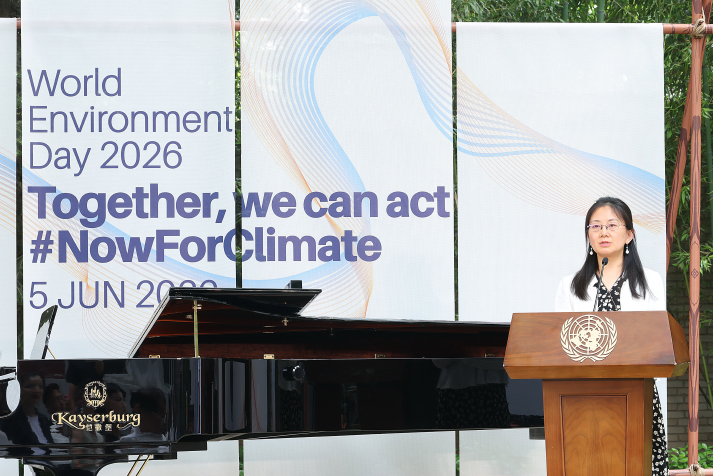 Wang Qian, programme manager for China at the United Nations Environment Programme, speaks during an event themed on World Environment Day in Beijing on June 2. World Environment Day is celebrated on June 5 every year (XINHUA)
Why reform is back on the agenda The formation of the group comes amid growing pressure on the existing global governance system. UN Secretary General António Guterres has described UN80 as a wide-ranging effort to make the organization more effective, agile and better equipped to respond to global challenges. On December 11, 2025, Fu delivered a joint statement on behalf of the group's 43 members at the UN General Assembly briefing on the UN80 reform initiative. The statement said reform is not simply about cutting budget or downsizing staff, but about enhancing the UN's capacity to respond to 21st-century challenges. It also stressed that the concerns of developing countries, which make up two thirds of UN membership, should be fully reflected, and that the reform process should be transparent, inclusive and member-state-led. As for the authority and capacity of the UN Security Council, Wang said the voices of developing countries and the vast number of small and medium-sized countries should be strengthened and the historical injustice faced by Africa should be addressed as a priority. The Security Council's rules of procedure should be improved, equal consultation should be promoted and the forced push of proposals or initiatives with obvious controversy should be avoided. Its five permanent members should strengthen communication and coordination on major proposals, seek consensus as much as possible and reduce confrontation. Unilateral actions and sanctions that bypass the Security Council should be opposed, Wang noted. Economic and financial governance is another focus. Take the International Monetary Fund (IMF) for example. Unlike international organizations operating on a "one nation, one vote" principle, the IMF employs a weighted voting system where financial contributions dictate decision-making power. Currently, this voting power remains heavily concentrated; the U.S. holds approximately 16.5 percent, a share larger than that of any other member and sufficient to veto critical decisions requiring an 85-percent supermajority. For many developing countries, these figures have become part of a broader argument that global financial institutions should better reflect changes in the world economy. New domains are also moving to the center of global governance. The UN's Global Digital Compact identifies digital cooperation and AI governance as matters for global coordination. It calls for narrowing digital divides, expanding inclusive participation in the digital economy and strengthening international AI governance. By outlining the nine directions for reforming and improving global governance, which include AI governance and rules for new domains, Wang's proposal places these emerging challenges alongside the persistent issues of peace, security, development and institutional reform. Michael Dunford, emeritus professor at the School of Global Studies at the University of Sussex, the United Kingdom, told Beijing Review that a new world order should return to some of the founding principles of the UN, including the equality of nations, global development and the elimination of poverty. He said the idea of promoting global development and eliminating global poverty reflects "core aspirations" of people across the planet. Dunford also linked this vision with China's global initiatives, including the Global Development Initiative, Global Security Initiative, Global Civilizations Initiative and GGI. He said the world should allow large and small countries alike to participate in shaping the future order. Voices from the Global South At the New York meeting, several foreign ministers and national representatives expressed support for the GGI and the Group of Friends mechanism. Pakistan attaches great importance to China's stabilizing role in international affairs and appreciates China's consistent support for the sovereignty, development and prosperity of developing countries, Pakistan's Deputy Prime Minister and Foreign Minister Ishaq Dar said. He stressed that the GGI seeks to reform and improve, rather than replace, the existing international system. It reinforces the central role of the UN while calling for greater representation and voice for the Global South in global decision-making, he added. Zimbabwean Minister of Foreign Affairs and International Trade Amon Murwira said the GGI is important because it addresses multilateral issues and ensures that multilateralism remains at the core of global governance. He pointed out that its emphasis on inclusiveness is reflected not only in financial architecture reform, but also in respect among civilizations and equal participation in dialogue. At a time when multilateralism faces challenges, he described the initiative as "highly relevant." According to Cuban Foreign Minister Bruno Rodríguez Parrilla, the meeting showed that the majority of members remain committed to multilateralism, dialogue and cooperation as the only viable path for addressing the challenges of the time. Cuba, he said, supports building a community with a shared future for humanity, a goal that requires joint action against unilateralism, coercion and war.  An electric vertical take-off-and-landing (eVTOL) aircraft on display at the exhibition area of the 2025 World AI Conference and High-Level Meeting on Global AI Governance in Shanghai on July 26, 2025. The three-day event kicked off that day (XINHUA)
The outcomes of the meeting have resonated widely with global affairs observers around the world. Danny Haiphong, a U.S. political commentator, told Beijing Review that countries in the Global South are increasingly looking for alternatives because many find the existing global financial environment unable to offer development beyond debt. He argued that this is pushing countries to work through multilateral organizations and initiatives, including BRICS and the Belt and Road Initiative, a China proposed framework to boost connectivity along and beyond the ancient Silk Road routes. BRICS is the acronym for an emerging-market cooperative mechanism that initially comprised Brazil, Russia, India, China and South Africa. Haiphong said the multipolar world has already emerged and is still developing. In his view, China's role lies partly in its capacity to provide infrastructure, investment and practical development cooperation. He said China is able to "put real muscle behind" cooperation by helping countries build bridges, stadiums, roads, railway stations and other infrastructure. China will continue to uphold the banner of multilateralism and contribute to global governance through its own governance experience, Wang said, adding China will host the Xiong'an Global Governance Forum this autumn. "All parties can come together to discuss plans for reforming and improving global governance and jointly build a community with a shared future for humanity," he stressed. (Print Edition Title: Fairer Governance, Shared Future) Copyedited by Elsbeth van Paridon Comments to liwenhan@cicgamericas.com |
|
||||||||||||||||||||||||||||||
|