
|
| Business |
| China's service economy is having its moment | |
|
|
 A technician inspects the engine of the Changying-8, China's first 7-ton-class cargo drone, ahead of a test flight at Zhengzhou Shangjie Airport in Zhengzhou, Henan Province, on March 30 (XINHUA)
At a national conference on the service sector held in Beijing on April 7-8, Premier Li Qiang called for a dual focus on expanding capacity and improving quality, while balancing development with effective regulation. The goal is a sector that is both dynamic and well-ordered. Li stressed the need to respond to the country's shifting demographic structure, evolving consumer preferences and ongoing industrial restructuring. The priority, he said, should be continuously fostering new growth drivers in the service sector and advancing its digital, intelligent, standardized, integrated and internationalized development toward a higher level. The conference was the latest in a series of high-profile signals that began at the start of the year. From the outline of the 15th Five-Year Plan, adopted in March at the Fourth Session of the National People's Congress, China's top legislature, which sets out China's development priorities for the 2026-30 period, to the government work report delivered to the same session, and through recent meetings of the State Council, the highest state administrative organ, "enhancing the capacity and quality of the service sector" has reached the top of the policy agenda. "Enhancing capacity" is about increasing the supply of high-quality services and strengthening the number and capability of market players, addressing a persistent mismatch where demand outpaces supply, Shen Danyang, head of the government work report drafting team and Director of the State Council Research Office, said at a press conference on March 5. "Improving quality" focuses on enhancing the professionalism, standardization and value added of the service sector, while avoiding low-efficiency, homogeneous competition, he added. 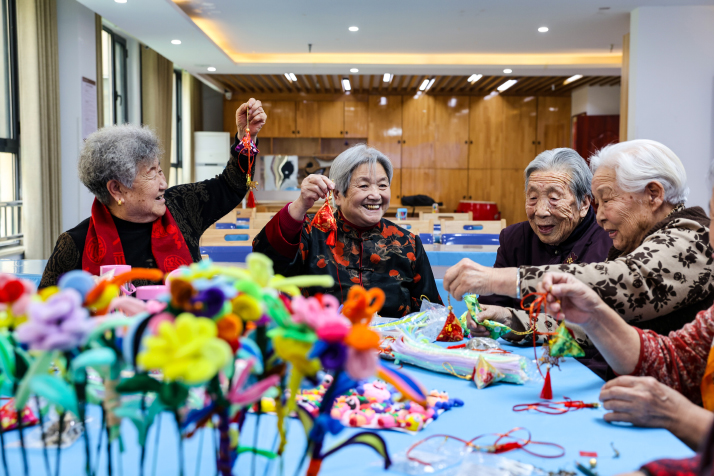 Residents at a senior care facility in Laoling, Shandong Province, make traditional fortune bags on December 19, 2025 (XINHUA)
Capacity and quality China's economic structure is in the midst of a fundamental transition, moving steadily toward a services-led model. According to the National Bureau of Statistics (NBS), the value added of the service sector exceeded 80 trillion yuan ($11.7 trillion) for the first time in 2025, growing 5.4 percent year on year and accounting for 61.4 percent of overall economic growth. It has become a main engine of the economy. Notably, services retail sales expanded 5.5 percent last year, outpacing goods retail sales by 1.7 percentage points. China's retail economy is shifting from one driven by price and physical goods to one driven by quality and services. In the first two months of 2026, boosted by an extended Spring Festival (Chinese New Year) holiday from February 15 to 23, services retail sales grew 5.6 percent, nearly double the 2.8-percent growth recorded for goods retail sales. The National Development and Reform Commission (NDRC) projected that during the 15th Five-Year Plan period, the size of China's service sector will surpass 100 trillion yuan ($14.6 trillion). The sector also plays a central role in employment. In 2025, roughly half of the workforce was employed in services, making it the primary source of job creation. Live-commerce streamers, food delivery riders, ride-hailing drivers and data analysts—occupations that barely existed 15 years ago—have become fixtures of everyday Chinese life. Structural improvement "The growing importance of services at this stage of China's development is hard to overstate," Luo Zhiheng, chief economist at Guangkai Securities, told Beijing Review. Developing the sector, he said, is both a critical pillar of industrial upgrading and manufacturing competitiveness. Producer services—supply chain management, financial services, intelligent quality inspection and modern logistics—are powering productivity gains across virtually every sector of the economy. On the consumer side, a new wave of life-enhancing services is gaining momentum including remote medical consultations, smart elderly care and on-demand home services. Former Mayor of Chongqing Municipality Huang Qifan emphasized that producer services are the soil for the development of new quality productive forces featuring new economic models, new businesses and new industries, and are the breeding ground for high-value startup companies and the growth engine of trade services. In recent years, China's producer services sector has entered a golden period of development. During the 14th Five-Year Plan (2020-25) period, its value added grew from 27.57 trillion yuan ($4 trillion) to 42.18 trillion yuan ($6 trillion), with information technology, software and financial services leading the expansion. Yet the sector remains largely underdeveloped relative to global peers. Zhang Xiaolan, Deputy Director of the Policy Simulation Laboratory within the Economic Forecasting Department of the National Information Center, told news website Yicai.com that producer services account for about 65 percent of total services output in the United States. In China, that figure stands at around 30 percent, suggesting untapped potential. The priority now, Zhang said, is to accelerate the transition of producer services from a supporting role to a central component of new quality productive forces. Currently, China's per-capita GDP has exceeded $13,000 for three consecutive years, and consumers' primary concern is rapidly shifting from "Do we have it?" to "Is it good enough?" On the other hand, consumer services have faced a persistent gap between strong demand and inadequate supply, Xing Wei, a researcher at the NDRC's Academy of Macroeconomic Research, told newspaper Economic Daily. For example, with the population aged 60 and above now surpassing 300 million, professional and affordable elderly care remains chronically scarce; and finding a skilled, reliable domestic worker is a persistent frustration for urban families across the country. Xing called for reforms to improve service accessibility, expand the provision of elderly and child care, raise professional standards and foster innovation in cultural tourism. 'China Services' Beyond its domestic role, the services sector is also a vehicle for expanding China's international economic footprint and strengthening its resilience, Luo said. In 2025, China's total trade in services crossed 8 trillion yuan ($1.2 trillion) for the first time, growing 7.4 percent year on year. Services exports alone reached 3.63 trillion yuan ($531.5 billion), up 14.2 percent. Even though "Made in China" has become a globally recognized brand after years of effort, "China Services" has still not gained widespread recognition, Lu Dongxiang, Executive Director of the Coastal Development Think Tank, told Economic Daily. This year's government work report called for the cultivation of more "China Services" brands. Building that recognition, Lu said, will require sustained progress on digital integration, quality standardization and deeper engagement with international partners. Lu said as all remaining foreign investment restrictions in manufacturing have been lifted, China's broader push for openness is extending into services. The Chinese Government has designated services as the new frontier of market access reform—with expanded pilot programs for value-added telecom services, biotechnology, wholly foreign-owned hospitals and other fields, alongside well-ordered steps to expand opening up in the digital sector, and further reductions of restrictions for cross-border trade in services. Looking further ahead, Lu suggested that China should move deliberately to become more internationally open in the fields of telecom, Internet, education and healthcare services in a well-sequenced manner. The ultimate goal is a service sector that aligns with international standards and excels in technology, business models and quality benchmarks. (Print Edition: Serve the People 2.0) Copyedited by G.P. Wilson Comments to zhangshsh@cicgamericas.com |
|
||||||||||||||||||||||||||||||
|