
|
| Business |
| China's economy starts 2026 and the new Five-Year Plan on solid footing | |
| Beyond the headline figures, these numbers serve as a barometer of the economy's evolving trajectory | |
|
|
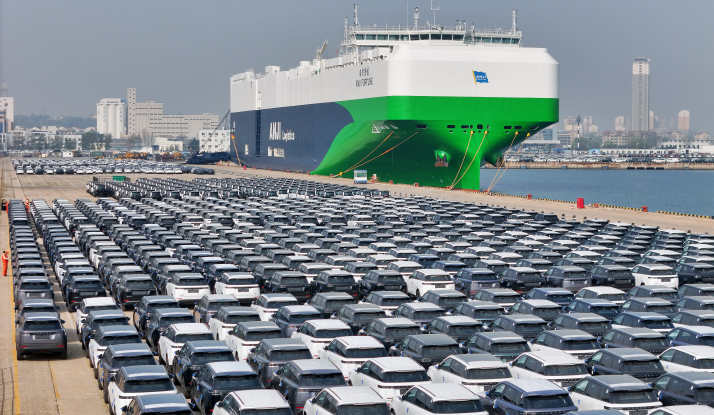 Vehicles wait to be loaded for export at Yantai Port in Shandong Province on April 14 (XINHUA)
As "becoming Chinese" trends across overseas social media, a growing number of users around the world are experimenting with distinctly Chinese ways of living—drinking hot water, stepping into cotton slippers, and practicing baduanjin qigong exercises to improve overall health and energy. What began as a cloud-driven cultural curiosity is translating into real consumption demand for Chinese products. Tea culture offers a clear example. In the first quarter (Q1) of 2026, exports of thermos flasks and tea reached 5 billion yuan ($733 million) and 2.7 billion yuan ($396 million), respectively. Related items such as goji berries also posted exports of around 200 million yuan ($29.3 million), all registering year-on-year growth. These everyday goods, rich with the texture of Chinese daily life, now reach more than 200 countries and regions worldwide. At the same time, increasing numbers of overseas visitors are traveling to China, seeking a more immersive and tangible experience. In recent months, a series of measures to expand opening up have further strengthened China's global connectivity. These include extending the country's visa-free policy, previously covering 48 countries, to ordinary passport holders from Canada and the United Kingdom in February, an expanded scope for 24-hour direct transit without inspection procedures, and the addition of more eligible ports of entry under the 240-hour visa-free transit policy. Data from the National Immigration Administration showed that in Q1, visa-free entries reached 8.315 million, accounting for 77.9 percent of all inbound foreign travelers, up 29.3 percent year on year. From riding high-speed rail to wearing hanfu, traditional Chinese attire, and enjoying hot pot, these encounters are reshaping how international visitors engage with Chinese culture. Their shopping baskets are expanding as well—from smartphones and virtual reality headsets to cultural and creative products and trendy collectibles. The surge in inbound tourism is quickly energizing China's consumption landscape. In Q1, Chinese customs processed more than 230,000 departure tax refund claims, a more than fivefold increase year on year—an indicator of the rapid release of spending potential among international visitors. The National Bureau of Statistics (NBS) released China's Q1 economic data at a press conference on April 16. Beyond the headline figures, these numbers serve as a barometer of the economy's evolving trajectory. According to the NBS, China's GDP reached 33.42 trillion yuan ($4.9 trillion) in Q1, expanding 5 percent year on year, 0.5 percentage points faster than in the fourth quarter of 2025. NBS Deputy Commissioner Mao Shengyong said at the press conference that major macroeconomic indicators showed an uptick, with new growth drivers gaining momentum and the economy getting off to a solid start. At the same time, he said the external environment has become more complex and volatile, while structural imbalances at home—particularly strong supply but relatively weak demand—remain evident, underscoring the need to further consolidate the foundation of economic recovery. Domestic demand "Friends from afar, welcome to the home of Pu'er tea…" The melody greets travelers the moment they arrive at the railway station in Pu'er, a mountainous city in Yunnan Province—a live performance offered as a warm first welcome. Later, strolling along Simao Old Street, visitors are met by a performer dressed as a historical figure, blending local folk songs with popular hits in a crossover performance that has quickly gone viral. Pu'er has emerged as one of the breakout cultural tourism destinations this year. During the Spring Festival (Chinese New Year) holiday on February 15-23, the city received 4 million visitors, up 25.04 percent year on year, generating 3.49 billion yuan ($512 million) in tourism revenue, a 34-percent increase year on year. Momentum carried into the Qingming Festival holiday on April 4-6, with travel service bookings on leading online travel platform Fliggy more than doubling compared with the same period last year. Qingming Festival, or Tomb-Sweeping Day, which fell on April 5 this year, is a traditional Chinese festival during which people visit burial places and pay tribute to their ancestors. It also provides a short break for people looking to engage in outdoor activities and sightseeing. Pu'er's rise as a trending destination is just one snapshot of China's broader consumption boom. According to the NBS, total retail sales of consumer goods reached 12.77 trillion yuan ($1.87 trillion) in Q1, up 2.4 percent year on year, 0.7 percentage points faster than in the last quarter of 2025. By category, retail sales of goods increased 2.2 percent, while services consumption continued to pick up pace, with retail sales of services rising 5.5 percent. The data point to a broad-based recovery in the services sector as a key highlight of Q1 consumption, Zong Liang, a senior research fellow with World Finance Forum, said at the Guoshi Forum hosted by China News Service on April 16. Sectors such as hospitality, food and beverages, culture and sport all posted strong growth, he said. He pointed out that the consumer goods trade-in program, first introduced in 2024, has also delivered tangible results in boosting consumption. The program encourages consumers to replace outdated products, including home appliances and vehicles, through government subsidies. According to the National Development and Reform Commission (NDRC), since the start of the year, the consumer goods trade-in program has generated sales exceeding 433 billion yuan ($63.5 billion), benefiting more than 60.93 million people. To sustain this momentum, the NDRC, together with the Ministry of Finance, has recently allocated a second batch of 62.5 billion yuan ($9.16 billion) in ultra-long special treasury bond funds to local governments, supporting the program's continued, steady implementation. On the investment front, China's fixed assets investment reached 10.27 trillion yuan ($1.5 trillion) in Q1, up 1.7 percent year on year, reversing the 3.8-percent decline recorded for the whole of last year. "The return to positive growth is an encouraging sign," Guo Liyan, Deputy Director of the Economic Research Institute at the NDRC, said at the forum. It reflects the timely launch and steady implementation of several major projects at the start of the 15th Five-Year Plan (2026-30) period. Driven by these large-scale projects, infrastructure investment grew by 8.9 percent in Q1, she said. At the same time, investment in hi-tech industries rose 7.4 percent in the first three months of this year, pointing to solid momentum in new growth drivers, she added. Emerging sectors, such as commercial space and information services, are maintaining double-digit growth, underscoring the strengthening role of innovation-led investment in the broader economy.  A visitor tries on AI glasses at the Sixth China International Consumer Products Expo in Haikou, Hainan Province, on April 13 (XINHUA)
Foreign trade In Hengcun Town in Hangzhou, Zhejiang Province—known as "China's knitting hub"—rows of computerized flat knitting machines hum at full capacity inside the workshop of Hangzhou Yukai Garment Co. Ltd. Seventy-two machines run simultaneously, as workers rush to complete a batch of export orders bound for Germany. "We've received about $7.5 million in foreign orders since the start of the year, mainly from Germany and the UK," Li Qiang, the company's deputy general manager, told Xinhua News Agency. "Given the current momentum, we expect our foreign trade to reach 15-20 million yuan ($2.2-2.93 million) this year. It's shaping up to be a strong year." Stories like this are echoed in the broader trade data. According to the General Administration of Customs of China (GACC), China's total trade in goods reached 11.84 trillion yuan ($1.74 trillion) in Q1, up 15 percent year on year—setting a record for the same period and marking the fastest quarterly growth in five years. Imports reached a record high for the same period, rising 19.6 percent year on year—7.7 percentage points faster than export growth. GACC deputy head Wang Jun said at a press conference on April 15 that China is not only willing to serve as the "world's factory," but also as the "world's market." China's commitment to opening up continues to deepen. Since December 1, 2024, the country has granted zero-tariff treatment for 100-percent tariff lines to the world's least developed countries with which it maintains diplomatic relations. Starting May 1, zero-tariff treatment will be implemented for the 53 African countries China has diplomatic relations with, further enabling their high-quality products to access the Chinese market. In Q1, imports from more than 150 countries and regions increased, with 51 trading partners each exporting over 10 billion yuan ($1.47 billion) worth of goods to China—three more than a year earlier. Particularly, this year's extended Spring Festival holiday contributed to a rebound in consumer goods imports, which rose by 5.4 percent. Exports remained resilient as well. In Q1, outbound shipments totaled 6.85 trillion yuan ($1 trillion), up 11.9 percent, maintaining double-digit growth. This performance reflects a combination of recovering external demand, a well-integrated domestic industrial system and rising innovation among Chinese firms, Wang said. He said the rapid global expansion of AI and green, low-carbon industries is fueling demand for smart and sustainable products. In Q1, exports of 3D printers and digital cameras, for instance, surged 119 percent and 32.7 percent; exports of electric vehicles, lithium-ion batteries and wind turbine equipment rose by 77.5 percent, 50.4 percent and 45.2 percent, respectively. Chinese companies are also expanding their overseas infrastructure efforts. In sub-Saharan Africa, microgrid projects built by Chinese firms are improving access to stable electricity. Exports of photovoltaic products to the region jumped 2.5 times, while shipments of inverters, wires and cables rose 56.1 percent. Wu Ge, chief economist at brokerage firm Changjiang Securities, said at the forum that the resilience of external demand in Q1 is largely underpinned by China's comprehensive industrial system and strong supply capacity. At the same time, geopolitical tensions and intensifying competition in areas such as AI have driven demand for manufacturing and high-end production. Coupled with China's advantages in both quality and cost, these factors have further strengthened the country's competitiveness in global markets, Wu said. The strong growth in Q1 trade has laid a solid foundation for stable performance throughout the year. At the same time, external uncertainties remain. Geopolitical tensions continue to weigh on global supply chains, and risks are still evolving, Wang warned. A solid start Wu said market expectations ahead of the data release had generally placed China's Q1 GDP growth in the range of 4.5-5 percent. The actual figure, 5 percent, came in at the upper end of that range. From a global perspective, a 5-percent expansion places China among the leading contributors to global economic growth, underscoring both its resilience and its continued importance to the world economy, Zong added. Looking ahead, Wu said external uncertainties are likely to persist. Ongoing tensions and broader geopolitical frictions may continue to weigh on the global economy, with the most pronounced impact expected to occur around the second quarter. While energy prices, particularly oil, could ease from their peaks over time, they are unlikely to return quickly to the levels of before the beginning of U.S.-Israel strikes on Iran on February 28, suggesting that global cost pressures may linger. That said, these shocks are not expected to escalate indefinitely, pointing instead to a period of adjustment rather than a sustained deterioration, according to Wu. Wu added that, domestically, the strong Q1 start provides a solid foundation, but sustaining this momentum will require consistent policy support. Measures to boost consumption, improve livelihoods and strengthen the services sector will be key to reinforcing domestic demand. At the same time, risks, especially in the real estate sector and related financial areas, remain a concern and will need close attention. Continued reform efforts, combined with targeted risk prevention, will be essential to maintaining stable growth and ensuring that the early-year recovery translates into longer-term economic resilience, he said. BR (Print Edition: Telling Figures) Copyedited by G.P. Wilson Comments to zhangshsh@cicgamericas.com China's Q1 Trade Growth With Major Partners (y.o.y.) European Union: up 14.6% United Kingdom: up 13.1% ASEAN: up 15.4% Latin America: up 15.4% Africa: up 23.7% Belt and Road Partners: 6.06 trillion yuan ($968 billion), up 14.2% Share of total trade: 51.2% (Source: General Administration of Customs of China) |
|
||||||||||||||||||||||||||||||
|