|
| Business |
| CIFIT returns with expanded scale, AI-driven business matchmaking and global outreach | |
|
|
|
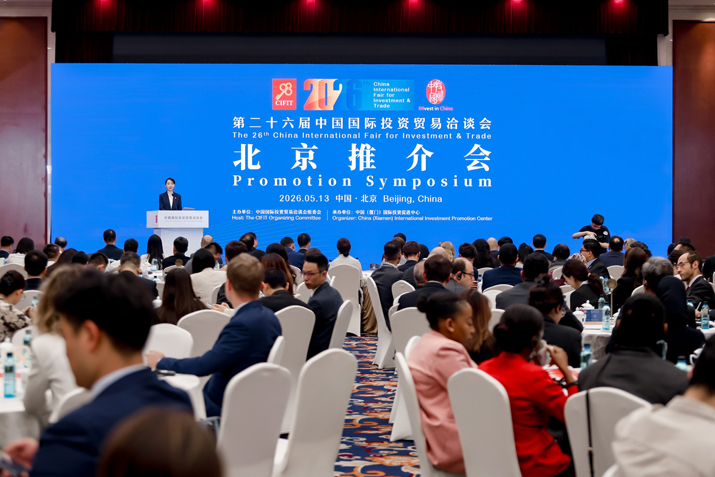
Yang Hao, an official at the Ministry of Commerce's Department of Outward Investment and Economic Cooperation, speaks at the 26th China International Fair for Investment and Trade Promotion Symposium in Beijing on May 13 (COURTESY PHOTO) Xiamen, a coastal city once named Amoy by Portuguese traders and where a pioneering special economic zone was established in 1980, is writing yet another chapter in China's opening-up story. This September, the city will once again host the country's flagship investment event, with record-breaking scale and AI-powered business matchmaking. The 26th China International Fair for Investment and Trade (CIFIT) will take place from September 8 to 11 in Xiamen, organizers announced at a symposium promoting the fair, in Beijing on May 13. "This year's CIFIT, to debut at the Xiamen International Expo Center, will cover a total exhibition area of about 200,000 square meters, a record high," Chen Min, an official at the Xiamen Municipal Bureau of Commerce, said at the symposium. "With a leap in both stature and space, the fair is advancing toward a more sophisticated platform for cross-border investment," Chen added. The Beijing promotional event, the first in a series of national and international promotions ahead of the fair, drew over 260 representatives from nearly 40 countries, including representatives of embassies, international organizations, Fortune 500 companies and financial institutions. Invest in China CIFIT, the only national-level investment-themed expo in China, is a flagship "invest in China" platform and one of the world's most influential platforms for international investment. Under the theme "Expand Two-Way Investment, Promote Global Development," this year's event will continue to showcase China's determination to double down on high-level opening up. Wu Di, Deputy Director General of the Department of Foreign Investment Administration at the Ministry of Commerce (MOFCOM), said China attracted over $750 billion dollars of foreign investment during the 14th Five-Year Plan period (2021-25), with the high-tech sector accounting for more than 30 percent. "We are reducing barriers to market access and increasing policy support," Wu said. He noted that the negative list for foreign investment has been shortened twice in recent years, restrictions on manufacturing have been fully lifted, and pilot openings in telecommunications, healthcare and other sectors are advancing. "We have resolved over 2,300 difficulties reported by foreign-funded companies through roundtables and special task forces," Wu added. Two-way investment, global benefits Yang Hao, an official at MOFCOM's Department of Outward Investment and Economic Cooperation, highlighted China's role as a responsible outward investor. In 2025, China's outbound direct investment (ODI) reached $174.38 billion, up 9.7 percent year on year. "China's ODI stock has exceeded $3 trillion, spanning 190 countries and regions," Yang said. "Since 2013, Chinese enterprises have paid over a cumulative total of $550 billion in taxes in their host countries, and created more than 2 million local jobs annually on average." "China's investments bring not only capital, but also technology and management expertise, helping host countries improve industrial capacity and social development," she said. Global investment Yu Guangsheng, Deputy Director General of MOFCOM's Investment Promotion Agency, said CIFIT 2026 will feature three main modules: "Invest in China," which invites global capital to invest in China, "China Investment," which encourages Chinese investors to invest in other countries, and "International Investment," highlighting the facilitation of capital flow global wide. "We will use AI-powered technologies to enhance investment matchmaking and launch an upgraded smart CIFIT service system to improve efficiency and experience for all participants," Yu said. He added that the "China Investment" section will focus on overseas services, global supply chains, and legal and technological infrastructure to support Chinese companies going global, reflecting MOFCOM's newly issued guidelines on improving overseas public service systems, the first of its kind in China. Finland, this year's guest country of honor, and Guangdong, the guest province of honor, showcased their synergies at the Beijing event. "Finland's participation will focus on circular economy, energy transition, clean technologies, digital solutions and advanced manufacturing, and health and wellness," Melissa Säilä, Minister Counselor and head of the Economic and Trade Section of the Embassy of Finland in China, said at the event. "A comprehensive series of business-matching events will connect enterprises, trade partners, investors and institutions from both countries." Säilä noted that about 250 Finnish companies operate in China, with an annual turnover of 15 billion euros ($17.5 billion). "Finland is widely recognized for its stability, transparency and efficiency—and yes, we have been named the happiest country in the world for several years. That happiness is built on trust, equality, freedom and functioning society." Liu Dezeng, Deputy Director of the Guangdong Board of Investment Promotion, said the province's GDP reached 14.58 trillion yuan ($2.02 trillion) in 2025, ranking first in China for 37 consecutive years and accounting for about one 10th of the national total. "Guangdong is home to the world's most complete industrial ecosystem," Liu said. "It produces 70 percent of the world's consumer drones, 40 percent of smartphones, and 30 percent of China's industrial robots. With 790,000 added to its population in 2025 alone, Guangdong remains the top choice for talent and businesses." Upgrading platforms As host city, Xiamen is deepening the integration of its roles as multiple national platforms, including the Pilot Free Trade Zone, BRICS Innovation Base, and a platform to pilot reforms for high-level opening up of the service sector. Chen noted that China has formally applied to host the secretariat of the Agreement on Marine Biodiversity of Areas Beyond National Jurisdiction in Xiamen. "Xiamen’s port connectivity ranks 11th in China, and the new Xiamen Xiang'an International Airport will begin operations in this December, with an annual capacity of 45 million passengers," Chen said. "We are fostering new quality productive forces, laying out six future industries, including AI, biomedicine and hydrogen energy," Chen added. "This is a platform where visions turn into cooperation, and consensus into results," Wu said. "We invite global investors to gather in Xiamen in September to explore cooperation, share development dividends, and create a win-win future together." Copyedited by G.P. Wilson Comments to zhangyage@cicgamericas.com |
|
||||||||||||||||||||||||||||||
|