|
| Business |
| More than a market | |
|
|
|
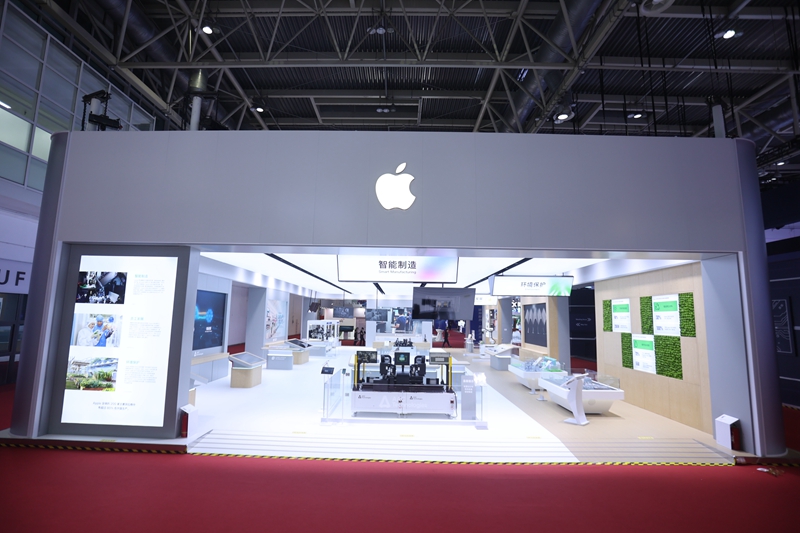
The booth of U.S. tech brand Apple and its three Chinese suppliers at the Fourth China International Supply Chain Expo (CISCE) in Beijing on June 22 (COURTESY PHOTO) As global supply chains undergo profound restructuring amid geopolitical tensions and technological shifts, China, with its growing manufacturing strengths and increasing capacity for innovation, is steadily emerging as a major engine of transformation. A direct testament to this trend came at this year's China International Supply Chain Expo (CISCE), where hundreds of multinational firms made one message clear: China’s industrial ecosystem is increasingly powering global innovation. Held in Beijing on June 22-26, the fourth edition of CISCE brought together more than 670 exhibitors from 85 countries, regions and international organizations, and featured a dedicated AI exhibition area for the first time. Apple Inc., which has participated in all four editions of CISCE, this year brought along three of its Chinese suppliers, demonstrating micro-precision assembly, AI-powered visual inspection and fully automated production lines. More than 80 percent of Apple’s 200 primary global suppliers are now based in China. Sabih Khan, the company’s Chief Operating Officer, described its cooperation with these Chinese partners as mutually empowering. “Our collaboration has gone beyond 1+1>2,” Khan told media at the expo. “It has become 1+1>3, 4, or even 5.” At the opening ceremony, Chinese Vice Premier Ding Xuexiang said China is maximizing the potential of its complete industrial system and vast market to facilitate steady global economic operations, and China’s actions have provided solid support for the stability and smooth functioning of global industrial and supply chains.
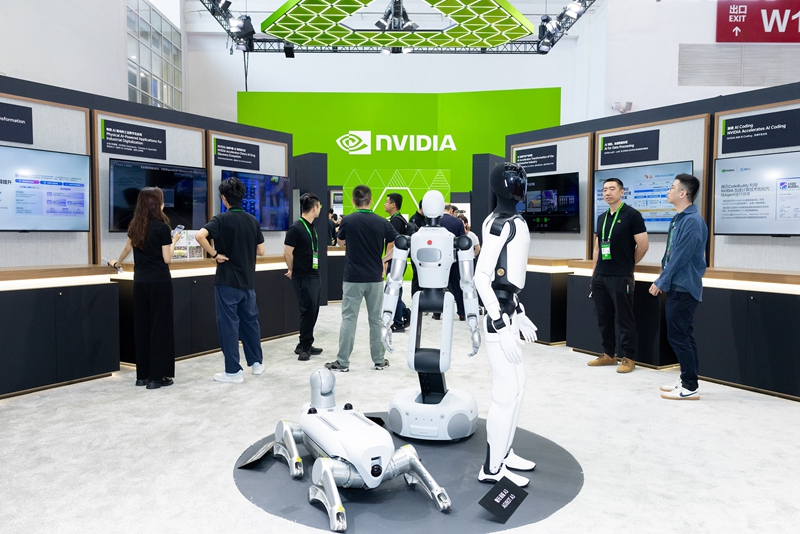
Robots equipped with NIvidia chips showcased at the Fourth CISCE on June 22 (COURTESY PHOTO) Innovative ecosystems For multinational companies operating in China, the country is not just a market--it is an integral part of their innovation ecosystem. Collaboration between domestic and international companies is booming. “China is one of the world’s great centers of technology and industry. The engineers are excellent. Developers move fast, and companies build at remarkable scale,” U.S. chip maker Nvidia’s CEO Jensen Huang said in a speech via video at the expo’s opening ceremony. Nvidia showcased its full five-layer AI stack at the expo, including applications, models, infrastructure, chips and energy. According to Huang, more than 1.6 million developers in China build on Nvidia. Together, they are creating useful AI for manufacturing, logistics, robotics, energy, healthcare and science. Nvidia is accelerating the development of the computing platform and helping developers and industries create useful AI. With a network of more than 15,000 partners in China, U.S. chip giant Intel is also riding the AI tide here by bringing next-generation technologies to life, ranging from AI agents to smart cockpits and home systems. Sarah Kemp, Vice President of Intel, said at the expo that there is a lot of dynamism and a lot of innovation happening in China. “We are seeing a growing number of U.S. companies expand AI-driven investment strategies in China. This reflects not only the broader shift toward AI adoption, but also the increasing importance of the Chinese market,” she said. U.S. electric vehicle maker Tesla presented its growing footprint in China. Over 95 percent of the company’s parts produced in China are manufactured in its Shanghai Gigafactory, and it has signed contracts with over 400 local suppliers in the country, more than 60 of which have been integrated into its worldwide supply chain. Tesla’s Shanghai Gigafactory has now produced its 4 millionth vehicle, with one car rolling off the line approximately every 30 seconds. Over the past year, the facility contributed more than half of Tesla’s global deliveries, according to the company. Tesla’s presence in China has expanded beyond electric vehicles into energy products with the launch of its energy storage Megafactory in Shanghai. The facility, which began production in February 2025, is the first of its kind Tesla has built outside the United States.
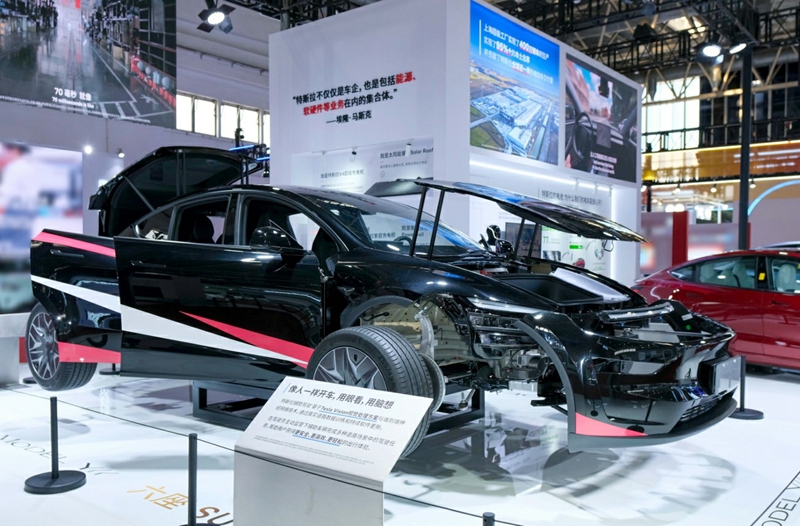
A vehicle displayed at the booth of U.S. electric vehicle maker Tesla at the Fourth CISCE on June 22 (COURTESY PHOTO) Presence in China With over 1,600 suppliers and a local procurement rate above 90 percent, China has become one of French industrial giant Schneider Electric’s key global supply chain and research and development (R&D) hubs. The company operates five R&D centers, an AI innovation lab and 30 factories and logistics centers in the country. At the expo, Schneider Electric highlighted its end-to-end capabilities across sourcing, smart manufacturing and operations. By leveraging AI, the company, after 39 years in China, is working with local partners to build a more resilient, low-carbon supply chain. By integrating AI and 5G technologies into its production line, one of its factories in Shanghai has achieved an 82-percent increase in per-capita productivity and a 67-percent reduction in order-to-delivery time. "Over the past three to five years, China has become a highly stable base for global suppliers in terms of competitiveness, resilience and the overall strength of its ecosystem," Zhang Kaipeng, Senior Vice President of the company, told Beijing Review. According to Zhang, China has evolved into a key innovation center. Since Chinese consumers eagerly embrace new products and technologies, many companies are pioneering the launch and testing of advanced technologies and AI application scenarios in the market. Schneider Electric is doubling down on China this year, with its industrial park in Xiamen, a coastal city in the southeastern province of Fujian Province, slated to begin production within the next 6 months. The facility will be the company’s largest medium-voltage manufacturing base globally. French cosmetics giant L'Oréal presented AI-driven supply chain technologies at the expo. Its booth featured end-to-end smart solutions spanning manufacturing, packaging design, and logistics, all powered by AI. This year is also the 30th anniversary of the launch of L’Oréal’s Suzhou Plant in Suzhou, Jiangsu Province, the group’s first and largest manufacturing facility worldwide. “We have built a more agile, safer and greener end-to-end smart supply chain, demonstrating our strong confidence in China’s innovation ecosystem,” Marc-Antoine Poullé, Senior Vice President of Operations for L’Oréal North Asia and China, said at the inauguration of the company’s booth at the expo. L’Oréal is positioning China not just as a consumer market, but as a global engine for beauty innovation and smart production, Lan Zhenzhen, President of Public Affairs for L’Oréal North Asia and China, said at the ceremony. This year was McDonald’s China’s third at the expo, participating together with its supply chain partners. According to Gu Lei, Chief Impact Officer of McDonald’s China, the expo has provided a platform for the brand to expand its partnerships in sustainable agriculture and global procurement, turning intra-chain collaboration into cross-chain cooperation. More than 90 percent of the ingredients it uses in China are produced, processed and procured domestically, the company said. Multinational agricultural trader and processor Louis Dreyfus Co (LDC) attended the expo for the second time. Leveraging AI traceability and regenerative farming techniques, LDC is embedding sustainability into its agri-food operations. The company launched its first office in Shanghai in 1994. In 2005, LDC Beijing was incorporated as one of the first wholly-owned foreign trading enterprises in China. The company established its regional headquarters in Shanghai in 2021 and a global R&D center in the city two years later. At the Seventh Qingdao Multinationals Summit in Qingdao, Shandong Province, held in early June, Maurice Kreft, Chief Financial Officer Netherlands at the company, told Beijing Review that the global agri-food sector is undergoing a profound transformation. In this context, collaborative innovation across technologies, processes and product development is increasingly a lever for long-term resilience and growth. To achieve this, like-minded partnerships are essential for LDC to forge alignment between its long-term strategy and its Chinese partners on high-quality development of the agri-food industry, Kreft said.
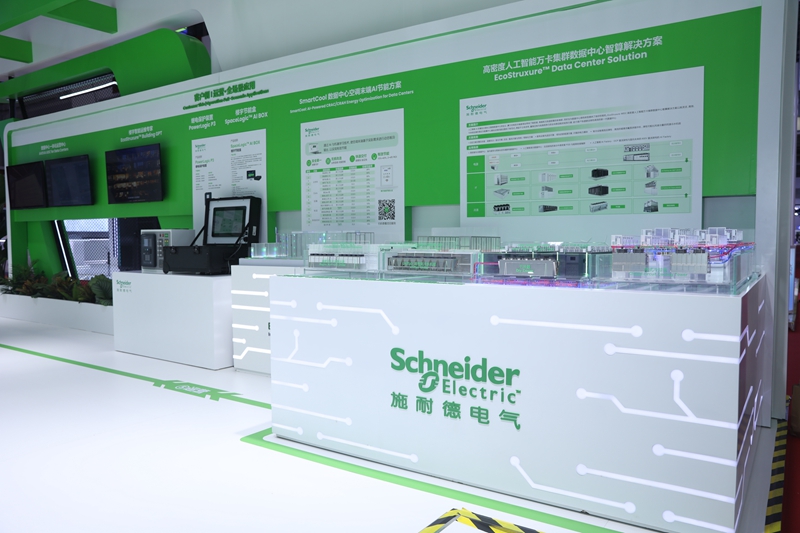
Green solutions showcased by French industrial giant Schneider Electric at the Fourth CISCE on June 22 (COURTESY PHOTO) Moving toward higher ends Chinese enterprises are increasingly becoming indispensable elements of the global supply chain. At the expo, Sunny Optical Technology, a local partner of Apple, presented its defect-detection machinery for camera lenses. Having collaborated with the U.S. tech brand since 2019, the company now achieves an inspection throughput of 1,500 units per hour, a substantial improvement over the average 4-second duration required for manual checks. In parallel, Lens Technology, a supplier to both Apple and various domestic Chinese smartphone brands, displayed its cover glass for mobile screens. With a thickness of just 0.03 mm, equivalent to just one third of the diameter of a human hair, the glass can endure up to 1 million folding cycles. This material will be incorporated into the new foldable iPhone, which is slated for introduction in the latter half of this year, according to the company. Many participants highlighted their confidence in China’s supply chain advantages. Steven Ducat, a representative of Australia’s photovoltaics industry, said in an interview with Chinese state broadcaster China Central Television that product modeling can take as little as week in China, while it can take almost a year elsewhere. Newegg, a U.S.-based e-commerce platform, has been exporting Chinese electronic products, including drones and AI glasses, to global markets. Lu Na, General Manager of China Application Software Division of Newegg, told Beijing Review that the company has developed a generative AI engine powering everything from content creation to marketing strategy for Chinese sellers, and facilitating direct factory-to-seller matching with its SellingPilot V2.0 platform. According to Lu, sales of Chinese-made hi-tech products on the platform have seen sustained growth over the years, unaffected by external factors. The supply chain for technology-driven products in China is unmatched, which offers speed and quality that cannot be easily replicated. “China has shifted from price competition to quality competition. It remains the top choice for global buyers,” she said, adding that the journey from quality to brand competition still lies ahead.
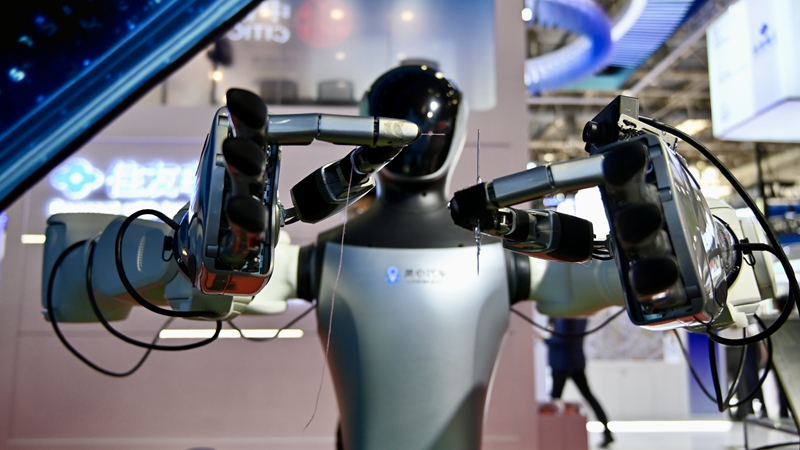
A robot demonstrates threading a needle at the exhibition area of advanced manufacturing at the Fourth CISCE on June 23 (XINHUA) Copyedited by G.P. Wilson Comments to lixiaoyang@cicgamericas.com |
|
||||||||||||||||||||||||||||||
|