
|
| Business |
| Patient capital pays off | |
|
|
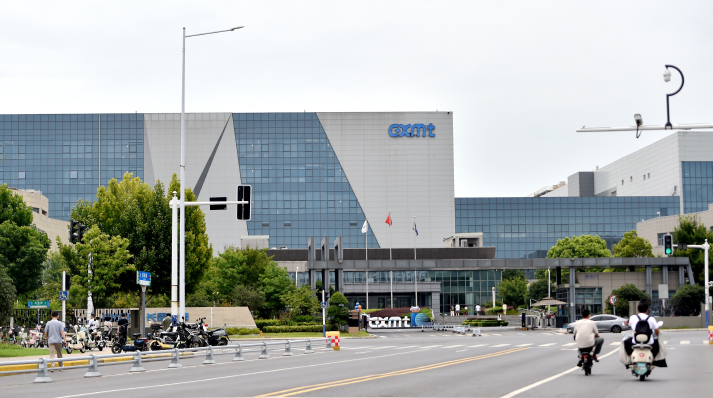 Changxin Memory Technologies’ facility in Hefei, Anhui Province, on July 27 (XINHUA)
On July 27, a new number flashed across trading screens: 8.66 yuan ($1.2), the offer price for shares of memory-chip maker ChangXin Memory Technologies (CXMT). By the end of its first day on China's sci-tech innovation board, the STAR Market, the company had grabbed the attention of financial media by making the largest IPO in the history of the exchange, with its share price surging more than 465 percent. The surge brought its market value to more than 3 trillion yuan ($443 billion), making it the most valuable company on the A-share market on its first trading day. The significance of this event transcends the sheer volume of capital. It is the culmination of a decade-long odyssey to breach one of the semiconductor industry's impregnable fortresses, driven by founders and investors who refused to be deterred by staggering losses, technological blockades and immense global competition. The listing was less a finishing line than a change of stage: The company, nurtured by both private and public capital, will now face more exacting scrutiny from investors, customers and global competitors. Born with a mission CXMT's story begins in 2016 in Hefei, Anhui Province, with a vision to create China's first homegrown dynamic random-access memory (DRAM, or your electronic device's short-term memory) manufacturer. Back then, the DRAM arena was dominated by the "Big Three"—Samsung and SK Hynix of the Republic of Korea plus American Micron, which held a lion's share of the global market. At the heart of the CXMT venture is founder Zhu Yiming, a Tsinghua-educated engineer who had already proven his mettle by establishing GigaDevice, a successful designer of NOR Flash memory (retaining data even when power is turned off), in 2005. The DRAM industry is a capital-intensive, technology-heavy market with a history of brutal boom-and-bust cycles that had bankrupted all but the most resilient players. Even the initial challenges were immense. In 2018, Zhu made a pivotal decision: He resigned as CEO of GigaDevice to focus full-time on CXMT, vowing to forgo his salary until the company turned a profit—a promise he kept for seven years. The necessary technological breakthroughs came through a unique strategy. In 2019, CXMT acquired a treasure trove of DRAM patents and technical documents from defunct German chipmaker Qimonda, which had collapsed during the 2008-09 financial crisis. This provided a legal and technological foundation, allowing CXMT to introduce its first 8Gb DDR4 product, a product that went mainstream in the global DRAM industry, in 2019, achieving a breakthrough in memory chip mass production in China. A test of resolve The journey from that first chip to profitability was arduous and financially draining. The unforgiving DRAM market demands continuous, multi-billion-dollar investment in research and development, as well as in manufacturing facilities, while new entrants grapple with low yields and depreciation costs. According to CXMT, DRAM prices fell roughly 50 percent from their peak in the first half of 2022 to a trough in the first half of 2023, and the company lost 16.34 billion yuan ($2.4 billion) in 2023 and 7.14 billion yuan ($1.1 billion) in 2024. This was the period that truly tested investor patience. The primary pillar of support was Hefei's state-owned enterprises. Initially, Hefei Industry Investment Holding Group shouldered a majority of the project's first-phase costs. Unlike venture capitalists seeking a quick exit, the Hefei Municipal Government, which guides and overseas the operations of the city's state-owned enterprises, went in with a decade-long strategic vision. By the time of the IPO, the city's state-owned entities held a combined stake of over 35 percent in CXMT, with analysts estimating a floating profit of over 1 trillion yuan ($148.1 billion) on the listing day. This long-term commitment is a textbook example of how local governments can act as catalysts for hi-tech, high-risk industrial ventures. But as Yuan Shuai, Deputy Director of the Investment Department at the China City Development Academy, told Beijing Review, Hefei's most consequential decision was not entering early, but refusing to retreat when uncertainty was greatest. "Hefei did not treat the project as an ordinary investment from which it could cash out at any time," he said. By staying through the industry's low point, he added, the city gave the company room to keep its technology route and production improvements on schedule. Patient and strategic investors CXMT's resilience was not solely the result of city government efforts. It attracted a diverse coalition of "patient capital" with a long-term vision. The National Integrated Circuit Industry Investment Fund Phase II Co. Ltd. became the third largest shareholder, holding 8.73 percent. China's five major state-owned banks also came on board during a crucial funding round in 2024, when the company was still in the red, providing a critical financial bridge to profitability. Domestic technology and industrial giants also saw the strategic opportunity. Alibaba, Tencent, Xiaomi and Midea all took stakes, building a powerful ecosystem that links CXMT's production capabilities with their massive downstream demand for cloud computing, AI and consumer electronics. GigaDevice, founded by Zhu, also held a significant stake and maintained a deep business relationship with CXMT. For these investors, it was never just a financial bet; it was a strategic move to secure a critical component of the digital supply chain. This approach, using state-owned platforms and market-oriented industrial funds to tie investment to both a company's establishment as well as a local industrial chain, is what Bai Wenxi, Vice Chairman of the China Enterprise Capital Alliance, defined to Beijing Review as the "Hefei Model." Its core principle, he noted, is to "bring in industry through investment while being a shareholder, not the boss." This distinguishes the model from more familiar policy tools. A conventional government-guided fund may prioritize financial return and a relatively quick exit. Hefei instead seeks a longer-term combined return from equity appreciation, industrial clustering, jobs and tax revenue. The city is therefore investing in connections as well as in a company. A DRAM plant needs equipment, electronic materials, industrial gases and specialized personnel. An anchor manufacturer creates steady demand against which suppliers can justify establishing their own facilities. As a result, Hefei's integrated-circuit industry grew from fewer than 40 companies in 2016 to more than 500 in 2026, forming a chain that spans design, manufacturing, packaging and materials. Arriving at the right moment Stakeholder patience is yielding spectacular returns. In a pivotal turn of fortune, the AI revolution ignited huge demand for memory chips. Demand for high-performance DRAM for AI servers has sent prices soaring, transforming CXMT's prospects. In the first quarter of 2026, the company reported a staggering 50.8 billion yuan ($7 billion) in revenue, a 719-percent year-on-year increase, with net profits of 33 billion yuan ($4.55 billion). This single quarter's profit has offset years of accumulated losses, pushing the company into a position of formidable financial strength. The company's global market share surged from 4 percent to about 8 percent in early 2026, making it the world's fourth largest DRAM maker. With the IPO now completed, CXMT is poised to enter its next phase. The proceeds will be used for technological upgrades, expanding production lines and developing next-generation DRAM technologies for the AI era. The founder and long-term investors have locked in their commitment for years to come. Zhu has pledged not to sell any of his shares for a decade, and has even committed half of his personal shareholding to a massive employee incentive plan to be executed over 10 years. This sends a powerful signal that the leaders of this company remain focused on long-term value creation. However, discipline is what allows patience to create value, as Guo Tao, an angel investor and senior AI expert, told Beijing Review. He argued that a patient investment should have strategic value, a validated technology route, a professional management team and mechanisms for post-investment monitoring and correction. For CXMT, the IPO proceeds are earmarked for technology upgrades and forward-looking DRAM research, while its disclosures also warn of high depreciation, inventory write-downs, trade frictions and global capacity expansion. Copyedited by G.P. Wilson Comments to zhangshsh@cicgamericas.com |
|
||||||||||||||||||||||||||||||
|