 |
|
|
| Cooperation Within BRICS |
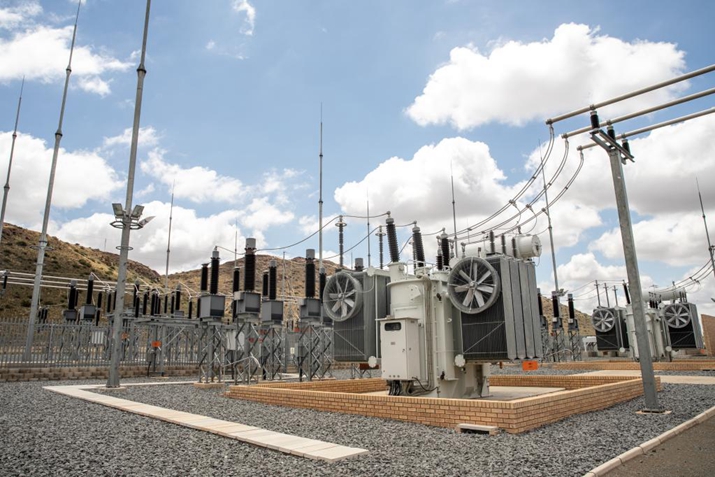
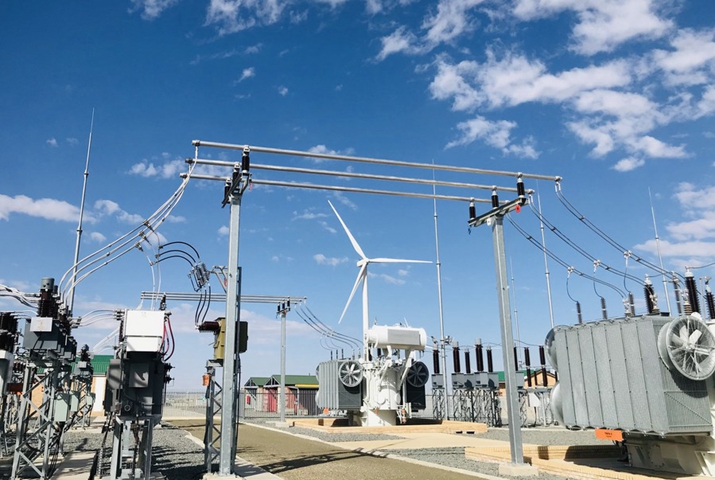
The De Aar Wind Power Project As the world is grappling with climate change in consensus to move to green energy. China-Africa’s renewable energy cooperation is bearing fruits. In De Aar, central South Africa, long and white blades on tall wind turbine towers were rotating like fans on top of the mountain. China’s Longyuan Power, through its South African subsidiary Longyuan South Africa Renewables and together with its South African partners including South African renewable energy developer Mulilo Group, has installed 163 wind turbines in two The installed capacity of the project is 244.5 megawatts, which can stably supply clean power of about 760-gigawatt hour annually, equivalent to saving more than 200,000 metric tons of standard coal, reducing carbon dioxide emissions of 700,000 metric tons. Since its operation in 2017, the project has been running in good condition and hasn’t experienced any interruption, said Sheng Bin, manager of Safety Production and Technology Department of Longyuan SA, who attributed the good operation to Chinese technology and a team of technicians. According to Zhao Mingming, director of Longyuan SA, Longyuan actively responds to the South African government’s plan of developing renewable energy through bidding for the projects, practically providing South Africa with clean energy and extra electricity capacity. (Source: Xinhua News Agency)
Facilities of the De Aar wind power project invested by China’s Longyuan Power and its South African partners in De Aar, South Africa, on November 22, 2021 (XINHUA)
The De Aar wind power project (XINHUA)
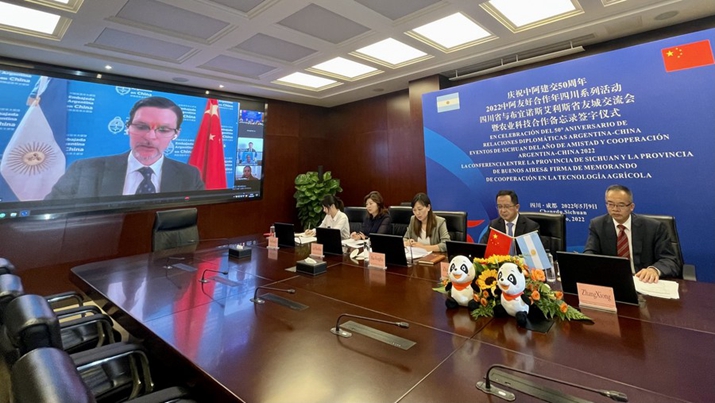
The Sichuan-Buenos Aires Agricultural Program Southwest China’s Sichuan Province and Argentina’s Buenos Aires Province signed a Memorandum of Understanding to promote agricultural collaboration. During a sister province exchange meet- ing between the two provinces on May 9, the department of agricultural development in Buenos Aires and the Sichuan Academy of Agricultural Sciences signed the document promoting the development of the agricul- tural and food industries. According to the text, they will conduct joint research in the development and com- mercialization of agricultural biotechnologies, genetic optimization, as well as innovation and research in forage grass, wheat, corn, soybeans, vegetables and fruits. Agricultural cooperation is an area of high complementarity, generating the finest results and greatest potential in teamwork between both countries, Wang Xiaolin, min- ister counselor of the Chinese Embassy in Argentina, said in his video address. “The signing of this memorandum will raise agricultural cooperation between the two parties to a new level,” said Sabino Vaca Narvaja, Argentina’s ambassador to China, pointing out that the geographical location of Sichuan greatly matters to the export of Argentine products to west China. “Local-level exchanges form an important supporting platform for the development of bilateral relations,” Wang said, adding that since the establishment of friendly and cooperative relations between Sichuan and Buenos Aires in 2017, the two have achieved much in terms of economic, commercial and educational exchanges, tourism development as well as nongovern- mental interactions. Both provinces will take the 50th anniver- sary of the establishment of China-Argentina diplomatic relations as an opportunity to further deepen their mutual support in agriculture, food production, scientific and technological innovation, education, culture and health. They will also seek to intensify friendly exchanges between governments, universities and other circles, Wang added. (Based on news reports from China.org and TheCover.cn)
A signing ceremony of the Memorandum of Understanding to promote agricultural collaboration between China’s Sichuan Province and Argentina’s Buenos Aires Province, in Chengdu, capital of Sichuan, on May 9 (CHINA.ORG.CN)
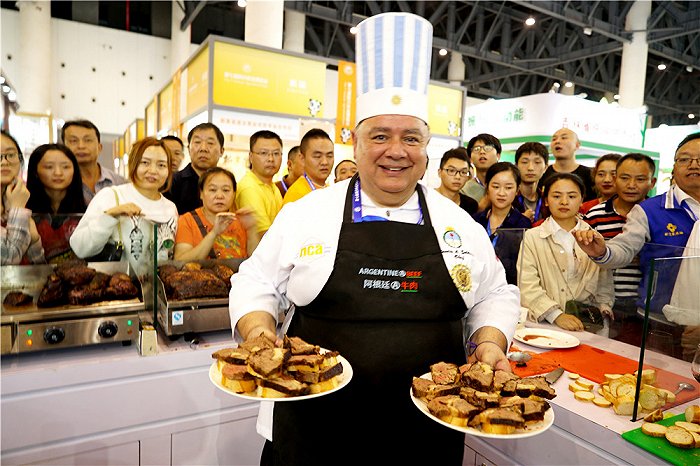
A chef serves Angus beef steak at the Seventh Sichuan Agricultural Expo in Chengdu, Sichuan Province, in 2019 (JIEMIAN.COM)
Sabino Vaca Narvaja (front), Argentina’s ambassador to China, visits the Sichuan Academy of Agricultural Sciences (SAAS) in Chengdu, Sichuan Province, in 2021 (SAAS)
China-Brazil Subsalt Ultra-Deepwater Oil Field In May, the phase I of Mero oilfield developed jointly by China National Offshore Oil Corp (CNOOC) and partners was put into production in Brazil. The CNOOC is the largest producer of offshore crude oil and natural gas in China. The Mero oilfield is located approximately 150 km off the coast of Rio de Janeiro and in a water depth of up to 1,930 meters. The field is part of Brazil’s giant offshore field called Libra Block, the third-largest subsalt ultra-deepwater oilfield in the world. The joint project is an important achievement for in-depth cooperation between China and Brazil, and a significant extension of China’s overseas oil and gas production, the company said. The project will promote the local economy’s sustainable development, all the while promoting the further advancement of the China-proposed Belt and Road Initiative and international energy cooperation. The Mero field is being developed in four phases, with a subsea production system and floating production storage and offload- ing facility. Total investment in the project has exceeded $20 billion; after going into full production, the first phase will see a daily capacity of 180,000 barrels of crude oil. Subsalt ultra-deepwater oil fields are an emerging arena in the global oil industry and an important trend for future development, accounting for one third of the world’s oil reserves, according to CNOOC. (Based on news reports from ThePaper.cn and Xinhua News Agency) A vessel used for the Mero project (Courtesy Photo)
The Mero oilfield Phase-I joint development project enters its production stage in Brazil in May (Courtesy Photo)
Sino-Russian Cooperation in Biodiversity Protection China and Russia are the world’s largest countries in terms of population and land area, respectively. Both countries are parties to international conventions such as the Convention on Biological Diversity and the Paris Agreement, and actively cooperate in biodiversity conservation, global climate change governance and green transition. They share a common border of over 4,300 km and are each other’s largest neighbors. In recent years, both have continued to deepen their cooperation in the protection of rare and endangered wild animals like the Siberian tiger and leopard as well as several migratory birds. They have also strengthened mutual support in the field of nature reserves, more specifically their cooperation in protecting cross-border Siberian tiger and leopard sanctuaries; and jointly carried out patrols across northeast China to monitor the region’s wild- life and ensure its wellbeing. The two sides jointly construct ecological corridors to warrant the free migration of the Siberian tiger and leopard along the Sino- Russian border. To enhance the friendship between the two peoples, China provided Russia with a pair of giant pandas in 2019, with both sides undertaking joint research in the protection and breeding of the species. As a result, the protection of endangered species and biodiversity in the two countries has been continuously strengthened. In February, the two countries signed 15 documents on further cooperation, including one between China’s Ministry of Commerce and the Ministry of Economic Development of the Russian Federation on promoting investment cooperation in green and sus- tainable development. CI (Based on a news report from People.cn)
Giant panda Ding Ding at the Moscow Zoo in the capital of Russia, on July 31, 2019. The zoo celebrated the birthdays of its two giant pandas—Ding Ding and Ru Yi— that arrived from China in late April 2019 as part of a 15-year scientific program (XINHUA)
Siberian tigers are at the Hengdaohezi Siberian tiger sanctuary in Hailin City, Heilongjiang Province, along the border with Russia, on July 27, 2020 (XINHUA)
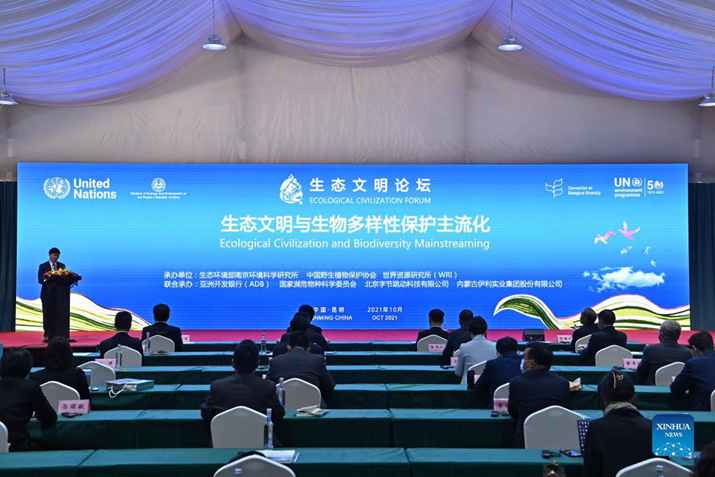
A sub-forum during the Ecological Civilization Forum at the 15th meeting of the Conference of the Parties to the Convention on Bio- logical Diversity (COP15) in Kunming, Yunnan Province, on October 14, 2021 (XINHUA) India’s Luban Workshop Robot making, 3D printing and solar panel designing... These are among the many training programs avail- able to students and teachers of the Luban Workshop located in the city of Chennai on the Bay of Bengal in east India. The institute is named after the ancient Chinese wood- craft master Lu Ban and has become a new model for international vocational training cooperation. Luban Workshop officially opened its doors in December 2017, with the support of three schools—China’s Tianjin Light Industry Vocational Technical College, Tianjin Vocational College of Mechanics and Electricity, plus the Chennai Institute of Technology. The workshop offers four majors and six training fields, covering numerical control equipment application and maintenance, photovoltaic power generation technology and application, industrial robotics, new energy vehicles and 3D reverse engineering. Based on mutual recognition, China offers high-quality vocational education to its foreign partners, according to the Tianjin Municipal Education Commission. Inside the Luban Workshop, Chinese teachers do not teach local students directly, but train their teachers first. The institute has trained hundreds of college students and employees in Chennai and provided several enterprises across India with its fresh graduates. China and India have been enhancing their collaboration on education in recent years. For example, on the fourth anniversary of the launch of the Luban Workshop, the China Education Association for International Exchange and the Chinese Embassy in India jointly hosted the 2021 China-India Vocational Education Cooperation Seminar in December 2021. Centering on “skills, employment and development,” the event gathered the efforts of governments, schools, industries and enterprises alike to offer suggestions for the development of vocational education in both countries. (Based on news reports from Huanqiu.com)
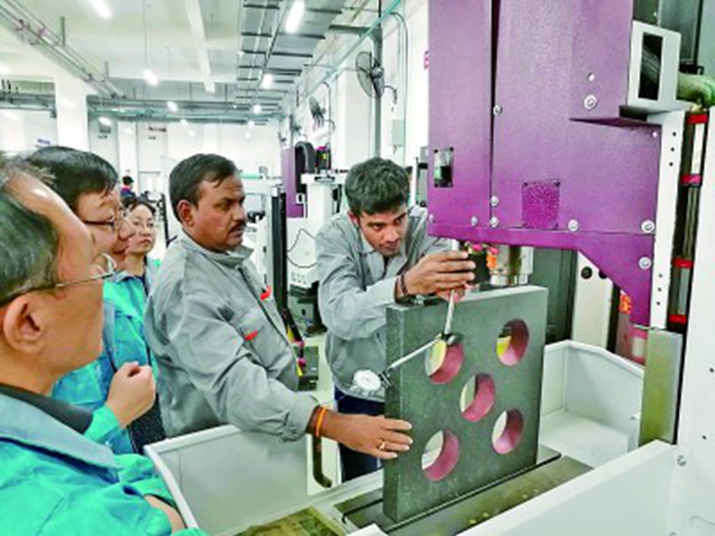
Trainees at the Luban Workshop in Chennai City, India (GUANGMING DAILY)
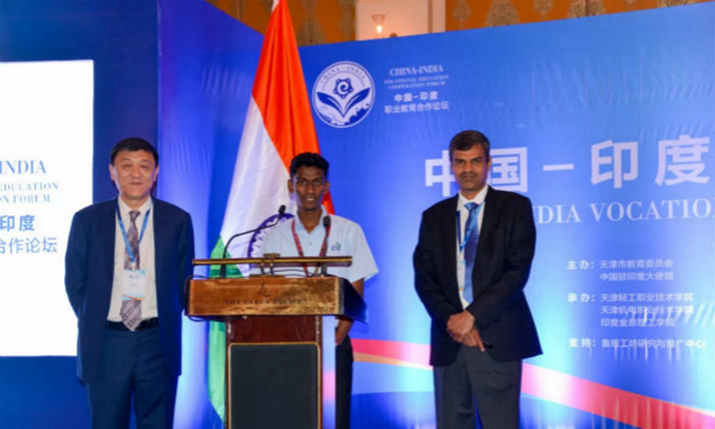
The China-India Vocational Education Cooperation Forum in New Delhi, India, on December 20, 2018 (EXPLORINGTIANJIN.COM) |
|
||
|
||||||||||||||||||||||||||||
|