
|
| China |
| Why it is time to downgrade COVID-19 management | |
|
|
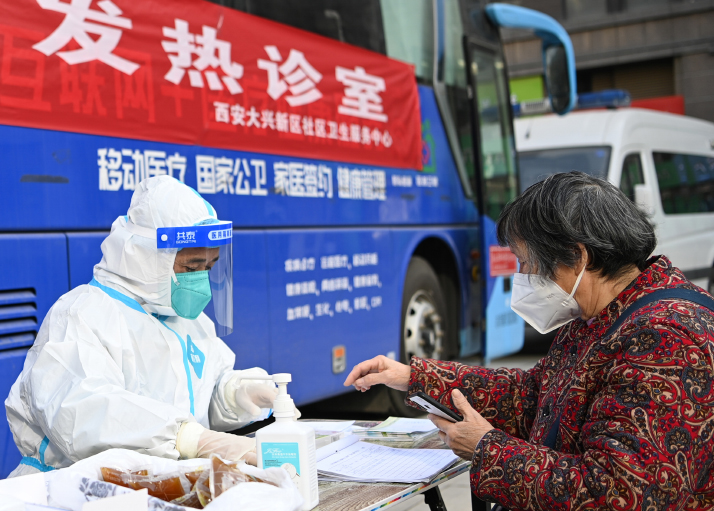 A resident consults a medical worker at a fever clinic in Lianhu District of Xi'an, Shaanxi Province, on December 21. Fever clinics have been set up in cities including Xi'an to provide timely treatment to patients with COVID-19 symptoms (XINHUA)
The Omicron sub-variants currently prevalent in China are becoming more transmissible, but they are much milder than previous strains, with more than 98 percent of those infected showing mild symptoms or being asymptomatic. The mortality rates are much lower than with previous strains. Most young and middle-aged patients are recovering within seven to 10 days after becoming infected. Those who have been inoculated against COVID-19, particularly those who have received booster shots, suffer from less severe symptoms. In this context, it's no longer suitable for this category B infectious disease to continue to be treated with prevention and control measures designed to target category A infectious diseases. The management of infectious diseases is based on their contagiousness and virulence. Diseases with high transmissibility and pathogenicity are classified as category A infectious diseases and are controlled through mandatory quarantine or lockdowns. The plague and cholera fall into this category. Diseases that are highly pathogenic but not highly transmissible such as COVID-19, HIV/AIDS and polio, fall into category B. China's medical systems as well as infectious disease prevention and control system have withstood the tests of three years of fighting against COVID-19. The country now boasts medical technologies and traditional Chinese medicine that are effective against the virus, and the vaccination rate has hit 90 percent. The public's sense of well-being is also increasing. Most importantly, the virulence of Omicron sub-variants are weaker than those of previous strains, making it possible to relax prevention and control measures. When COVID-19 management is downgraded, medical resources can be released from temporary hospitals to treat other diseases and, even if they're being used to treat COVID-19 infection, they can be focused on treating the most severe cases. The new categorization also allows for the implementation of relaxed and more targeted prevention and control measures. Sun Dongdong (www.cn-healthcare.com): As Omicron sub-variants go through their stages of infection, the number of infected people in Beijing is expected to decline after December 21. When most people have contracted and recovered from infection, the population's understanding of the virus will increase and fewer people will jump to hoard antipyretics or rush to fever clinics. However, some companies and organizations remain too cautious of the virus and take stringent measures against their staff. Also, some staff refuse to return to offices for fear of being infected. The pace of going back to normal is thus slowed down. In reality, although Omicron sub-variants lead to different symptoms in different individuals, the vast majority only suffer from infection of the upper respiratory tract, with no impairment of lung function. Thus, it's all right to treat the current round of Omicron infection as a seasonal influenza and correspondingly downgrade prevention and control measures. Zeng Guang (163.com): In the very early days of the COVID-19 outbreak, it was classified as a category B infectious disease, but treated with measures normally used against category A infectious disease, because the virus was very aggressive and transmissible, leading to high mortality rates. At that time, stringent policies in response were evidence-based and necessary. These practices protected the Chinese public for three years. Now it is time to address COVID-19 using category B measures, which means management of COVID-19 will return to a normal grade in the overall health system. Every case of COVID-19 infection will still be diagnosed and reported, while patients and close contacts can still get quarantined. However, the government will no longer impose large-scale community lockdowns, suspend transport or take similar measures. Emergency control measures against COVID-19 will be replaced by regular management of infectious diseases. Although Omicron sub-variants are very transmissible, people's symptoms are similar to those of ordinary influenza or cold. We must patiently wait for the return of normal life. Copyedited by G.P. Wilson Comments to dingying@cicgamericas.com |
|
||||||||||||||||||||||||||||
|