
|
| China |
| Repatriating relics calls increase for the return of Chinese relics from overseas | |
|
|
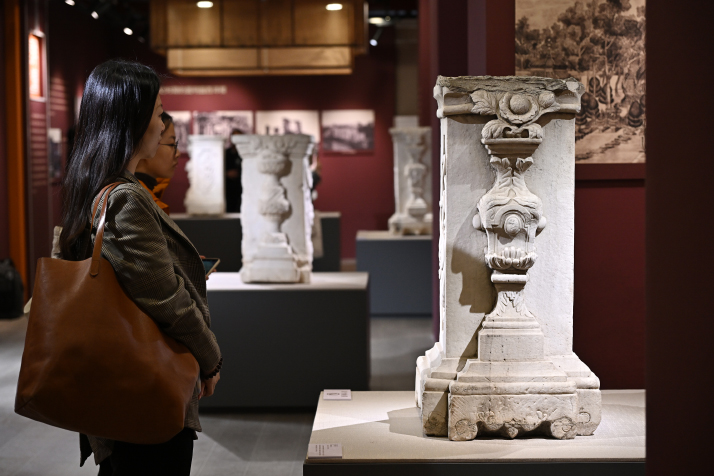 An exhibition displaying all seven marble columns repatriated from Norway opened to the public at the Old Summer Palace, or Yuanmingyuan, in Beijing on October 13
It was a long trip back home. Seven ancient marble columns, after leaving China for over a century, finally returned to their original home, the Old Summer Palace or Yuanmingyuan in Beijing. The columns, featuring a fusion of traditional Chinese and European Baroque styles, are thought to have been part of the Western mansion area constructed within the palace ground from the 1740s to 1760s. Regarded as the apex of Chinese landscape architecture, Yuanmingyuan, a royal resort that was originally five times the size of the imperial palace complex in the center of Beijing, was brutally burned down and looted by the invading Anglo-French forces in 1860 during the Second Opium War (1856-60). It gradually fell into ruins in the following decades, and many relics from within it were stolen and sold, often overseas. The seven marble columns, first collected by a Norwegian who lived in China for half a century, were then housed in the West Norway Museum of Decorative Art in Bergen. In 2013, a Chinese entrepreneur visited the museum and proposed the repatriation of the columns. Five years later, the Norwegian Government approved the return of the columns. With the collaborative efforts of government departments and other institutions, the columns finally embarked on the journey back to China. On October 13, an exhibition opened at the ruins of Yuanmingyuan, displaying the columns and related old pictures. Last time the Old Summer Palace received a repatriated item was in 2020, with the return of the head of a bronze horse statue. Long way back home As a significant repatriation of important cultural relics, the seven columns have sparked a new wave of discussions in China about relics lost overseas. The topic had already been widely discussed in previous months in response to an exhibition in the British Museum. Titled China's Hidden Century: 1796-1912, the exhibition opened on May 18 and concluded on October 8, and displayed approximately 300 objects. Half of the items were from the British Museum and half were borrowed from 30 different British and international lenders. Most had never been publicly displayed before. "No Chinese person can walk out of the British Museum with a smiling face"—this popular saying in China reflects the complicated feeling of Chinese visiting the museum, as many of the Chinese items displayed there have never been seen in China. Now, about 23,000 Chinese relics, spanning from the Neolithic age to the present, including paintings, prints, jade and ceramics, are kept in the British Museum, among which 2,000 are on long-term display. One relic still on display after the conclusion of the China's Hidden Century exhibition is a copy of a Chinese painting, Admonitions of the Instructress to the Court Ladies. Believed to represent the apex level of China's silk painting, the original painting is still lost today and only two copies are known to exist. One of the copies is on display six weeks a year at the British Museum and another is at the Palace Museum in Beijing. During the Second Opium War, British and French troops looted art and cultural artifacts from China and the precious items subsequently made their way to museums and private collections across Europe. "It reminds us of the painful history and what the Chinese people suffered in those days," a blogger wrote on China's leading short video platform Douyin. "Some of the items in the British Museum were originally designed in pairs, but now they are separated in different places." In late August, two influencers released a video series named Escape From the British Museum, depicting the story of a jade teapot at the British Museum turning into a woman and escaping from the museum. With the help of a Chinese journalist she met on the street, she found her way back to China. In the series, the teapot woman then visited a museum in China. She brought a pile of letters from the other Chinese artifacts in the British Museum and read them to the artifacts in the Chinese museum. "Hi big horse, I am the small horse," read one letter from a Tang Dynasty (618-907) tri-color ceramic horse. "We haven't seen each other for 163 years but I have never forgotten our promise of galloping around our home." Many viewers said they were moved to tears by the plot. Along with the release of the video series came the news that approximately 2,000 artifacts in the British Museum had been stolen. Shortly after that, another museum in Cologne, Germany, was robbed, resulting in the loss of valuable Chinese porcelain from the Ming and Qing dynasties (1368-1911). These accidents triggered questioning of the loose security measures in those museums and whether the museums are safe enough to house the cultural relics. Slow but in motion Huo Zhengxin, a professor of law at the China University of Political Science and Law, said during an interview with China News Service that in 2002, several famous Western museums jointly issued the Declaration on the Value and Importance of Universal Museums, claiming that one of the reasons that they resist demands for repatriation of the relics was they could provide better protection. This claim has become invalid in face of the theft and robbery scandals and in recent years, calls for the return of cultural relics from countries including Egypt, Nigeria, Ethiopia and China have increased. Accordingly, a growing trend has been triggered in Europe and the United States of returning cultural artifacts to their home countries. The spark is believed to have begun in France in 2017, when the French Government expressed its willingness to return a collection of cultural relics that had flowed into the country from what were then its colonies. The repatriation of Chinese relics has also been in progress in recent years. In August, Switzerland returned five illegally imported precious cultural relics to China, including four pieces of chinaware and one coin, demonstrating a willingness by both countries to strengthen cooperation in cultural heritage protection. According to statistics from the Chinese Society of Cultural Relics, after the First Opium War in 1840, over 10 million Chinese cultural relics were looted and transported overseas. From 1949 to 2019, China successfully facilitated the return of over 150,000 of these looted cultural relics. "Reclaiming cultural relics is a global challenge with many difficulties," Huo said. "International treaties have weak enforceability and do not apply to the restitution of cultural relics." "I believe mother countries are the only right places for cultural relics," said Shan Jixiang, former Curator of the Palace Museum, "as they carry cultural genes and rich historical information of the countries." At the end of the series Escape From the British Museum, the teapot woman returns to the British Museum. "I don't want to go back to my hometown in a sneaky way. I will, with all the other items wandering overseas, go back home in an aboveboard way one day," she said. BR Copyedited by G.P. Wilson Comments to yuanyuan@cicgamericas.com |
|
||||||||||||||||||||||||||||
|