




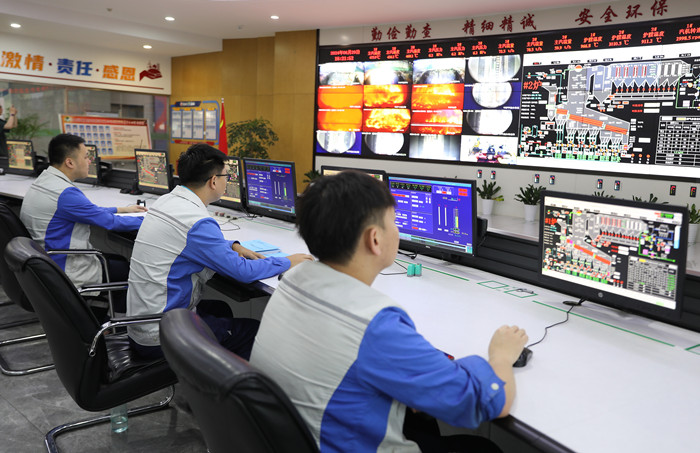
Staff monitor the operation of the waste-to-energy plant at the Nanchang Solid Waste Circular Economy Industrial Park in Nanchang, Jiangxi Province, on June 29 (XINHUA)
Standing on a 120-meter-high observation platform at the Solid Waste Treatment and Recycling Industrial Park in Nanchang, capital of Jiangxi Province, one can see a hillside field covered with green film. Buried under the impermeable green film is the city's household waste from 1997 to 2021.
The place was previously known as the Maiyuan Household Waste Landfill, once the only domestic waste landfill in Nanchang. By the time it was closed in 2021, approximately 17 million tons of household waste had been buried there, emitting a foul odor and breeding mosquitoes and flies.
Xiong Wei, Chairman of Jiangxi Dingyuan Environmental Protection Co. Ltd., which manages the waste treatment park, said during hot or windy weather, the traditional open-air landfill emitted an odor that could be smelled several km away. Also, when the garbage soaked up rainwater, the leachate polluted surrounding rivers. The smell and pollution seriously affected the local living environment. From 2017 to 2021, local residents filed more than 1,000 complaints to the government about the pollution.
To treat it, the Nanchang Municipal Government decided to close the landfill and build a waste treatment park, to treat urban waste in a more environmentally friendly way.
Nanchang and other cities in Jiangxi have been ramping up efforts to pursue green and high-quality development. Since it was first proposed at the 19th National Congress of the Communist Party of China in 2017, high-quality development has become the focus of China's socioeconomic development. Under this development concept, obsolete production capacity and technology will gradually be phased out while green emerging industries and renewable resource technologies will be developed. This will lead to a new pattern of innovation-driven, green development that fosters a harmonious relationship between humans and nature.
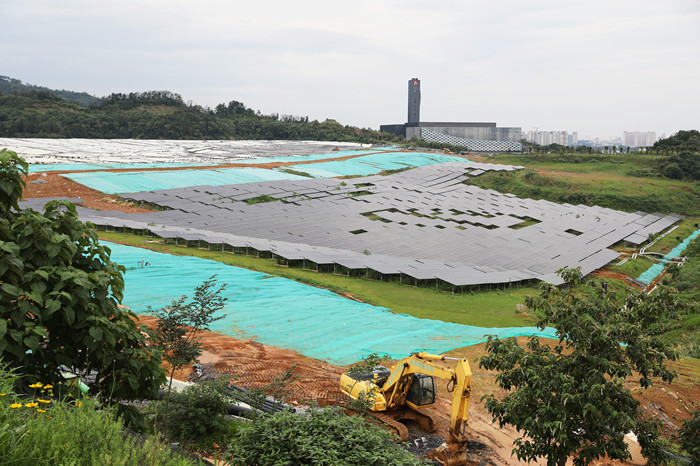
Solar panels atop a landfill, now also used to produce biogas, at the Nanchang Solid Waste Circular Economy Industrial Park on June 29 (XINHUA)
Waste to energy
Xiong said to ensure that the smell would not escape from the landfill, it was covered with nine layers of materials including soil, rubble and polyethylene film. Black tubes installed on top of the nine layers collect biogas generated by the decomposition of the materials in the landfill. The biogas is then used for power generation.
Xiong said several years ago the tubes collected around 180,000 cubic meters of biogas every day, but now the number has reduced to 20,000 to 30,000 cubic meters per day, indicating that the landfill is gradually breaking down.
The waste management park plans to install more than 80,000 solar panels above the tubes, which are expected to generate 43.93 million kilowatt-hours (kWh) of electricity every year, reducing carbon dioxide emissions by 37,700 tons.
To treat the city's household waste after the landfill was closed, the park established a waste-to-energy plant that burns municipal solid waste (MSW) to produce steam for electricity production. MSW is a mixture of energy-rich materials such as paper, plastics and products made from wood.
The electricity is supplied to local industries and residents. "Our daily power generation is about 1.4 million kWh, excluding our own industrial power use, about 1.2 million kWh are transmitted to local residents, which can meet the daily electricity needs of 120,000 local households," Gong Yuliang, Deputy General Manager of Jiangxi Hongcheng Kangheng Environmental Energy Co. Ltd., which is responsible for the waste-to-energy plant project, said. Gong said that the power plant treats the exhaust from the plant so it's cleaner than the national standard.
Trash to treasure
Fengcheng, a city in Jiangxi known for its waste collection and recycling industry, has been upgrading its recycling industry and pursuing green development for over a decade.
By the 1980s, waste collection and recycling had become one of the primary means for locals to make a living.
To facilitate management of the waste recycling industry, the city built a waste collection market in 2004. After just a few years, the market had more than 10,000 staff members and had become the largest waste collection and distribution center in Jiangnan, the region south of the Yangtze River's lower reaches.
However, as the industry expanded, problems such as the disordered stockpiling of waste and foul odors began to emerge, and the dirty and smelly market began to seriously affect the surrounding living environment.
Also, much of the recycling was conducted in small individual workshops rather than in well-managed plants. After extracting the most valuable components, these small workshops often discarded the remaining materials in environmentally unfriendly ways. For instance, waste such as home appliances contains materials like heavy metals and organic solvents, which can pose health hazards to humans if not treated properly.
To reduce the negative impact of the recycling industry on the environment, the city started building the Fengcheng Circular Economy Industrial Park in 2007 and encouraged recycling business owners to pursue green recycling. A circular economy is one that minimizes waste and maximizes the efficient reuse of resources.
Jiangxi Green Recycling Co. Ltd. in Fengcheng dismantles and recycles electrical appliances into materials used to make new appliances and in the automobile industry.
"Our company recycles over 100,000 tons of waste plastics and home appliances every year, and the renewable plastic particles we produce will once again be applied in fields such as home appliances, automobiles, and electronic products," Qin Yufei, Chairman of Jiangxi Green Recycling Co. Ltd., said. He added that environmentally friendly recycling is seen as a green industry with enormous potential, because it reduces not only resource consumption but also pollution. Now, the city has formed a complete recycling industrial chain, ranging from waste collection, disassembly and sorting to smelting and deep-processing. The recycling industry has developed into the biggest industry in Fengcheng. In 2023, the Fengcheng Circular Economy Industrial Park achieved an output value of 42 billion yuan ($5.8 billion) and paid taxes of 3 billion yuan ($412.3 million). BR
(Print Edition Title: Recycle, Reuse, Reimagine)



