
|
| China |
| The double-edged sword of smart toys in China | |
|
|
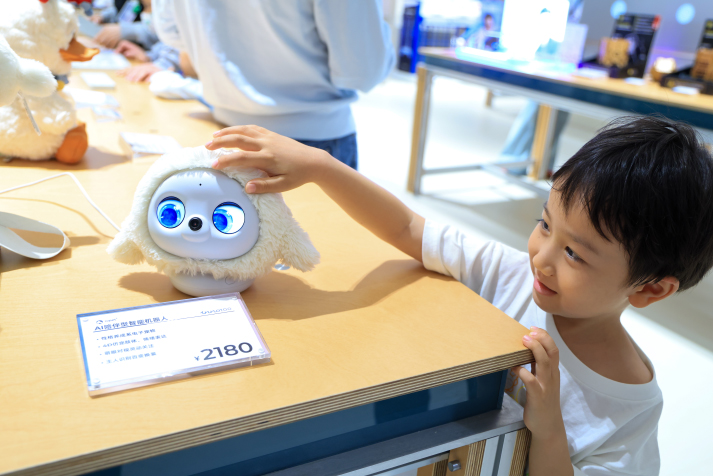 A child touches an AI-powered toy at a store in Shenzhen, Guangdong Province, on December 21, 2025 (XINHUA)
A new wave of AI-powered toys is transforming children's rooms, offering parents "tech-savvy" childcare assistants. These companions, capable of chatting, providing comfort and even aiding with reading, are rapidly gaining traction. The AI companion doll, for instance, has become a standout product, making it into e-commerce titan Taobao's top 10 hottest selling products in 2025. From Gen Z's AI pets to chatty senior companions, these intelligent playmates are reshaping China's consumption landscape for companionship. AI toys represent a sophisticated blend of AI and traditional play. Leveraging large AI models, they utilize speech recognition, computer vision, natural language processing and deep learning to deliver interactive, personalized learning and entertainment. These advanced technologies allow them to excel in multi-modal interaction, emotional intelligence and continuous learning, offering a richer user experience than traditional toys. A thriving sector The appeal is clear to a young father surnamed Wu, who was browsing AI toys at a Shanghai mall in late March. "My child is 3 now. The AI early education machine we bought last year really was a great help so I'm looking to see if there are any new products this year," he told Xinhua News Agency. Experts confirm the convenience these products offer. Wang Fang, an associate researcher at the Institute of Sociology, Shanghai Academy of Social Sciences, noted, "AI products designed for infants and small children can bring great convenience to parenting. AI products can respond instantly to every call or question from a child and, unlike humans, they do not become irritable due to physical exhaustion; their 'emotions' remain relatively stable. In addition, these products have, for example, built-in story libraries and nursery rhymes, which can offer content tailored to the child's age and interaction history." Market data validate this burgeoning trend. E-commerce giant JD.com reported that China's AI toy market exceeded 10 billion yuan ($1.5 billion) in 2023 and is projected to surpass 100 billion yuan ($15 billion) by 2030, with a compound annual growth rate exceeding 50 percent. Innovative products are leading the charge. Shanghai-based AI companion toy brand Robopoet's Fuzozo, a plush AI "friend" priced around 400 yuan ($59), responds to touch, offers no-strings-attached comfort and has resonated strongly with Gen Z shoppers, topping AI toy sales on major e-commerce platforms JD.com and Tmall during last year's Double 11 shopping festival—China's equivalent of Black Friday, but far longer, running from mid-October to mid-November in 2025. Users on Chinese lifestyle and e-commerce platform Xiaohongshu (RedNote) are even personalizing their Fuzozos with, for example, customized clothing, demonstrating how these AI toys are evolving beyond mere products to become emotional anchors. Similarly, JD.com's "chatty parrot" AI companion robot, priced at 159 yuan ($23), engages with users in the dialect of their preference, provides healthcare reminders and offers a range of entertainment options, from different Chinese operas to storytelling. It also functions as a silent guardian, delivering emergency alerts and activity updates to family members. What's driving this trend? Robopoet's founder and CEO Sun Zhaozhi told Shanghai-based newspaper Laodong Daily that it reflects a global "emotional consumption" trend. "Young people are experiencing anxiety and confusion," he said, "making them willing to invest in emotional value." This insight came from extensive user research. Sun's team learned through interviews with Gen Z users that contemporary young adults have limited avenues for emotional release, which makes AI "pets" an appealing source of burden-free companionship. Seniors also need companionship. JD.com's research and development team took a similar approach when creating their chatty parrot, visiting over 20 cities and gathering feedback from more than 5,000 elderly customers. The key findings showed that users preferred listening over watching, valued dialect communication because it felt more familiar, and needed practical features such as health reminders and emergency alerts. The team understood that for the silver market, true value lies not in flashy features but in providing peace of mind. This led them to simplify operations, implement thoughtful scenario-based greetings and enhance long-term memory functions. For instance, if a senior user expresses a liking for Peking Opera, the robot proactively offers it, a subtle but powerful way to build trust through the feeling of being remembered. Moreover, dialect recognition accuracy has been improved to accommodate the diverse linguistic habits of seniors across different regions. JD.com's broader vision is "all-age companionship"—recognizing that the need for connection spans all demographics, and that as AI capabilities mature, they can effectively meet these diverse wants. Problems to be addressed Yet, as the AI toy sector experiences rapid growth, more and more industry concerns are surfacing. A primary challenge is the prevailing issue of product homogenization and a deficiency in user experience. Online reviews frequently criticize AI toys for "laggy interactions and nonsensical answers." Sun acknowledged this widespread problem, stating, "Users anticipate partners capable of deep communication and providing emotional value, but many products are mere cosmetic shells lacking genuine technical substance." He predicts a future industry shake-up, where only those products offering truly superior experiences will endure. For many parents, a deeper concern lies in the potential impact of AI toys on children's cognitive and behavioral development. "While AI toys can function as 'online tutors,' they tend to provide 'direct answers.' This over-reliance could hinder children's ability to think independently," a woman surnamed Liu, a parent of a primary school student in Beijing's Haidian District, shared her apprehension with Xinhua. Data from the China Youth and Children Research Center in 2025 underscore these concerns. A nationwide survey of over 8,500 minors revealed that more than 20 percent exhibit a "reliance inertia," preferring to "depend on AI and avoid independent thought." Another 20 percent tend to "only chat with AI, becoming unwilling to communicate with real people." To navigate these challenges, Wang offered some practical advice. She suggested parents establish clear usage boundaries, recommending no more than 30 minutes of daily AI toy use for children, and stressing that these toys should never replace outdoor play or family conversations. Furthermore, parents should monitor their children's reactions after using these toys and adjust their product choices accordingly. Wang stressed that the key is to use AI toys to "enhance children's learning and thinking, not to replace the fundamental responsibility of parental companionship." "Real human interaction and independent exploration must never be sacrificed," she concluded. Copyedited by Elsbeth van Paridon Comments to jijing@cicgamericas.com |
|
||||||||||||||||||||||||||||||
|








