|
| China |
| Landmark translation | |
| After nearly eight decades, the complete Tokyo Trial records are available in Chinese | |
|
|
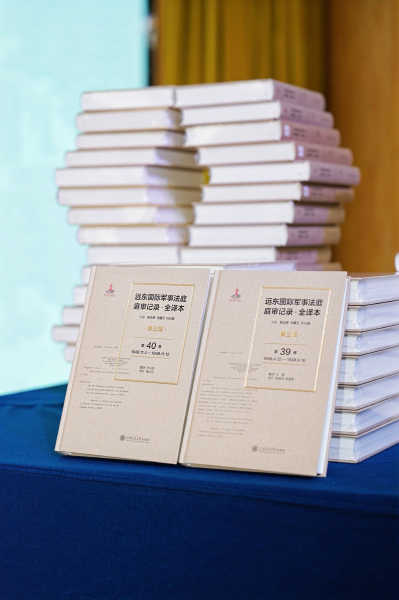 The Chinese version of The International Military Tribunal for the Far East: Complete Trial Records (Full Chinese Translation) on display at its release at Zhejiang Yuexiu University in Shaoxing, Zhejiang Province, on April 30 (XINHUA)
Forty hefty volumes, over 22.3 million Chinese characters—the complete Chinese translation of the courtroom records of the International Military Tribunal for the Far East (IMTFE), commonly known as the Tokyo Trial, has been officially released. Titled The International Military Tribunal for the Far East: Complete Trial Records (Full Chinese Translation), the collection was unveiled at Zhejiang Yuexiu University in Shaoxing, Zhejiang Province, on April 30. Eight months after World War II (WWII) ended in September 1945, the IMTFE was convened in Tokyo. It was composed of judges from 11 nations, including China, the United States, the United Kingdom and France. From May 1946 to November 1948, the IMTFE tried 28 Japanese Class-A war crime suspects and convicted 25. The Tokyo Trial stands alongside the Nuremberg Trials as a landmark judicial event in the wake of WWII. Few people realize, however, that for nearly 80 years, scholars and the public in China, the country in Asia that suffered most during WWII, had almost never been able to read the records of the trial completely and directly in their own language. "The publication of the complete translated records means that for the first time Chinese readers can examine, in their own language, every testimony, every debate and every page of judgment concerning Japan's crimes of aggression against China," Wang Zhongyi, special adviser and former Editor in Chief of the China International Communications Group Center for Asia and Pacific, told People's China magazine. Published by the Shanghai Jiao Tong University Press (SJTUP), the collection was translated by a joint translation and editorial team formed by the press, the Research Institute of War Trial and World Peace (RIWTWP) at Shanghai Jiao Tong University and Zhejiang Yuexiu University. Over more than a decade, the team translated about 50,000 pages of original English courtroom transcripts into Chinese.
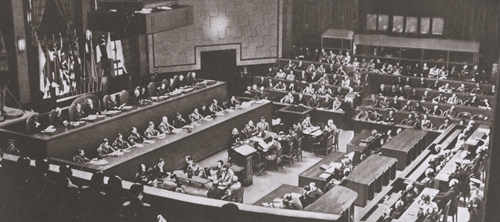
The International Military Tribunal for the Far East in session in Tokyo, Japan, between 1946 and 1948 (FILE) A decade in the making The IMTFE opened on May 3, 1946. Over two and a half years, the tribunal held 818 sessions, heard testimony from 419 witnesses and reviewed 4,336 pieces of evidence. The resulting English-language trial records run to about 50,000 pages. Yet for a long time these massive primary sources existed in complete form only in English and Japanese. Chinese researchers had to rely on sources in those languages to piece together evidence of crimes committed on Chinese soil, reconstructing the nation's traumatic history through foreign languages. This placed Chinese researchers at a disadvantage. "Despite being the greatest victim in the main theater in the East of WWII, China's research on the Tokyo Trial remained almost blank for a long time," Cui Xia, Assistant Editor in Chief of SJTUP and head of the Tokyo Trial publishing project, told Beijing Review. The turning point came in 2010, when Xiang Longwan, the son of Xiang Zhejun (also spelled as Hsiang Che-Chun), a Chinese prosecutor at the Tokyo Trial, published a book with SJTUP in memory of his father. The book, titled The Tokyo Trial: Chinese Prosecutor Xiang Zhejun, was the press' first publication on the subject. In May 2011, the Center for the Tokyo Trial Studies (TTS) was founded at Shanghai Jiao Tong University, and four years later a comprehensive initiative known as the Tokyo Trial Publishing Project was launched, covering archival collection, facsimile publication, translation research and database construction. In 2017, TTS was renamed RIWTWP. "This project was unprecedented," Cui said. The team faced daunting challenges, including acquiring historical materials and ensuring strict quality control. The most difficult task was translating the 50,000 pages of English trial transcripts into Chinese word for word—a process that required not just linguistic work but meticulous scholarly verification. The translation began in 2015. Zhejiang Yuexiu University organized a professional team of nearly 20 faculty members who undertook the translation of 30 of the collection's 40 volumes. Few expected it would take a full decade. To remain faithful to the original text and to historical facts, team members immersed themselves in vast archives. They compiled a corpus of more than 15 million words to ensure consistency in legal terminology, personal names, and place names across the volumes. Their determination to verify historical details was striking. Whenever translators encountered questionable passages in the English transcripts, they checked them against the original Japanese records. One example involved the diary of Koichi Kido, a Class-A war criminal. The English transcript stated that on March 19, 1942, the Imperial Household Minister visited Kido's office and discussed atrocities in Hong Kong. However, when the translators examined Kido's original Japanese diary, they found no such entry on March 19; the relevant passage actually appeared on March 13, 1942. The translators therefore added a note explaining the discrepancy. "There are more than 1,000 such translator's notes," said Yang Aijun, Director of the Office of Scientific Research, Zhejiang Yuexiu University, and a member of the project team. "Whether it was a military unit number, a date, a name or a factual detail, we verified and annotated every inconsistency," he added. The emotional toll was also significant. "One testimony described what Hsu Chuan-ying, a member of the Nanjing International Relief Committee, saw three days after Japanese troops entered the city—bodies scattered throughout Nanjing," Yang recalled. "Details of the Nanjing Massacre were deeply distressing for the translators and pushed some to the brink of emotional breakdown. But these bloodstained historical records also strengthened our resolve to complete the translation."
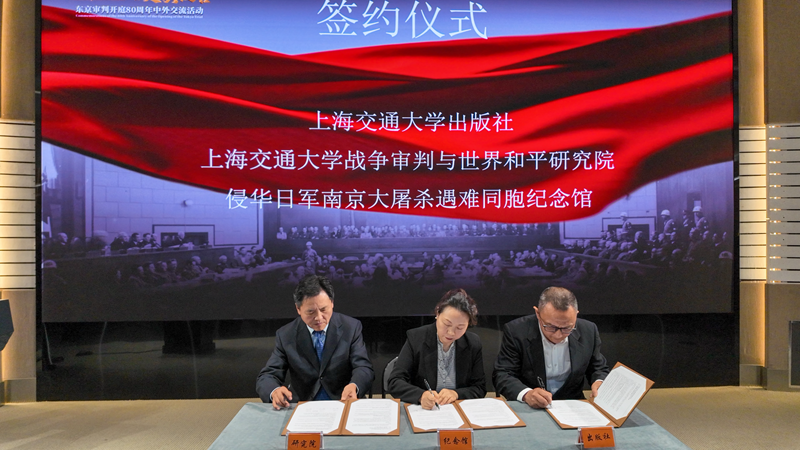
Shanghai Jiao Tong University Press and the Research Institute of War Trial and World Peace at Shanghai Jiao Tong University donate the War Crimes Trials Database to the Nanjing Massacre Documentation Center of the Memorial Hall of the Victims in Nanjing Massacre by Japanese Invaders in Nanjing, Jiangsu Province, on April 29 (ZHANG WEI) Contemporary significance Why revisit the Tokyo Trial now? This year is the 80th anniversary of the opening of the Tokyo Trial. "Its official publication at this historic moment demonstrates Chinese scholars' commitment to learning from history and facing the future, contributing Chinese wisdom to safeguarding the achievements of the victory over fascism," Yong Heming, President of Zhejiang Yuexiu University, said. The historical conclusions and legal principles established by the Tokyo Trial should have become a global consensus for peace. Yet over the past eight decades, the Japanese Government has gone so far as to revise their historical textbooks and whitewash their atrocities in WWII. Right-wing forces in Japan have continued to challenge the verdict of the trial, claiming it was merely "victors' justice." Now 86, Xiang is one of the chief editors of the Chinese edition of the complete records. He argued that the courtroom records themselves expose the weakness of such claims. For example, on October 6, 1947, during proceedings concerning the crimes of Seishiro Itagaki, three Chinese prosecutors engaged in more than 120 rounds of debate with a six-member defense team composed of Japanese and American lawyers. The records show that the tribunal fully protected the defendants' right to defense. When Japanese lawyers were unfamiliar with Anglo-American legal procedures, the court even arranged for American lawyers to assist them. Judges made decisions independently and were not subject to coercion. "Chinese prosecutors and judges made major contributions throughout the Tokyo Trial," Xiang told Beijing Review. "The publication of the full translation will help Chinese readers better understand the entire process of this landmark trial, especially the important role China played in it." Cheng Zhaoqi, chief expert at the RIWTWP and another chief editor of the series, said the Chinese edition provides a solid textual basis for defending the authority of the Tokyo Trial and, by extension, the legal foundations of the postwar international order. Digitizing historical records The translation and publication are not the end of the project. To bring this history closer to the public, the team has built the world's first fully searchable Tokyo Trial document database. It includes more than 100 million words of trial records and documentary evidence, over 700 historical photographs, and 6,600 minutes of audio and video recordings from the proceedings. Scholars worldwide can consult Chinese, English and Japanese materials side by side, cross-referencing texts, images and audiovisual sources. On April 29, the SJTUP and the RIWTWP donated the database to the Nanjing Massacre Documentation Center of the Memorial Hall of the Victims in Nanjing Massacre by Japanese Invaders. The three institutions will work together to advance the digital preservation of historical materials, using technology to support archival preservation, academic research and international communication. The team is continuing to explore new ways to present the database to the public. It plans to link trial transcripts, archival documents, judgments, memoirs, and scholarly works, and build timelines, event chains, and networks of personal relationships to help researchers achieve deeper discoveries. The team also plans to develop an immersive virtual museum and launch digital resource packages tailored for teaching, transforming specialized historical materials into content that young people can understand and connect with. "Academic materials are often far from the general public," Cui said. "So we have also been working to increase awareness of the Tokyo Trial and bring it to the public." Copyedited by G.P. Wilson Comments to linan@cicgamericas.com |
|
||
|
||||||||||||||||||||||||||||
|