
|
| China |
| How far should scenic spot signs be allowed to go? | |
|
|
 LI SHIGONG
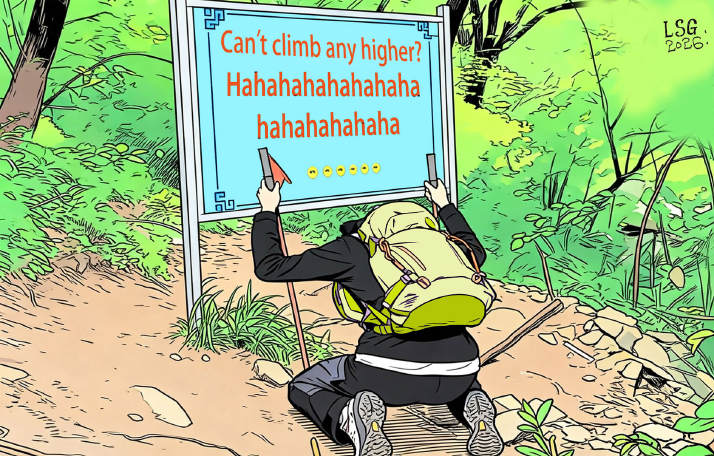
Two recent cases of scenic area management responding to visitor complaints have ignited debate over taste, humor and public appeasement, with netizens asking just how far parks should go in their quest for engagement. In May, in response to complaints from tourists, the management of Mount Songshan in Henan Province removed a sign reading "Can't climb any higher? Hahahaha," which it had erected half way up the mountain with the aim of offering some humor and encouragement. Shortly after, however, it re-erected the sign as its removal sparked an even larger online backlash. The management of Mount Fuxi, also in Henan, quickly jumped on the bandwagon, creating its own sign in answer to the one on Mount Songshan, asking "Why not ditch your kids? Or your wife?" before swiftly removing it due to the negative public response. Zheng Chu (Jinan Times): The brief saga of the removal and restoration of the sign at Mount Songshan reveals an anxious tendency in scenic area management: fearing all dissent and rushing to appease every critic. "Can't climb any higher? Hahahaha" is hardly a serious jab; it is a lighthearted, self-deprecating nod to the very real exhaustion hikers feel halfway up. Of course, humor is subjective. A handful may mistake it for mockery, but as long as a slogan does not violate public decency or law, diversity of expression should be allowed. Yielding to every complaint means over-serving a vocal minority while ignoring the silent majority who enjoyed the joke. In today's hyper-opinionated social media environment, any detail can be magnified or distorted. If attractions chase every online whisper, they will exhaust themselves in futile fence-sitting. The rational path is to distinguish serious concerns such safety hazards and poor services from aesthetic preferences. The former demand prompt action; the latter, like sign style, merit measured confidence in mainstream visitor feedback. Mount Songshan's eventual reinstatement was wise, but the initial flip-flop was unnecessary. Operators need the courage to innovate and the composure to face debate. Not every critique is a crisis. Unique, warm touches, within legal and safety bounds, are precisely what make a destination memorable. Liu Chen (The Beijing News): The Mount Fuxi incident is a cautionary tale of mimicry going awry. Borrowing Mount Songshan's "Can't climb any higher? Hahahaha" format, the site tried to up the ante with "Why not ditch your kids? Or your wife?" This is not witty banter; it is offensive and carries a pernicious undertone, framing family members as burdens to be discarded. Such "humor" degrades the visitor experience and is a sign of poor taste. While some netizens defend it as harmless fun, context matters. The original sign on Mount Songshan struck a delicate balance: It acknowledged fatigue without denigrating anyone. Mount Fuxi's version overshot, turning playful empathy into clumsy ridicule. Worse, it was an unoriginal knockoff, lacking any local character. If every mountain copies the same gag, the novelty dies, and the intended camaraderie becomes grating. Critics who urge the site to ignore complaints miss the point: Not all grievances are equal. Here, the objections were valid, touching on respect and social responsibility. Scenic areas should not panic over every online storm, but they must exercise good judgement. A complaint that is frivolous can be dismissed; one that highlights genuine offensiveness demands action. Mount Fuxi did right to remove the sign promptly. Rather than chasing viral trends, attractions should invest in original, context-sensitive creativity that uplifts rather than alienates. BR Copyedited by G.P. Wilson Comments to yanwei@cicgamericas.com |
|
||||||||||||||||||||||||||||||
|








