
|
| China |
| A centuries-old lotus landscape is evolving through ecological aquaculture | |
|
|
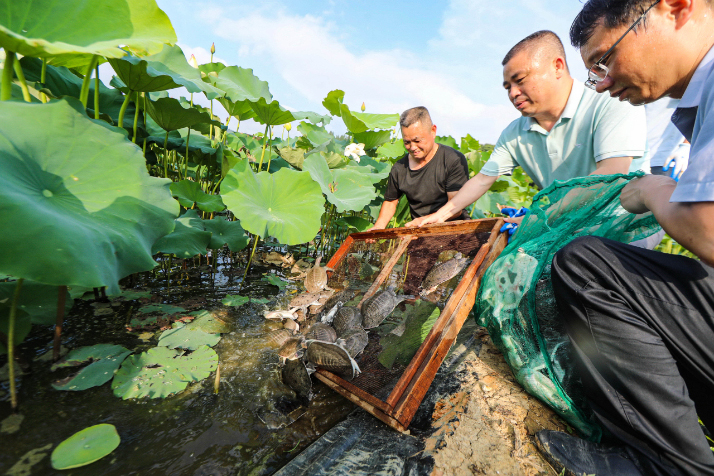 Farm workers release juvenile softshell turtles into a lotus pond in Xifang Village in Guangchang County of Fuzhou in Jiangxi Province (COURTESY PHOTO)
In midsummer, Guangchang County in Fuzhou, Jiangxi Province in east China is transformed into a sea of emerald leaves and pink blossoms. Lotus flowers rise above the water as dragonflies skim the ponds and a light breeze stirs the broad, umbrella-like leaves. Known as one of China's foremost producers of white lotus, the county has cultivated the crop for more than a thousand years, which has sustained generations of local families. At first glance, the lotus ponds in Dazhuang Village of Shuinanxu Township look no different from countless others across Guangchang. A closer look, however, reveals a difference: Beneath the broad leaves, Chinese softshell turtles are gliding quietly through clear, spring-fed water. Unlike those raised in conventional ponds, they roam freely through the lotus ponds within a carefully managed ecosystem. The relationship is remarkably simple. The lotus provides shade during the sweltering summer months and helps regulate water temperature, while the turtles return the favor by naturally fertilizing the ponds, reducing the need for chemical inputs. As local farmers like to say, "The lotus shelters the turtles, and the turtles nourish the lotus." This mutually beneficial relationship forms the foundation of Guangchang's lotus-turtle integrated farming system. By combining one of the county's oldest agricultural traditions with ecological farming, the model produces premium-quality softshell turtles that command higher prices while improving the quality of the lotus crop. A landscape long celebrated for its beauty is also becoming a practical example of how ecology and agriculture can reinforce each other. Rural shift The system has also attracted entrepreneurs from outside Guangchang, including Huang Jianguo from neighboring Nanfeng County. He arrived in Guangchang in 2022 through an investment promotion program, initially exploring opportunities in ecological softshell turtle farming. Before that, he had run a building materials business. Softshell turtles are a traditional food in parts of East and Southeast Asia, and are considered a delicacy in China. "High-quality softshell turtles are actually quite rare in the market, and the supply of premium products is limited," Huang told Beijing Review. Guangchang's landscape soon drew his attention. The county's extensive lotus fields, many fed by mountain spring water in hilly areas, offer conditions that are difficult to replicate in conventional aquaculture. With local government support, including land-use coordination, financial assistance and guidance on pollution control, Huang launched his lotus-turtle integrated farming project in 2023. For Huang, the key challenge lay in balancing lotus cultivation and turtle farming through precise control of stocking density. "If too many turtles are introduced, the lotus plants can be damaged, disrupting the ecological cycle," he explained. After two years of experimentation across around 70 lotus ponds, each managed at different stocking levels, he settled on a model in which juvenile turtles are raised for about two years before reaching an average weight of around 500 grams, with roughly 3,000 turtles stocked per hectare. The investment required for this two-year trial period was around 3 million yuan ($442,179), he said, though significantly more has gone into breeding and improving stock quality. In this integrated system, juvenile turtles are fed small fish and shrimp, and hunt for insects and mollusks from the lotus ponds. Harvesting is carried out in batches once they reach market size and quality standards, allowing supply to adjust flexibly to demand. Balancing act Huang said ecological farming is more demanding and tiring than his previous business. "It is hard work every day from 6 a.m. to 9 p.m.," he said. His home is only 40 km away from the farming base, but he returns only once every week or two. "Entrepreneurship means moving forward with confidence," he said. With the system fully established, Huang recorded his first major harvest in December 2025, with total sales reaching around 20,000 kg. Average yield stood at about 3,750 kg per hectare, generating roughly 300,000 yuan ($44,203) per hectare in output value. At the same time, the system has reduced fertilizer use by around 80 percent and eliminated pesticides entirely. Because of the high ecological standards, the turtles are firm in texture and free of muddy odor, while lotus production has also improved due to reduced chemical inputs. The system delivers higher efficiency, with profits more than tripling compared with lotus monoculture and more than doubling compared with single-species turtle farming, he said. Huang now operates about 40 hectares of hatchery, breeding and integrated lotus-turtle ponds, employing eight to 10 full-time workers and generating about 2,000 seasonal rural job opportunities each year, involving local villagers during peak farming and harvesting periods. Looking ahead, he plans to expand production, strengthen branding and develop deeper processing of agricultural products. He also hopes for improved access to financing and more direct channels to high-end markets to support further growth. Policy support Lotus farming has a long history in Guangchang County, where farmers once practiced traditional lotus-fish integrated farming. However, the sector remained largely underdeveloped for years due to outdated techniques, limited production models, weak management and insufficient investment. A shift began in 2020, when the lotus-turtle integrated farming system was introduced at scale amid rising market demand for softshell turtles. In 2024, Guangchang was included in a specialty industry project to produce softshell turtles that had been introduced from the nearby Poyang Lake, China's largest freshwater lake, further advancing standardized development. According to Zeng Zhiyong of the Guangchang Bureau of Agriculture and Rural Affairs, since 2021, the county has organized eight county-level training sessions and 15 township-level programs, reaching more than 900 farmers. Training topics include pond reinforcement, water system upgrades, breed selection, daily management and disease control. The system has been incorporated into existing provincial rice-fish integrated farming subsidy programs and is also supported by agricultural development funds. Today, more than 30 farming entities and over 200 workers are involved in Guangchang's integrated farming sector, with output expected to exceed 400 tons of softshell turtles and a production value of over 32 million yuan ($4.7 million) this year. "The integrated farming area has expanded to more than 533 hectares, covering lotus-turtle, lotus-shrimp and lotus-carp systems," Zeng said. Looking ahead, the county plans to further upgrade infrastructure through continued industry cluster funding and deepen technical support through ongoing collaboration with provincial and municipal experts. (Printed Edition Title: Ponds in Transition) Copyedited by G.P. Wilson Comments to liqing@cicgamericas.com |
|
||||||||||||||||||||||||||||
|