




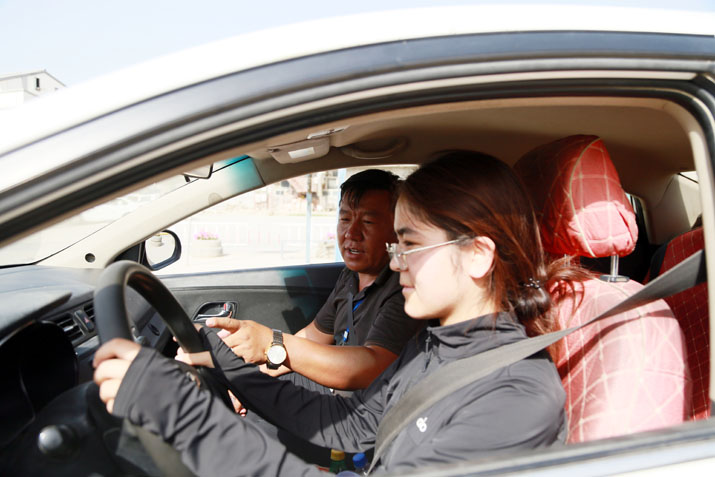
A high school graduate practices driving skills at a driving school in Awat County, Aksu Prefecture, Xinjiang Uygur Autonomous Region, on July 1 (VCG)
For years, obtaining a driver's license in China was a rite of passage requiring endurance. Aspiring drivers would spend sweltering summer afternoons in long, winding queues, waiting for their turn behind the wheel of a battered training vehicle. For many, it was a grueling test of patience, often exacerbated by demanding and sometimes temperamental instructors.
But today, the once-bustling driver training industry is experiencing a profound, unsettling downturn, a phenomenon that has recently ignited widespread debate on Chinese social media platforms.
The contrast is stark. Where once driving schools had the luxury of turning away applicants or placing them on multi-month waiting lists, they now face evaporating demand and a surplus of resources. Across the country, many practice lots are quiet. In some regional hubs, it is common to see only four out of 15 training vehicles in use, with the rest sitting idle.
Financial data tell a similar story. The Annual Report on China's Driver Training Industry released in May last year revealed a grim reality: Of the more than 21,000 registered driver training institutions nationwide, over 80 percent were operating at a loss. The report was published by the China Communications and Transportation Association and Wuhan Mucang Technology Co. Ltd., a leading mobile Internet firm specializing in the automotive consumption sector.
The report shows that the average capacity utilization rate across the industry has plummeted to a mere 28.6 percent. This oversupply has triggered desperate, cutthroat competition for the few students who remain. In Panyu District of Guangzhou in Guangdong Province, driving schools are now advertising "immediate enrollment, day and night sessions, one-on-one training, and free mock tests" to lure a dwindling pool of applicants.
According to the Ministry of Public Security, in 2015, 36.13 million new drivers obtained licenses. By 2019, that number had declined to 29.43 million. In recent years, the decline has continued: 24.29 million in 2023, 22.26 million in 2024, and 20.51 million in 2025.
The shrinking pool
Several interconnected factors are fueling this slump, primarily a demographic shift. In the early stages of China's automotive boom, the demand for licenses was incredibly diverse. It wasn't just the 18-year-olds; it was professionals in their 30s, 40s and 50s who were finally gaining the financial means to purchase their first family car. That massive demographic wave has now crested and largely receded. Today, the primary target demographic for driving schools consists of young people who have just graduated from high school.
Beyond demographics, the very nature of urban life is changing. For the younger generation, having one's own car is losing its status as the ultimate symbol of success. In major cities, the rise of sophisticated, high-speed subway networks and the ubiquity of on-demand ride-hailing services have made private car ownership feel like a burden rather than a convenience. Why deal with the stress of traffic, the headache of parking and the heavy costs of maintenance when a ride-hailing app can summon a car in minutes?
A Panyu resident surnamed Li, who sold his SUV after just two years of ownership, told Yicai magazine: "With the convenience of subways and ride-hailing, the expenses of owning and maintaining a car far outweigh the benefits."
A young resident surnamed Jiang in Chengdu, Sichuan Province, has simply decided against getting a driver's license. He did the math: 3,500 yuan ($521) for the registration fee, 1,000 yuan ($149) for mock tests and about 500 yuan ($74) for the physical exam. "That's over 5,000 yuan ($744) spent before I've even touched the steering wheel, which is roughly what I spend on commuting in a year," he told the local Consumption Quality newspaper. Then there's the ongoing cost and effort of buying and maintaining a car. In contrast, Chengdu's public transport is incredibly convenient and inexpensive. "Taking the subway means no traffic jams, plus it saves me money every month. There's no point in adding that extra pressure to my life," he added.
A smarter future
The implications of this declining demand are far-reaching. The intense competition created by the excess supply of driving schools and instructors has left many smaller institutions struggling to stay afloat and some even facing bankruptcy. The pressure to attract students has driven down prices to a point where profitability is severely compromised. In Chengdu, for example, the cost of obtaining a driver's license has plummeted to just over 2,000 yuan ($297), a price point that barely covers operational costs and rental fees for many schools, a stark contrast to the 4,000-5,000 yuan ($595-744) charged in previous years.
The industry-wide crisis is also leading many driving instructors to seek alternative employment. Ten years ago, one resident of Shiyan, Hubei Province, surnamed Liu, transitioned from driving a taxi to giving driving lessons, capitalizing on the booming demand for licenses. During the peak years, he trained over 300 students each year. However, from 2020 onward, his student numbers began a steep decline, falling to fewer than 50 in 2024. Consequently, in 2025, he returned to the ride-hailing industry.
In response to these challenging times, the driver training industry is accelerating the adoption of intelligent technologies, reducing operational costs and enhancing teaching quality and service standards. Eastern Pioneer Driving School Co. Ltd., a leading industry player, is championing an intelligent driver training system that integrates virtual reality (VR), AI and on-road practice. Students kick things off in a VR simulator, where AI provides real-time feedback on their steering and braking. Only after they've mastered the basics do they take a real car on the road.
It's a win-win: no waiting and no shouting instructors—just instant, data-driven correction. It boosts efficiency, and for the "socially anxious," it's a dream come true: no awkward chats, just you and the machine.
Beyond technological advancements, driving schools are increasingly focusing on improving the overall student experience. Recognizing the high expectations of consumers, schools are striving to offer greater transparency in pricing, better instructor service and more efficient licensing processes. Services like "one-on-one training" and complimentary pick-up and drop-off are becoming standard offerings.
Looking ahead, industry experts predict a period of consolidation. Cui Dongshu, Secretary General of the China Passenger Car Association, a platform for automotive industry information exchange and market research in China, told Yicai magazine that 2026-27 will be a peak period for driving school closures, with the total industry size expected to shrink by 25 to 35 percent by 2030. This indicates a move away from the era of extensive, unmanaged growth toward a more concentrated market dominated by efficient, service-oriented driving schools.



